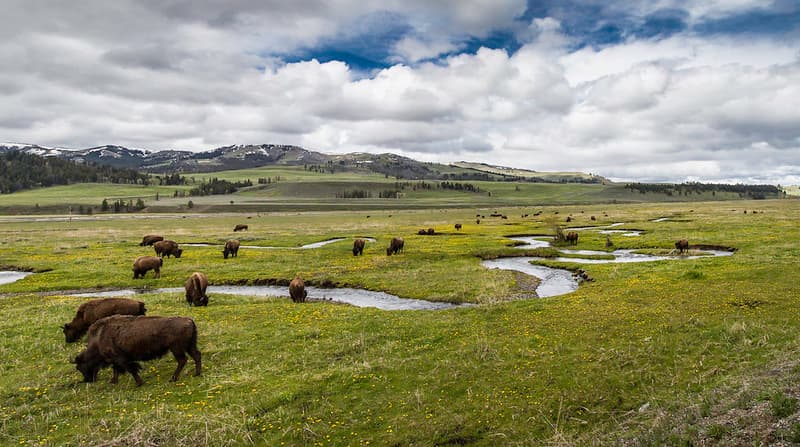
Yellowstone National Park, primarily located in the state of Wyoming (extending into Montana and Idaho), UNITED STATES, was established in 1872 as the world’s first national park. Spanning approximately 2.2 million acres, it sits atop a massive volcanic caldera—the largest supervolcano on the continent—which powers the park’s legendary geothermal activity.
Yellowstone is a vast, high-altitude wilderness defined by its dramatic contrast of landscapes. It features lush subalpine forests, expansive grasslands like the Lamar Valley, and the massive Yellowstone Lake, one of the largest high-elevation lakes in North America.
The park is essentially a “living laboratory” of geology and biology. Its most distinctive feature is the collection of more than 10,000 hydrothermal features, including boiling mud pots, colorful hot springs, and steam-venting fumaroles. This is all fueled by a shallow magma chamber that remains active today.
Attraction
Yellowstone is a “bucket-list” destination for international travelers due to its rare combination of geological wonders and “Mega-Fauna”:
- Geyser Gazing: The park contains half of the world’s known geothermal features. Old Faithful is world-famous for its predictable, towering eruptions, while the Grand Prismatic Spring draws millions for its surreal, rainbow-colored waters.
- “America’s Serengeti”: It is the premier location in the contiguous U.S. to see free-ranging wildlife. Visitors come to see the “Big Five” of the park: Bison, Grizzly Bears, Gray Wolves, Elk, and Moose.
- The Grand Canyon of the Yellowstone: A magnificent 20-mile-long canyon with yellow-tinted walls and two massive waterfalls (the Upper and Lower Falls) that rival the beauty of the Grand Canyon in Arizona.

Heritage
Yellowstone was inscribed as a UNESCO World Heritage site in 1978 (one of the first in the world) because it met several critical criteria:
- Natural Beauty: It contains superlative natural phenomena, specifically the highest concentration of geysers on Earth.
- Geological Record: The park provides an unparalleled record of Cenozoic volcanic activity and the ongoing processes of a “hot spot” under the Earth’s crust.
- Intact Ecosystem: It is the centerpiece of the Greater Yellowstone Ecosystem, the largest nearly intact temperate ecosystem remaining in the northern hemisphere.
- The National Park Idea: UNESCO recognizes Yellowstone as the site where the very concept of a “National Park”—preserving land for the enjoyment of the public rather than private gain—was born and subsequently shared with the world.
Gateway
While there are small towns at every entrance, the most practical gateway for an international or long-distance domestic traveler is Bozeman (Belgrade), Montana.
- Commercial Airport: Bozeman Yellowstone International Airport (BZN). It is the busiest airport in Montana and offers the best connectivity to major U.S. hubs.
- Lodging: Bozeman and its neighbor, Belgrade, offer a massive inventory of lodging, from high-end boutiques like The Kimpton Armory to reliable chains and local lodges.
- Access: It is a scenic 90-minute drive to the North Entrance (Gardiner, MT), which is the only entrance open to wheeled vehicles year-round.
When
- Early Fall (September to early October): This is widely considered the prime time. The summer crowds have vanished, the mosquitoes are gone, the fall colors are out, and the Elk Rut (mating season) begins, filling the valleys with the haunting sound of bull elk bugling.
- Late Spring (June): Best for seeing “Red Dogs” (baby bison) and bear cubs. The waterfalls are at their peak volume due to snowmelt, though some high-altitude trails may still be muddy.
- Winter (December to February): A magical time to visit via snowcoach or snowmobile to see geysers erupting against the white snow, but require significant planning as most roads are closed to regular cars.

Consideration
- Wildlife Distance: This is not a zoo. You are strictly required to stay at least 100 yards from bears and wolves, and 25 yards from bison and elk. Bison can run three times faster than humans; do not approach them for photos.
- The “Yellowstone Jam”: Traffic can stop for hours if a grizzly bear or a bison herd is near the road. Always pack extra snacks and water in your car.
- Altitude and Weather: Much of the park is above 7,000 feet. It can snow in July, and the sun is much more intense than at sea level. Layer your clothing and stay hydrated.
- Boardwalk Safety: Never step off the wooden boardwalks in thermal areas. The ground is often a thin crust over boiling acidic water.

Resources
- NPS.gov – Yellowstone Official Site – The “Gold Standard” for current road conditions, entrance fees, and safety alerts.
- UNESCO World Heritage – Yellowstone – For the deep dive into the scientific and cultural reasons for its protected status.
- Travel Wyoming – The official state tourism guide with excellent regional itineraries.
- Yellowstone Forever – A non-profit partner of the park that offers educational seminars and field programs.
- Yellowstone Roadtrip – A comprehensive planning blog that includes gear recommendations and booking links.


Comments:
Leave a Reply