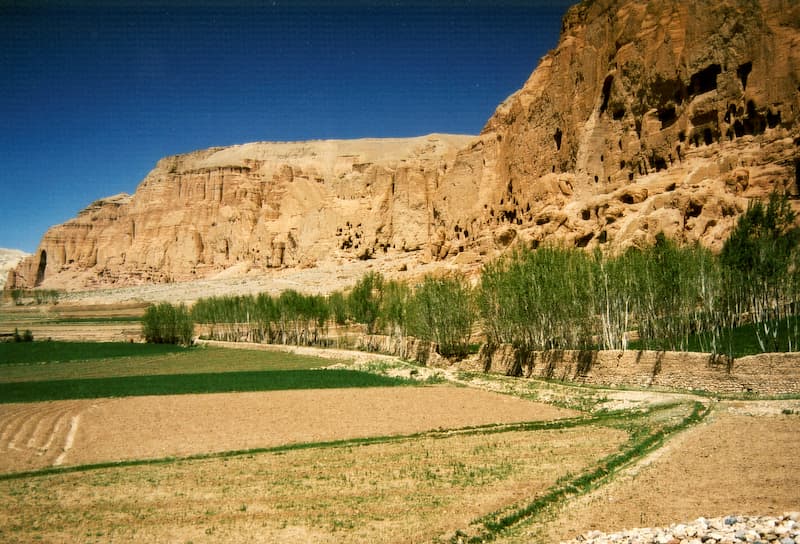
The following are the heritage sites, grouped into recommended gateway cities. This may help in planning on the logistics (travel and accommodation) of your journey.
BAMYAN (BIN)
High in the Hindu Kush mountains, Bamyan is a breathtaking blend of ancient history and natural wonder. Once a flourishing center of Buddhism, it is most famous for the UNESCO-listed cliffs where the colossal Great Buddhas stood for centuries. Today, visitors explore the intricate network of caves and the nearby Shahr-e Gholghola, known as the “City of Screams.” Just a short drive away lies the otherworldly beauty of Band-e Amir National Park, a series of six deep-blue lakes separated by natural travertine dams. Bamyan remains a serene sanctuary of culture and rugged Afghan landscape.

KABUL (KBL)
Situated in a high-altitude valley surrounded by the Hindu Kush, Kabul is a historic center of trade and culture on the Silk Road. Its most celebrated sanctuary is the Babur Garden, a terraced Mughal masterpiece and the resting place of Emperor Babur. The city’s deep heritage is preserved within The National Museum of Afghanistan, which houses artifacts spanning millennia. Visitors are often moved by the brilliant blue tiles of the Sakhi Shrine and the bustling energy of local bazaars. Despite its complex modern history, Kabul remains a resilient urban hub defined by its dramatic mountain backdrop and ancient spirit.


Comments:
Leave a Reply