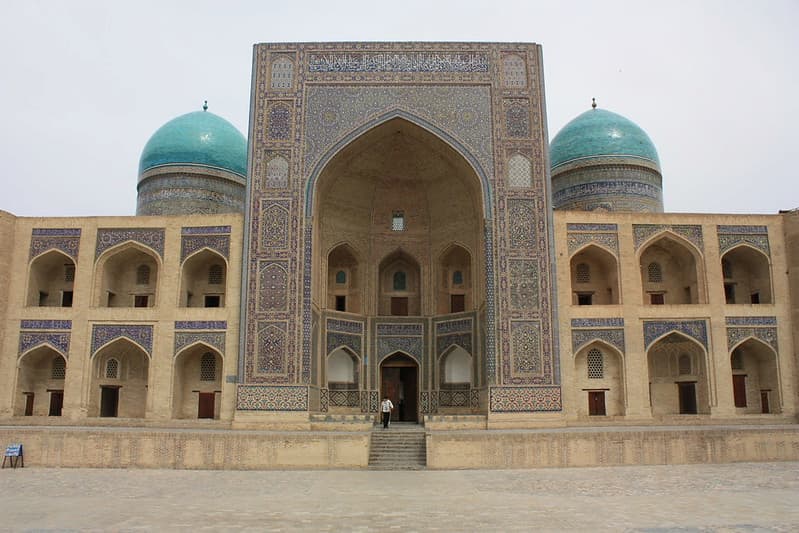
The following are the heritage sites, grouped into recommended gateway cities. This may help in planning on the logistics (travel and accommodation) of your journey.
BUKHARA (BHK)
Bukhara, an ancient jewel along the historic Silk Road in Uzbekistan, is a living museum of Islamic architecture and Central Asian history. A UNESCO World Heritage site for over two millennia, its amazingly preserved historic center is dominated by the monumental Po-i-Kalyan complex, featuring the majestic Kalyan Minaret which famously survived Genghis Khan’s conquests. Visitors can wander through bustling covered trading domes, admire the stunning turquoise tilework of ancient madrasas, and explore the formidable Ark fortress. Centered around the serene Lyabi-Khauz pool, Bukhara offers an authentic, timeless atmosphere steeped in deep trade legacy, traditional scholarship, and vibrant artisan craftsmanship.

SAMARKAND (SKD)
Samarkand, an iconic Silk Road jewel in Uzbekistan, stands as one of the ancient world’s most breathtaking crossroads of culture. A UNESCO World Heritage site for over two millennia, the city is renowned for its grand Islamic architecture adorned with brilliant blue mosaic tiles. At its heart lies the Registan, a grand plaza framed by three magnificent, intricate madrasas. Visitors can marvel at the monumental Gur-e-Amir mausoleum of Amir Timur, the sprawling Bibi-Khanym Mosque, and the luminous, tile-clad tombs along the Shah-i-Zinda avenue. With its vibrant bazaar aromas and rich scholarly legacy, Samarkand delivers a truly timeless, enchanting Central Asian experience.

SHAKHRISABZ (RBZ)
Shakhrisabz, a historic city in southern Uzbekistan, is renowned as the birthplace of the 14th-century conqueror Amir Timur (Tamerlane). Nestled at the foot of the Pamir-Alay mountains, its UNESCO-listed historic center showcases grand monumental architecture designed to reflect the empire’s vast power. The city’s defining landmark is the magnificent Ak-Saray Palace, where massive, mosaic-covered ruins of the entrance tower still stand. Visitors can explore the historic Dorut Tilavat and Dorus Siadat complexes, featuring serene mausoleums and blue-domed mosques. With its tranquil green parks, vibrant local markets, and deep Silk Road heritage, Shakhrisabz offers an inspiring glimpse into Uzbekistan’s imperial past.
TASHKENT (TAS)
Tashkent, the bustling capital of Uzbekistan and Central Asia’s largest metropolis, seamlessly blends ancient Silk Road heritage with Soviet brutalist design and modern urban flair. Rebuilt after a devastating 1966 earthquake, the city features wide tree-lined avenues, grand public squares like Amir Timur Square, and lush green parks. Key landmarks include the historic Khast Imom complex, housing the world’s oldest Quran, and the iconic turquoise-domed Chorsu Bazaar, a sensory hub of spices and local life. Beneath the surface, its chandelier-lit metro system doubles as a subterranean art museum. Tashkent offers a fascinating, vibrant gateway to Uzbek culture.
NUKUS (NCU)
Located in the remote autonomous republic of Karakalpakstan, Nukus is a resilient desert outpost and a beacon of high culture amidst the Kyzylkum Desert. Its crowning jewel is the Savitsky Museum, often called the “Louvre of the Steppe,” which houses a world-renowned collection of banned Soviet-era avant-garde art. The city serves as the vital gateway for travelers venturing to the haunting Ship Graveyard in Moynaq, where rusted hulls sit atop the former Aral Sea bed. From the ancient Zoroastrian ruins of the Mizdahkan Necropolis to the vibrant Karakalpak ethnographic displays, Nukus offers a profound, off-the-beaten-path encounter with Central Asian history and survival.


Comments:
Leave a Reply