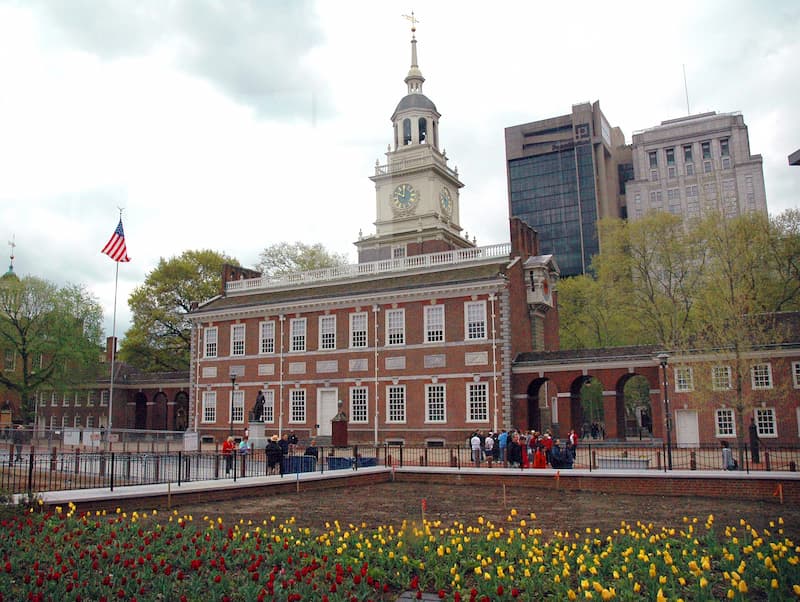
Philadelphia’s Birthplace of a Nation
The UNESCO World Heritage site “Independence Hall”, officially known as the Pennsylvania State House during its construction, is an iconic historic building situated in the heart of Old City, Philadelphia, Pennsylvania, UNITED STATES OF AMERICA. Constructed between 1732 and 1753 under the oversight of master builder Edmund Woolley and designer Andrew Hamilton, the red-brick monumental complex serves as the focal centerpiece of Independence National Historical Park. The main two-story central building is flanked by two symmetrical wing structures—Congress Hall to the west and Old City Hall to the east—forming a unified, formal civic plaza facing historic Independence Square.
Architecturally, Independence Hall is considered a textbook masterpiece of American Georgian style, distinguished by classical symmetry, an ornate white wooden clock tower and bell steeple, limestone belt courses, symmetrical multi-pane sash windows, and exposed brick masonry. Inside, the focal point of the ground level is the famous Assembly Room, where historic delegates gathered during the 18th century. The room retains meticulously preserved period furnishings, including green baize-draped tables, wooden quill inkstands, brass candlesticks, and the original carved “Rising Sun” chair used by George Washington while presiding over the Constitutional Convention. Directly opposite across the central corridor lies the Supreme Court Room of Pennsylvania, depicting the architectural evolution of colonial legal and administrative institutions.
Attraction
Independence Hall attracts international travelers, historians, students, and legal scholars worldwide due to its premier status as the physical birthplace of the United States of America. It is the exact historical chamber where two foundational documents that altered the trajectory of modern democratic governance were debated, drafted, and signed: the United States Declaration of Independence in 1776 and the United States Constitution in 1787.
Global tourists flock to the site to experience standing in the room where prominent historical figures such as George Washington, Benjamin Franklin, Thomas Jefferson, Alexander Hamilton, and James Madison articulated timeless concepts of individual liberty and democratic rule. Beyond the main hall, visitors explore the broader national park landscape, which includes the nearby Liberty Bell Center housing the famous cracked symbol of freedom, as well as the National Constitution Center and the Museum of the American Revolution. Guided educational tours delivered by National Park Service rangers provide deep historical narrative and context, explaining how colonial grievances led to revolution and how early leaders established a lasting federal constitutional republic.

World Heritage
Inscribed on the UNESCO World Heritage List in 1979 as a cultural property, Independence Hall holds outstanding universal value under UNESCO Criterion (vi):
- Criterion (vi) – Direct Association with Ideas and Events of Universal Significance: Independence Hall is designated not primarily for its physical architectural form, but for the universal impact of the democratic principles declared and codified within its walls. The concepts of human equality, the right to revolution, self-governance, and constitutional liberty set forth in the Declaration of Independence (1776) and the U.S. Constitution (1787) profoundly influenced political thinkers, lawmakers, and revolutionary movements around the world. The structural formats and core philosophy of these documents served as models for national constitutions across Latin America, Europe, Asia, and Africa, while directly shaping the United Nations Charter and the Universal Declaration of Human Rights.
Gateway
Visitors traveling to Independence Hall access the landmark through major transportation gateways within the United States featuring IATA-coded airports, comprehensive transit infrastructure, and ample overnight lodging options:
- Philadelphia (Direct Host Gateway):
- Airport: Philadelphia International Airport (IATA Code: PHL; ICAO Code: KPHL).
- Infrastructure and Distance: Located approximately 18 kilometers southwest of Independence Hall, PHL serves as the primary gateway, operating frequent direct international flights from Europe, Canada, and Latin America, alongside extensive domestic routes. The SEPTA Airport Regional Rail Line connects airport passenger terminals directly to Jefferson Station in Center City Philadelphia in under 25 minutes, putting travelers within a short 10-minute walk of the historic district. Philadelphia provides abundant accommodation options ranging from luxury high-rise hotels to historic boutique inns and guesthouses. The city features robust public transit networks, taxi fleets, ride-share coverage, and numerous licensed walking and trolley tour companies.
- Newark / New York Metropolitan Area (Regional Secondary Gateway):
- Airport: Newark Liberty International Airport (IATA Code: EWR; ICAO Code: KEWR).
- Infrastructure and Distance: Situated 130 kilometers northeast in New Jersey, EWR serves as a major intercontinental flight hub. Amtrak high-speed rail connects Newark Airport Station directly to Philadelphia’s 30th Street Station in under one hour, providing a seamless regional alternative for international arrivals.
When
The ideal seasons to visit Independence Hall are Spring (April to May) and Autumn (September to November):
- Spring (April to May): Features pleasant mild weather with daily temperatures averaging between 15°C and 22°C (59°F to 72°F). Public park foliage blooms across the historic square, and crowd sizes are moderate compared to peak summer tourism months.
- Autumn (September to November): Brings crisp, dry weather (12°C to 20°C / 54°F to 68°F) and striking fall foliage framing the historic red-brick plazas, creating optimal walking conditions for outdoor sightseeing tours.
- Summer (June to August): Hot, humid weather (averaging 28°C to 33°C / 82°F to 91°F) coincides with peak domestic travel, resulting in long security wait times and high demand for tour tickets.
- Winter (December to February):Cold weather (0°C to 7°C / 32°F to 45°F), but offers significantly smaller crowds, festive holiday light displays in Old City, and easier ticket availability.
Consideration
- Timed-Entry Ticket Reservations: Entry inside Independence Hall requires timed-entry tickets reserved in advance via Recreation.gov for a $1.00 administrative processing fee per ticket during most months (typically March through December). Tickets are released in advance batches and sell out rapidly.
- Airport-Style Security Screening: All visitors must pass through a security screening building on 5th Street before entering Independence Square. Metal detectors and x-ray machines inspect all personal belongings. Open food and drink containers (except sealed water bottles) and weapons are strictly prohibited.
- Punctuality and Arrival Planning: Guests must arrive at the security screening entrance at least 30 minutes prior to their scheduled tour ticket time to avoid missing their designated entry slot.
- Facility Limitations: There are no public restrooms or dining options inside Independence Hall or on Independence Square; visitors must utilize facilities located inside the adjacent Independence Visitor Center.
- Accessibility Considerations: The primary ground floor (Assembly Room and Supreme Court Room) is fully accessible via entry ramps, whereas upper floors require climbing stairs.

Resources
- National Park Service (Independence National Historical Park): Official government management portal containing visitor guidelines, tour schedules, and security information.
- UNESCO World Heritage Centre: Official property listing outlining inscription criteria, historical significance, and preservation status.
- Visit Philadelphia: Official destination marketing tourism portal providing lodging listings, city maps, and historical neighborhood itineraries.
- Independence Visitor Center Corporation: Official visitor concierge portal detailing attraction ticket availability, city parking, and tour passes.
- Trip.com: Leading online travel marketplace offering bookings for guided walking tours, museum passes, and historical excursions in Philadelphia.


