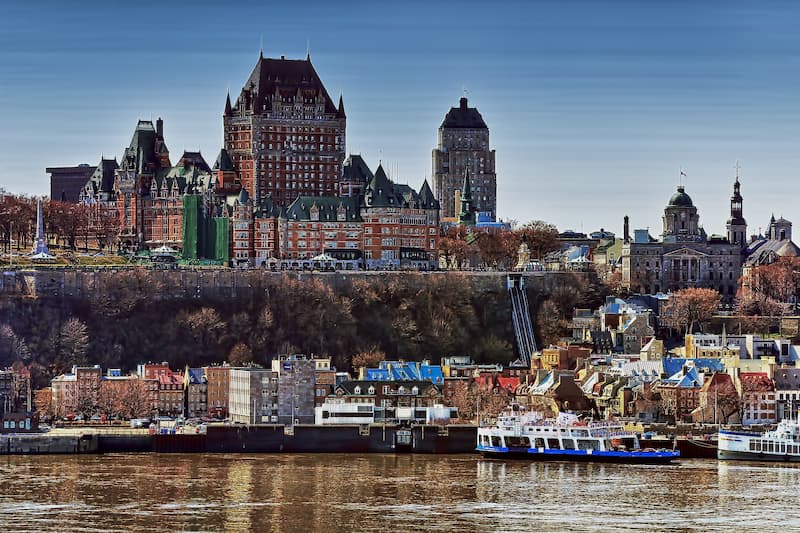
The Historic District of Old Québec (Vieux-Québec), perched along the cliffside of Cap Diamant above the St. Lawrence River in Quebec, CANADA, is one of North America’s most iconic historic urban landscapes. Founded in 1608 by French explorer Samuel de Champlain, the area spans approximately 135 hectares and represents the heart of French America. The district is geographically divided into two urban tiers connected by steep staircases—such as the famous Escalier Casse-Cou (Breakneck Steps)—and the Old Québec Funicular.
The Upper Town (Haute-Ville), positioned atop the limestone promontory, historically served as the administrative, military, and religious center. It features stone convents, sanctuaries like Notre-Dame de Québec Basilica-Cathedral, 4.6 kilometers of stone ramparts, and the star-shaped La Citadelle. Dominating the Upper Town skyline is the Fairmont Le Château Frontenac hotel. Down along the riverbank lies the Lower Town (Basse-Ville), built around Champlain’s original settlement at Place Royale. This quarter retains historic maritime charm with narrow cobblestone streets, preserved stone homes, and the pedestrian thoroughfare of Quartier Petit Champlain.
Attraction
Old Québec attracts global travelers by delivering an authentic European atmosphere without requiring a trip across the Atlantic. Walking through fortified walls, cobblestone lanes, and historic public squares transports visitors into a 17th-century French colonial setting. Architectural enthusiasts admire the seamless blend of French colonial, British Georgian, and Victorian Gothic stone structures preserved across four centuries.
The site serves as a premier destination for seasonal celebrations. In winter, Old Québec transforms into a festive wonderland hosting the world-renowned Québec Winter Carnival (Carnaval de Québec), featuring ice sculptures, night parades, and horse-drawn carriages along snow-covered ramparts. In summer, streets come alive with outdoor patios, street performers, and the Festival d’été de Québec music festival. Furthermore, the district’s rich culinary scene—offering authentic French-Canadian dishes like tourtière, pea soup, poutine, and maple treats—provides visitors with an extraordinary cultural journey.

World Heritage
In 1985, UNESCO inscribed the Historic District of Old Québec on the World Heritage List under cultural criteria (iv) and (vi).
- Outstanding Fortified Urban Ensemble (Criterion iv): Old Québec is recognized as an exceptional, preserved example of a fortified colonial city. Crucially, it stands as the only urban center in North America north of Mexico preserving its defensive ramparts, bastions, gates, and star-shaped Citadel intact. The urban layout illustrates major stages in European colonial expansion, military fortification engineering, and urban planning in the New World under French and British rule.
- Cradle of French Civilization in North America (Criterion vi): The historic district is directly associated with the establishment and continuous preservation of French culture and identity in North America. Founded by Samuel de Champlain in 1608, Old Québec served as the capital of New France and later British Québec, functioning as a living cultural bastion that maintains its distinct identity across centuries.
Gateway
The primary gateway city serving visitors to the historic district is Québec City, located within Quebec, Canada. Because the UNESCO World Heritage property forms the historical core of the modern municipality itself, staying directly in Québec City offers seamless access to all attractions.
Québec City is directly served by Québec City Jean Lesage International Airport (IATA Code: YQB; ICAO Code: CYQB). Situated approximately 15 kilometers (9.3 miles) west of the historic center, YQB operates as an active commercial airport with direct domestic flights from major Canadian transit hubs like Montreal and Toronto, alongside transborder and seasonal international flights. Travelers arriving at YQB reach Old Québec in roughly 20 to 25 minutes via public bus (RTC routes), airport taxis, ride-sharing services, or rental cars. Québec City offers exceptional lodging options across all categories, ranging from luxury historic hotels inside the walled city to boutique inns, bed-and-breakfasts, and modern chain hotels.
When
The best time to visit the Historic District of Old Québec depends on preferred climate and activities, with Summer (June to August) and Winter (December to February) representing peak periods.
- Summer (June to August): Delivers warm weather averaging 20°C to 26°C (68°F to 79°F). Summer is ideal for walking tours, outdoor dining, river cruises, and attending summer festivals.
- Autumn (September to October): Offers crisp air, comfortable walking temperatures around 10°C to 18°C (50°F to 64°F), vibrant foliage along the St. Lawrence valley, and lower crowds.
- Winter (December to February): While temperatures drop below freezing (averaging -15°C to -5°C / 5°F to 23°F) with heavy snowfall, winter brings Old Québec’s holiday magic, festive lights, winter sports, and the vibrant Winter Carnival.
- Spring (March to May): Brings thaws and variable weather with minimal crowds.
Considerations
- Hilly Topography and Footwear: Navigating between Upper Town and Lower Town requires walking up steep cobblestone streets, inclines, and staircases. Sturdy walking shoes are essential year-round.
- Winter Dressing Requirements: Visiting during winter months requires arctic-grade gear, including insulated waterproof boots, thermal base layers, heavy winter coats, gloves, scarves, and warm hats to handle sub-zero temperatures and icy sidewalks safely.
- Language and Culture: French is the official language of Quebec and the primary language spoken throughout the city. While staff at tourist establishments speak fluent English, learning basic French greetings (Bonjour, Merci) is warmly appreciated.
- Vehicular Restrictions and Parking: Vehicle access inside the historic walled district is restricted, and street parking is extremely limited. Visitors traveling by car should park in public garages outside the ramparts and explore on foot.

Resources
- UNESCO World Heritage Centre: Official UNESCO portal providing technical inscription history, property boundaries, and state-of-conservation reports.
- Destination Québec cité: Official tourism board website for Québec City, offering event schedules, visitor itineraries, neighborhood guides, and travel updates.
- Parks Canada: Official federal agency portal managing National Historic Sites within Old Québec, including the Fortifications of Québec and La Citadelle.
- Gouvernement du Québec Tourism Portal: Official provincial government tourism platform providing travel advice, transport links, and regional cultural context.
- Trip.com: Global travel review platform featuring community feedback, hotel reservations, guided walking tour listings, and local restaurant reviews.


Comments:
11 responses to “Historic District of Old Québec”
-
My favorite is Chateau Frontenac because of its architecture and I think funiculare looks fun too!
-
It’s just like being in Paris.
-
Almost everything about Old Quebec feels European, and not simply because its people speak French. The continental ambience comes from its cafes and pâtisseries, its beautifully preserved colonial buildings and the clip-clop of horse-drawn carriages. It comes from the rabbit warren of cobbled streets so long and steep that railings are affixed to the sides of buildings. It comes from the feeling that every stone, every narrow lane, every colorful shutter and awning is steeped in history and character.
We paused for a few minutes along the way to marvel at a towering statue of Samuel de Champlain and the beautiful St. Lawrence River, and then boarded the funicular that connects the Old City’s upper and lower districts. The glass-walled tram slowly lowered us down over the rooftops of the Lower Town and into the Quartier du Petit Champlain, where charming shops and cafes make up the oldest commercial district in North America.
-
Old Quebec’s red brick buildings, cobblestone streets and wrought-iron balconies are so European that if it weren’t for the ubiquitous Tim Horton’s coffee shop, we would have been fooled.
-
Don’t forget to walk along the walls that surround the Old Quebec; the views are magnificent. Notable sites like the Petit-Champlain District, the Plains of Abraham, and the Parliament Building are not to be missed. As is the most photographed hotel in the world, Chateau Frontenac.
-
The Old Quebec (Old Town) is split into Upper Town (Haute-Ville), and Lower Town (Basse-Ville). Upper Town is home to shops, hotels, restaurants, art-filled alleys and musician-dotted corners. Lower Town — a mix of the same and more of the quaint and historic, housed in marvelous stone buildings. And if you’re tired of the steep inclines between Upper and Lower Towns, get a lift on the funiculaire, which connects Terrasse Dufferin with Lower Town. The views are spectacular on this short, cliff-climbing cable railway, in operation since 1879.
-
All around are historic buildings — Parliament, Cathedral-Basilica of Notre-Dame, the Citadelle — but it’s the area with no buildings that caught my attention: the snowy fields of the Plains of Abraham. In the summer, it’s a 240-acre green space commemorating the 1759 battle between the French and British Empires in North America. It includes gardens, greenhouses and a museum that tells the story of the battle. But in the winter, especially from above, it’s just fields and fields of snow. You can take a guided snowshoe tour or cross-country skiing tour on its trails. Or skate on its rink. Skis, snowshoes and skates are all available for rent if you want to tour on your own.
-
The best activity in Quebec is to simply meander through the streets and plazas – forget your map and immerse yourself in the narrow roads and alleys. You’ll never get lost, the city walls will be your guide. Simply close your eyes and imagine living here in the 17th or 18th centuries. If contemporary paintings from those eras are to be believed, it may not have been all that different than it is today.
-
You can not miss the cradle of French America, center of old Quebec, an area completely made to walk by foot. It is also very safe, you can go day or night without any problem. Discover the Plaza Real, where the first house was created, and also has the oldest stone church in all of North America. Visit the Parliamentary Hill, is an area surrounded by government buildings of which the parliament building stands out that enhances its beauty with night lighting. In addition, in this area is the Palace of Fine Arts of Quebec, site where the largest collection of works from the 18th century region to date. Admire the majesty of the Château de Frontenac, undoubtedly one of the most outstanding architectural pieces of the city, and that is also a historic hotel that is still in operation, so if you have the possibility to stay at least one night in this place you can tour it completely, it is considered the most photographed hotel in the world.
-
Old Québec stars narrow lanes with mansard-roofed cottages and storied sites such as Le Monastère des Augustines, a 17th-century monastery with a museum of religious artifacts and a wellness-focused hotel. Start in the upper town with dazzling views of the St. Lawrence River from the Terrasse Dufferin, then head to the lower city via the steep L’Escalier Casse-Cou (Breakneck Steps), or, in winter, by toboggan slide.
-
Right in the heart of Québec City, you could spend an entire day walking the streets through this historic district. Quebec is the only walled city north of Mexico, and the entire area of Old Quebec is a UNESCO World Heritage Site. You can actually walk along the top of the wall or on the path next to it for a great self-guided walking tour. If you walk the entire wall, it’s 4.6 km (just under 3 miles), but you can also choose to just walk a portion of it.

Leave a Reply