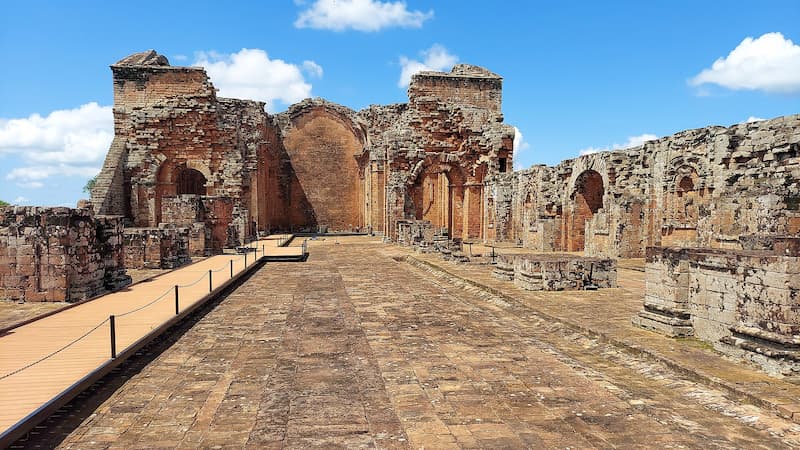
Towering red sandstone arches blending European and Guaraní heritage
The UNESCO World Heritage site titled “Jesuit Missions of La Santísima Trinidad de Paraná and Jesús de Tavarangue” comprises two remarkably preserved 17th- and 18th-century religious settlements (reducciones) located in the Itapúa Department of southern PARAGUAY, near the Paraná River. Constructed by Society of Jesus (Jesuit) missionaries alongside indigenous Guaraní communities between 1609 and 1767, these complexes represent the physical remains of a unique socio-religious socio-economic experiment in colonial South America.
La Santísima Trinidad de Paraná, founded in 1706, is the most extensive and complete ruin complex in the region. Built from local red sandstone, its grid-like urban layout features a central plaza flanked by a monumental main church, an elaborate stone pulpit, a crypt, a bell tower, a school (colegio), workshops, and arcaded residential quarters for thousands of Guaraní families. Located roughly 12 kilometers to the north, Jesús de Tavarangue was founded in 1685 and moved to its current location in 1760. It features a grand, unfinished church designed in a distinct Mudéjar-influenced architectural style, displaying massive stone arches and portals that were left incomplete following the expulsion of the Jesuits by the Spanish Crown in 1767.
Attraction
The Jesuit Missions of Trinidad and Jesús draw historians, architects, and travelers who come to experience one of South America’s most poignant historical landscapes. Standing among the towering red sandstone arches, visitors encounter the tangible legacy of an autonomous communal society where European Baroque art harmoniously fused with indigenous Guaraní craftsmanship.
Visitors flock to Trinidad to wander through intact stone arcades, admire delicate floral and angel reliefs carved into sandstone walls, and climb the historic bell tower for panoramic views across the rural Paraguayan countryside. At night, Trinidad hosts an immersive light and sound show (Luces y Sonido), where soft illumination, sacred Baroque-Guaraní musical compositions, and guided pathways bring the quiet ruins to life under the starry sky. At Jesús de Tavarangue, tourists marvel at the sheer scale of the massive unfinished archways, offering a fascinating glimpse into historical stonemasonry techniques interrupted at the height of the Jesuit era.

World Heritage
Inscribed on the UNESCO World Heritage List in 1993 under Cultural Criterion (iv), the property is recognized for its outstanding architectural, historical, and social significance:
- Criterion (iv) – Outstanding Architectural Ensemble: The missions represent an exceptional physical ensemble of religious and residential architecture illustrating a major historical era—the Jesuit evangelization of South America. The ruins demonstrate a unique fusion of European Baroque architectural forms with indigenous Guaraní artistry, creating an unprecedented vernacular stone architecture preserved within an intact original urban plan.
Gateway
Travelers planning an excursion to the Jesuit Missions can conveniently access the site via two practical Paraguayan gateway locations featuring public IATA-listed airports, overnight lodging options, transport infrastructure, and local tour guide services:
- Encarnación (Primary Local Gateway):
- Airport: Teniente Amín Ayub González Airport (IATA Code: ENO; ICAO Code: SGEN).
- Infrastructure and Distance: Situated in Capitán Miranda, approximately 12 kilometers north of downtown Encarnación and 28 kilometers southwest of Trinidad. As the capital of the Itapúa Department, Encarnación features an active public IATA-listed regional airport. The city offers comprehensive lodging choices ranging from modern riverfront hotels along the Paraná River to budget pensions. Travelers reach Trinidad in 30 minutes via private taxis, rental cars, or regular local buses running along Route PY06. Certified English-speaking guides operate out of Encarnación and at the entrance desks of both mission sites.
- Asunción (Primary National Gateway):
- Airport: Silvio Pettirossi International Airport (IATA Code: ASU; ICAO Code: SGAS).
- Infrastructure and Distance: Located roughly 380 kilometers northwest of the missions. As Paraguay’s principal international aviation hub, ASU handles global and regional flights. Travelers can hire private vehicles, rent cars, or take long-distance express buses along Route PY01 to Encarnación (taking 5 to 6 hours) before continuing to the ruins.
When
The ideal window to visit the Jesuit Missions is during the Southern Hemisphere Autumn and Winter (May to September):
- Cool Season / Winter (May to September): Delivers clear, comfortable weather with daytime temperatures averaging 15°C to 24°C (59°F to 75°F). Humidity levels are lower, creating pleasant conditions for walking around open air stone ruins and attending evening light shows.
- Spring (October to November): Brings warm, pleasant days (20°C to 28°C / 68°F to 82°F) alongside blooming wildflowers, though rain showers become slightly more frequent.
- Summer (December to March): Extremely hot and humid, with temperatures frequently exceeding 36°C to 40°C (97°F to 104°F), accompanied by intense solar exposure and heavy afternoon thunderstorms.
Consideration
- Combined Single Entry Ticket: A single admission ticket purchased at either Trinidad or Jesús covers entry to both sites—plus the nearby mission site of San Cosme y Damián—and remains valid for three consecutive days.
- Sun Protection and Outdoor Footwear: Exploring the wide grassy plazas and open stone structures offers minimal shade. High-SPF sunscreen, wide-brimmed hats, sunglasses, and comfortable, non-slip walking shoes are essential.
- Transportation between Sites: While Trinidad sits right off Route PY06, Jesús de Tavarangue lies 12 kilometers inland along a paved secondary road. Coordinating round-trip taxi waiting times or taking private tours from Encarnación is recommended.
- Evening Light Show Schedule: The Luces y Sonido show at Trinidad operates on specific evening schedules that vary seasonally and depend on dry weather conditions. Confirming showtimes at the Encarnación tourist office prior to evening travel is advised.
- Currency and Financial Services: Transactions use the Paraguayan Guaraní (PYG). Cash is required for paying entry tickets, local buses, small artisan stalls, and tips; reliable ATMs are readily available in Encarnación.


Resources
- UNESCO World Heritage Centre: Official inscription page providing site maps, criteria summaries, and conservation state reports.
- SENATUR Official Paraguay Tourism Portal: Official national tourist office website offering travel planning tools, route details, and mission guides.
- Itapúa Regional Tourism Association: Regional portal detailing local hotels, transit routes, and event schedules across Encarnación and the missions.
- Paraguay Travel Guide: Comprehensive national destination portal featuring historical background, transport advice, and regional itineraries.
- GetYourGuide: Booking marketplace offering day tours, private transfer packages, and guided excursions from Encarnación or Ciudad del Este to the Jesuit Missions.
Featured Image
Jesuit Mission of La Santísima Trinidad de Parana (P. Hughes, Wikimedia/CC BY 4.0).
News Feed
Advertisement


Comments:
Leave a Reply