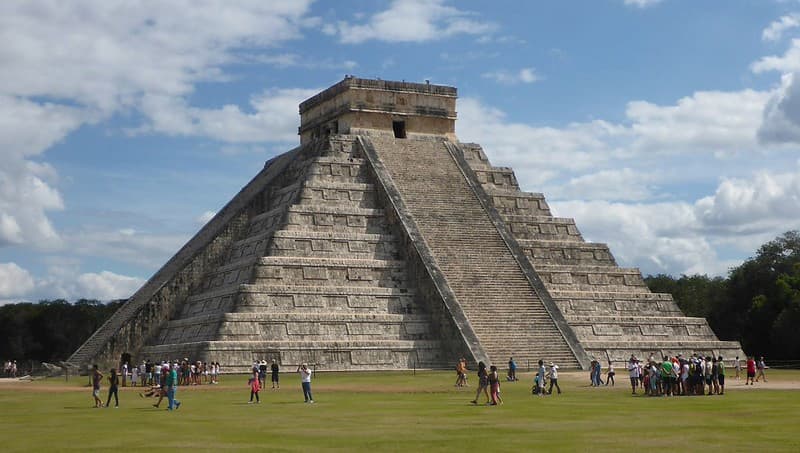
Located in the heart of the Yucatán Peninsula, the Pre-Hispanic City of Chichen-Itza is one of the most iconic and celebrated archaeological sites in Mexico. It serves as a monumental testimony to the brilliance of the Mayan civilization and its later fusion with Toltec influences.
Chichen-Itza was a major focal point of the Northern Maya Lowlands from the Late Classic (c. AD 600–900) through the Terminal Classic (c. AD 800–900) and into the early portion of the Postclassic period (c. AD 900–1200). The site spans approximately 4 square miles and is characterized by a “Mayan-Toltec” architectural style—a unique blend of traditional Puuc Mayan designs and central Mexican Toltec features.
Key structures include:
- El Castillo (The Temple of Kukulkan): A 24-meter-high pyramid that functions as a physical solar calendar.
- The Great Ball Court: The largest and best-preserved ball court in Mesoamerica, measuring 168 meters long.
- The Temple of the Warriors: A large stepped pyramid surrounded by the “Group of a Thousand Columns.”
- El Caracol: A circular observatory used by Mayan astronomers to track the movements of Venus and the sun.
- The Sacred Cenote: A natural limestone sinkhole used for ritual offerings to the rain god, Chaac.
Attraction
Chichen-Itza attracts millions of visitors annually as one of the New Seven Wonders of the World. Its global appeal lies in its “astronomical magic.” The Maya built their structures with such precision that during the Spring and Autumn Equinoxes, the sunlight creates a shadow that looks like a serpent slithering down the side of El Castillo. Beyond the math and science, the site offers a deep spiritual connection to one of history’s most advanced civilizations, all nestled within a lush, tropical jungle setting.

Heritage
UNESCO inscribed Chichen-Itza in 1988 under three cultural criteria:
- Criterion (i): The monuments, particularly the Temple of Kukulkan and the Great Ball Court, are masterpieces of Mesoamerican architecture.
- Criterion (ii): The site illustrates an important interchange of human values, showing the fusion of Mayan and Toltec cultural and artistic traditions.
- Criterion (iii): It is an exceptional testimony to the Mayan civilization and the political/religious power they wielded in the Yucatán for centuries.
Gateway
The city of Mérida, the capital of the state of Yucatán, serves as the most authentic and convenient gateway to Chichen-Itza.
- Commercial Airport: Mérida International Airport (MID) receives direct flights from major hubs in Mexico, the USA, and Canada.
- Lodging: Known as the “White City,” Mérida offers a vast array of lodging, from 5-star colonial haciendas and boutique hotels to modern international chains.
- Proximity: It is located approximately 120 km (1.5 hours) from the ruins, making it a perfect base for exploring the site early in the day.
When
- Dry Season (November to April): This period offers the most comfortable temperatures and minimal rainfall.
- Equinox Dates (March 20–21 / September 21–22): If you wish to see the “Descent of the Feathered Serpent” shadow phenomenon, though be prepared for extreme crowds.
- Early Morning (8:00 AM): Arriving exactly when the gates open allows you to explore before the heat becomes intense and the large tour buses from Cancun arrive at mid-morning.

Consideration
- Sun Protection: The site is very open with little shade. Bring a wide-brimmed hat, high-SPF sunscreen, and light, breathable clothing.
- Entrance Fees: There are two separate fees (one federal, one state) that total roughly $614–$671 MXN (approx. $35–$40 USD) for foreign adults.
- Cash: While some areas accept cards, bring plenty of Mexican Pesos for local vendors, small tips, and the occasional technical failure of credit card machines.
- No Climbing: For conservation reasons, climbing the pyramids is strictly prohibited.
- Hydration: There are no water fountains inside the archaeological zone. Carry at least 2 liters of water per person.

Resources
- UNESCO World Heritage Centre – The official source for maps and historical criteria.
- Britannica: Chichen-Itza – A comprehensive historical overview of the site’s development.
- Yucatán Travel (Official) – Practical travel advice and regional news from the state tourism board.
- INAH (National Institute of Anthropology and History) – The official Mexican government agency responsible for the site.
- ChichenItza.com – A popular site for booking guided tours and transport.


Comments:
One response to “Pre-Hispanic City of Chichen-Itza”
-
I visited there this year. It is an absolutely magical place. The atmosphere was electric. So much history to see and take in.

Leave a Reply