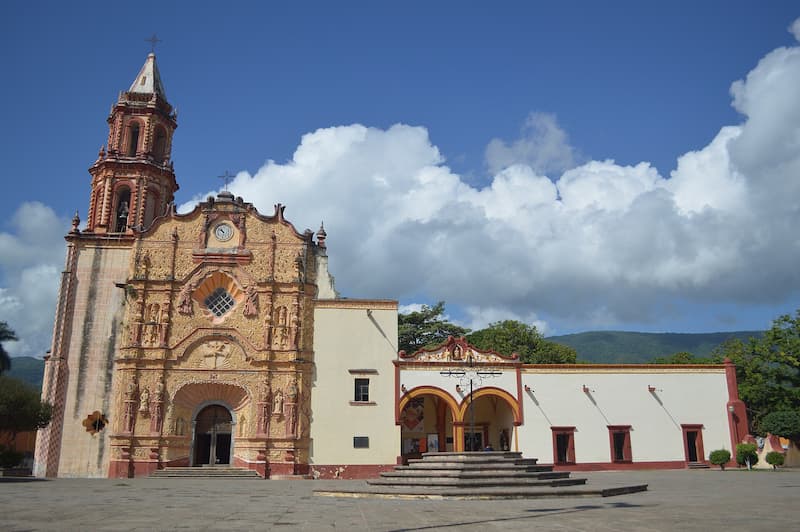
The Franciscan Missions in the Sierra Gorda of Querétaro are a collection of five remarkably preserved 18th-century religious complexes nestled in the rugged mountains of central Mexico. Built between 1750 and 1760, these missions—Jalpan, Concá, Tilaco, Tancoyol, and Landa—are celebrated for their unique “Mestizo Baroque” style, which fuses traditional European religious motifs with vibrant indigenous artistic expressions.
The missions were established under the guidance of Junípero Serra, who later went on to found missions in California. The core of each mission is its church, featuring exceptionally ornate, colorful facades. These facades serve as “stone catechisms,” designed to teach Christian doctrine to the local Pame people using a visual language that incorporates native symbols like jaguars, rabbits, flowers, and fruits alongside traditional Catholic iconography.
Attraction
- Artistic Uniqueness: The “Mestizo Baroque” facades are unlike any other colonial architecture in the Americas. They are masterpieces of stucco and stone, deeply influenced by the worldview of the indigenous people who helped build them.
- Off-the-Beaten-Path Experience: Located in a remote biosphere reserve, these sites offer a peaceful alternative to Mexico’s more crowded colonial towns. Travelers visit to enjoy the serene atmosphere of the mountain villages and the stunning surrounding natural landscapes.
- Integrated Nature: The missions are situated within the Sierra Gorda Biosphere Reserve, allowing tourists to pair their cultural exploration with visits to waterfalls (like Puente de Dios), viewpoints (like Cuatro Palos), and diverse forest ecosystems.

World Heritage
Inscribed in 2003, the sites are recognized for their:
- Cultural Exchange: They provide exceptional testimony to the exchange of values between European missionaries and the indigenous peoples of the region during the 18th century.
- Architectural Synthesis: They illustrate a significant phase in the evangelization of North America, where the architectural and decorative language of the Baroque was successfully adapted to incorporate local cultural identity.
Gateway
Santiago de Querétaro is the essential gateway.
- Commercial Airport: Querétaro International Airport (QRO) serves the region with various domestic and international flights.
- Lodging: As a large colonial city and a UNESCO World Heritage site in its own right, Querétaro offers a vast array of accommodations ranging from historic boutique hotels to modern international brands.
When
- October to April: The cooler, drier months are ideal for navigating the winding, mountainous roads of the Sierra Gorda. Summers can be humid, and the rainy season may occasionally disrupt mountain travel.
Consideration
- Transportation: The missions are spread out. Public buses connect the main towns (like Jalpan de Serra), but the most efficient way to see all five in a short time is to rent a car or hire a local driver in Querétaro or Jalpan.
- Road Conditions: The roads into the Sierra Gorda are winding and mountainous. Drive slowly, especially if you are not accustomed to mountain driving, and ensure you have offline maps, as mobile data is often spotty.
- Pace: These are not “quick stops.” The beauty of the Sierra Gorda lies in its slow, contemplative pace. Give yourself at least two to three days to explore the five missions and the surrounding natural wonders.

Resources
- UNESCO World Heritage – Sierra Gorda Missions – The official historical and cultural documentation.
- VisitMexico – Sierra Gorda – A great resource for general tourism and nearby attractions.
- Slight North – Sierra Gorda Guide – An excellent, practical blog post covering road-trip logistics and hiking tips.
- Visit Queretaro (Official State Portal) – Official tourism information for the state and the biosphere reserve.
- Booking.com – Querétaro Hotels – A reliable platform to book your stay in the gateway city.


Comments:
Leave a Reply