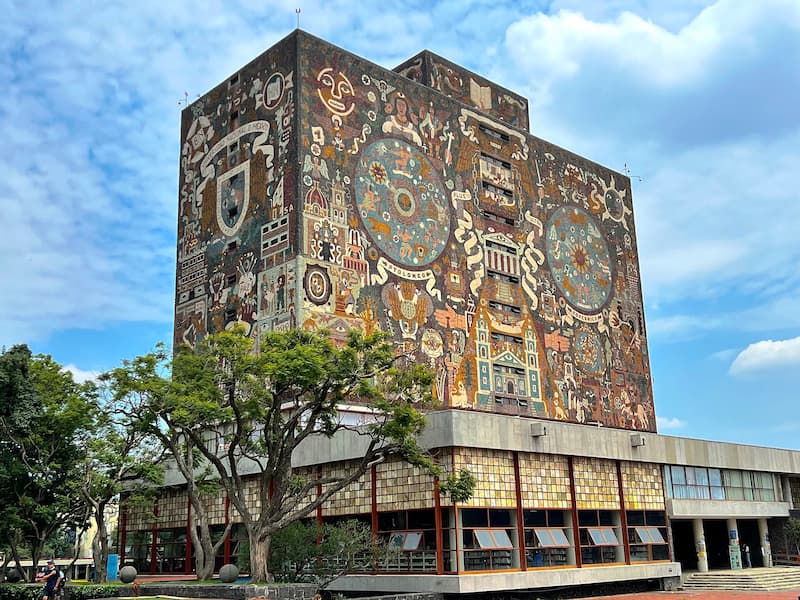
The Central University City Campus of the Universidad Nacional Autónoma de México (UNAM) is not just a school—it is a monumental intersection of art, history, and urban planning. Sprawling across more than 700 hectares in the southern part of Mexico City, “CU” (as locals call it) stands as a testament to Mexico’s mid-20th-century “Mexican Miracle,” a period of rapid modernization and cultural pride.
Built between 1949 and 1952, the campus was a collaborative masterwork involving over 60 architects, engineers, and artists. It replaced scattered colonial-era buildings in the city center with a unified, modern “city within a city.” The landscape is dominated by the Pedregal, a rugged terrain formed by the ancient eruption of the Xitle volcano. The architecture follows a “Super-manzana” (super-block) design, where buildings are grouped by discipline and connected by vast pedestrian plazas and green spaces.
The most iconic structures include:
- The Central Library: Famous for its four-sided mosaic titled Historical Representation of Culture, created by Juan O’Gorman using thousands of naturally colored stones.
- The Olympic Stadium: A volcano-shaped arena featuring a high-relief mural by Diego Rivera.
- The Rectoría Tower: A modernist skyscraper adorned with three-dimensional “sculpture-paintings” by David Alfaro Siqueiros.
Attraction
Tourists flock here to witness one of the world’s most successful fusions of Modernism and Pre-Hispanic tradition. Unlike many 1950s modernist projects that feel cold or clinical, UNAM feels deeply “Mexican.”
- The Murals: The campus functions as an open-air museum. Seeing the works of the “Big Three” (Rivera, Siqueiros, and Orozco) in their original architectural context is a bucket-list item for art historians.
- Espacio Escultórico (Sculpture Space): Located in the university’s ecological reserve, this massive circular concrete installation surrounds a field of jagged black lava rock. It is a hauntingly beautiful spot for photography and contemplation.
- Vibrant Campus Life: Visitors can enjoy the energetic atmosphere, from students practicing dance in the plazas to “Pumas” football fans gathering on weekends.


Heritage
In 2007, UNESCO designated the campus a World Heritage site under several criteria, most notably:
- Human Creative Genius (Criterion i): It represents a “total work of art” where architecture, engineering, landscape design, and fine arts were integrated into a single vision.
- Interchange of Values (Criterion ii): It successfully merged 20th-century modern movements (inspired by Le Corbusier and Bauhaus) with indigenous Mexican motifs and local materials (volcanic rock).
- Outstanding Urban Ensemble (Criterion iv): It is one of the few models in the world where the principles of the Modern Movement were applied to an entire urban scale, creating a functional yet aesthetic academic city.
Gateway
The gateway is Mexico City (CDMX).
- Airport: The city is served by Benito Juárez International Airport (MEX), a major global hub with direct flights from across the Americas, Europe, and Asia.
- Lodging: For easy access to the campus, travelers usually stay in the neighborhoods of Coyoacán (for a bohemian, colonial vibe), San Ángel, or Roma/Condesa (for trendy boutiques and dining). All offer extensive options ranging from budget hostels to luxury hotels.
When
The ideal time to visit is during the dry season (November to April).
- March and April are particularly magical because the Jacaranda trees bloom, painting the campus in vibrant shades of purple.
- Avoid the rainy season (June to September) if you plan on doing the extensive walking required, as heavy afternoon downpours are common.
- Tip: Visit on a weekday to see the university in action, or a Sunday morning for a quieter, more relaxed exploration.

Consideration
- The Altitude: Mexico City sits at an elevation of approximately 2,240 meters (7,350 feet). If you are coming from sea level, you may feel winded or get a slight headache. Hydrate well and take it slow on your first day.
- Size and Walking: The campus is enormous. Wear comfortable shoes and use the PumaBús (the free internal shuttle system) to move between the Central Library and the Cultural Center.
- Safety: While the campus is generally safe, it is a public space. Keep an eye on your belongings in crowded areas. Avoid wandering into the further reaches of the ecological reserve alone at dusk.
- Sun Protection: Due to the altitude and the open plazas, the sun is quite strong. Wear sunscreen and a hat.

Resources
- UNESCO World Heritage Centre: The official dossier on why the site is protected.
- UNAM Official Website: For campus maps and event calendars (mostly in Spanish).
- Visit Mexico: The official national tourism portal for broad travel planning.
- Mexico City Tourism Board: Excellent for local transport tips and neighborhood guides.
- Viator: A popular platform to book guided mural tours or architectural walks (this site earns commissions from bookings).
Featured Image
The Central Library, UNAM (Dead Rabbit, Wikimedia/CC BY-SA 4.0).
In The News
Advertisement


Comments:
Leave a Reply