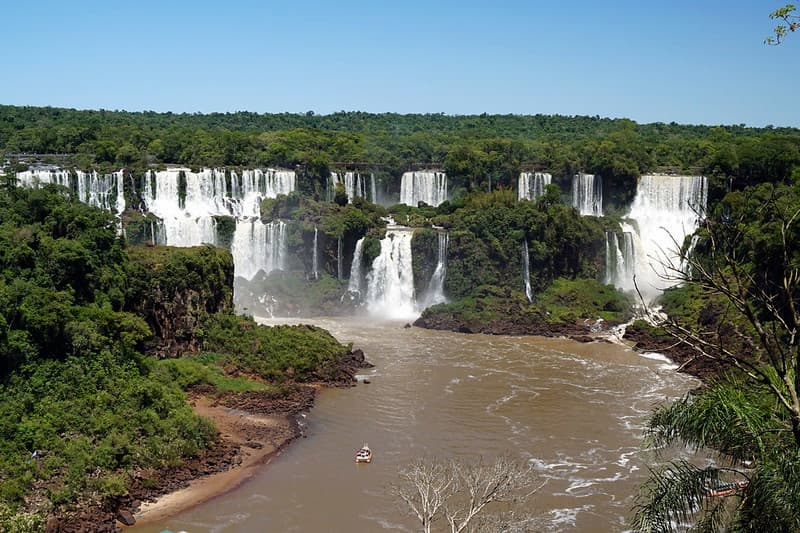
A spectacular rainforest sanctuary surrounding one of the world’s greatest waterfalls.
The UNESCO World Heritage property titled “Iguaçu National Park” (Parque Nacional do Iguaçu) is an expansive 185,262-hectare protected reserve located in the extreme southwest of Paraná State, southern BRAZIL. Established on January 10, 1939, by federal decree, the park preserves one of the largest remaining contiguous stretches of the Interior Atlantic Forest (Mata Atlântica) in South America. The reserve is defined by the mighty Iguaçu River, which forms a natural international border between Brazil and Argentina before flowing into the Paraná River downstream. Indigenous Guaraní tradition holds that the massive waterfall was created when a serpent deity sliced the riverbed to halt two fleeing lovers.
The park’s central feature is Iguaçu Falls (Cataratas do Iguaçu), a world-famous cascade system comprising over 275 individual waterfalls extending across a horseshoe-shaped precipice nearly 2.7 kilometers wide. While the majority of the physical drops lie within Argentine territory, the Brazilian side offers unmatched, sweeping panoramic views of the entire amphitheater. The cascades plunge up to 82 meters into the narrow basaltic canyon known as the Devil’s Throat (Garganta do Diabo). Surrounding the roaring waters is a pristine subtropical rainforest characterized by rich flora, towering trees, and diverse fauna.
Attraction
Iguaçu National Park attracts global travelers through its breathtaking scale, immense water volume, and exceptional eco-tourism activities. Unlike the Argentine side, which focuses on walking directly above or alongside individual cascades, the Brazilian park offers grand, wide-angle sightlines that allow visitors to view the full magnitude and symmetry of the waterfall system in a single breathtaking panorama.
The primary highlight for visitors is walking along the long wooden catwalk that extends out over the river waters, leading directly to a glass-walled observation tower and balcony at the edge of the Devil’s Throat (Espaço Naipi). Here, tourists are engulfed by rising mist and surrounded by vibrant rainbows. Adventure enthusiasts can experience the Macuco Safari, an exhilarating excursion that combines open-top electric jeep rides through rainforest trails with twin-engine inflatable boat trips that navigate directly into the spray of the cascades. Other key attractions within or adjacent to the park include scenic helicopter flights over the falls, guided nature treks along the Poço Preto and Bananeiras trails, and visits to the nearby Parque das Aves bird sanctuary.

World Heritage
Inscribed on the UNESCO World Heritage List in 1986, Iguaçu National Park was recognized as a Natural World Heritage Site under criteria (vii) and (x):
- Criterion (vii) – Exceptional Natural Beauty and Aesthetic Importance: The park encompasses one of the world’s most spectacular waterfall complexes. The dramatic interface between thundering cascades, permanent mist clouds, forested river islands, and dynamic river aesthetics framed by lush subtropical rainforest creates an extraordinary landscape of visual and acoustic beauty.
- Criterion (x) – Significant Natural Habitat for In-Situ Biodiversity Conservation: Together with the adjoining Iguazú National Park in Argentina, the site protects the largest remnant of the Paranaense subtropical rainforest within the critically endangered Atlantic Forest biome. The park harbors over 2,000 vascular plant species and provides a critical refugium for endangered wildlife, including the jaguar (Panthera onca), puma, ocelot, giant anteater, giant otter, broad-snouted caiman, and harpy eagle.
Gateway
The historic national park is served by an immediate, highly accessible gateway city located within Brazil:
- Foz do Iguaçu (Primary Brazilian Gateway):
- Airport: Foz do Iguaçu/Cataratas International Airport (IATA Code: IGU; ICAO Code: SBFI).
- Infrastructure and Distance: Situated in Paraná State, Foz do Iguaçu sits 12 kilometers from downtown and approximately 3 kilometers from the national park entrance. Located at the famous Triple Frontier (Tríplice Fronteira) where Brazil, Argentina, and Paraguay converge, the city’s international airport receives frequent domestic connections from major hubs like São Paulo, Rio de Janeiro, and Curitiba.
- Lodging and Transport: Foz do Iguaçu features a highly developed tourism infrastructure with hundreds of accommodation options, ranging from luxury eco-resorts—such as the Belmond Hotel das Cataratas located inside the park—to mid-range hotels and budget hostels. Public transit Line 120 directly connects the airport, city center, and park entrance at frequent intervals. Taxis, rideshare vehicles, and private hotel shuttles are readily available. Local travel agencies, visitor bureaus, and bilingual tour operators offer guided tours of the falls, cross-border excursions to Argentina, and trips to the massive Itaipu Hydroelectric Dam.
When
The optimal time to visit Iguaçu National Park is during the shoulder seasons of Spring (September to November) and Autumn (March to May).
- Spring and Autumn: These transitional seasons offer pleasant weather with daytime temperatures ranging between 18°C and 28°C (64°F to 82°F), moderate rainfall, and reliable water flow over the falls. Sightseeing along the exposed catwalks is comfortable without oppressive summer heat, humidity, or winter chills, and tourist density is significantly lower than during peak vacation periods.
- Summer (December to February): Brings heavy rain and maximum waterfall volume, creating a powerful spectacle. However, high temperatures exceeding 33°C (91°F), intense humidity, and large holiday crowds can make long walks challenging.
- Winter (June to August): Features cooler, drier conditions (15°C to 24°C / 59°F to 75°F) with clear skies. While trekking is very pleasant, prolonged dry spells can occasionally reduce the water volume of smaller cascades.
Consideration
- Water Protection and Clothing: Visitors will get drenched by wind-driven spray on the Devil’s Throat catwalk and during boat excursions. Bringing waterproof bags for electronic devices, wearing fast-drying clothing, and using rain ponchos and non-slip sandals or shoes are essential.
- Wildlife Interactions: South American coatis (nasua nasua) are abundant along park pathways. Although accustomed to humans, they are wild animals that forcefully steal food and can inflict bites or scratches; feeding or touching them is strictly forbidden.
- Park Transportation and Booking: Private vehicles cannot enter the park grounds. Visitors ride double-decker panoramic shuttle buses operating continuously from the main visitor center to various trailheads. Reserving entry tickets online in advance is highly recommended to secure preferred entry time slots and avoid long waiting lines.
- Cross-Border Travel: Most travelers visit both the Brazilian and Argentine sides of the falls. Crossing the international border via the Tancredo Neves Bridge requires passport control checks, so visitors must ensure they possess required visas and identification documents.
- Sun and Insect Protection: High humidity and outdoor trails necessitate applying biodegradable sunscreen, wearing wide-brimmed hats, and using effective insect repellent.

Resources
- UNESCO World Heritage Centre: Official property listing detailing outstanding universal value criteria, conservation reports, and boundary mapping.
- Parque Nacional do Iguaçu Official Site: Official concessionaire portal offering online ticket purchases, operating schedules, visitor rules, and park updates.
- Chico Mendes Institute for Biodiversity Conservation (ICMBio): Official Brazilian federal agency governing environmental management and national park operations.
- Visit Brasil: Official Ministry of Tourism portal providing regional travel guides, transportation advice, and ecological itineraries.
- GetYourGuide: Popular online travel marketplace offering booking services for skip-the-line admission, Macuco Safari excursions, and guided tours.
Featured Image
Devil’s Throat, Iguacu National Park (Matt Kieffer, Flickr/CC BY-SA 2.0).
News Feed
Advertisement


Comments:
Leave a Reply