Beyond Moonscapes: The World’s Ultimate Triassic Fossil Frontier.
The UNESCO World Heritage site titled “Ischigualasto / Talampaya Natural Parks” comprises two contiguous protected reserves situated in the arid desert basin of northwestern ARGENTINA: Ischigualasto Provincial Park in San Juan Province and Talampaya National Park in La Rioja Province.Spanning a vast combined area of over 275,000 hectares along the western edge of the dry Monte desert ecoregion, these adjacent reserves form an unbroken desert landscape framed by the dramatic, snow-capped pre-Andean mountain ranges.
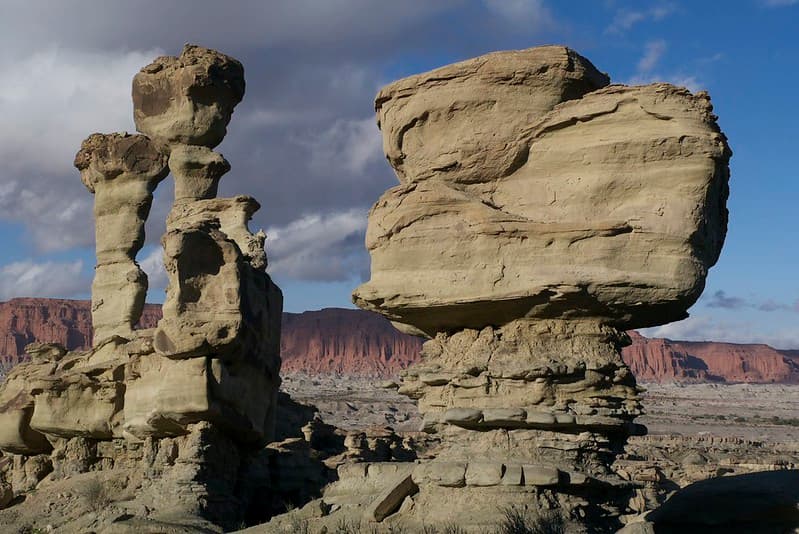
Ischigualasto Provincial Park, popularly referred to as the Valle de la Luna (“Valley of the Moon”), is celebrated globally for its surreal, starkly eroded claylands, ash beds, and sandstone structures. Over tens of millions of years, flash floods, fierce desert winds, and atmospheric weathering have carved out extraordinary geomorphic formations, intricate badlands, narrow dry canyons, and balanced rock spires bearing evocative local names such as El Hongo (“The Mushroom”), El Submarino (“The Submarine”), and Cancha de Bochas (“Bowling Alley”).
Immediately adjoining it to the northeast, Talampaya National Park features massive, sheer sandstone monoliths and vertical cliffs towering up to 150 meters high, cut by deep canyons such as the Quebrada de Talampaya. The vibrant ochre, vermilion, and rust-red rock faces rise dramatically above sandy dry riverbeds lined with desert scrub, algarrobo trees, and ancient petroglyphs. Together, these two natural parks protect an intact and fully exposed Continental Triassic sedimentary basin spanning nearly 50 million years of Earth’s geological history.
Attraction
The Ischigualasto and Talampaya natural parks draw international paleontologists, geology enthusiasts, nature photographers, and adventure travelers with their breathtaking desert vistas, unique rock sculptures, and world-renowned evolutionary heritage.
The primary visual draw lies in the otherworldly, high-contrast desert topography. Visitors exploring Ischigualasto can witness eerie lunar landscapes where light grey and whitish clay beds contrast sharply against dark volcanic basalt capstones. At Talampaya, eco-buses, open-air trucks, and guided cycling tours navigate narrow canyon floors flanked by towering red sandstone walls that produce remarkable acoustic echoes. Intricate pre-Columbian petroglyphs carved into canyon walls by ancient Ciénaga and Diaguita cultures offer a fascinating historical glimpse into early human habitation and Indigenous ceremonial sites.
Beyond the majestic scenery, the parks hold world-class status as a prime destination for dinosaur and fossil enthusiasts. Ischigualasto is widely recognized as one of the most significant paleontological excavation sites on Earth, having yielded extraordinarily complete fossil skeletons of foundational primitive dinosaurs, early plant-eating mammal ancestors, aquatic amphibians, and flying reptiles.

World Heritage
Inscribed on the UNESCO World Heritage List in 2000 under Natural Criterion (viii), the Ischigualasto / Talampaya property is recognized for its outstanding global geological and paleontological importance:
- Criterion (viii) – Exceptional Earth History and Fossil Record: The parks preserve the world’s most complete, continuous, and undisturbed fossiliferous continental sedimentary record of the Triassic Period (spanning from 245 to 208 million years ago). Six distinct geological formations exposed across the two parks display an unbroken succession of plant, insect, amphibian, reptile, and early dinosaur evolution through the entire Triassic Era.
- Evolutionary Transition Epoch: The fossil deposits capture the crucial evolutionary epoch when primitive archosaurs transitioned into true dinosaurs, alongside early cynodont ancestors of modern mammals. The discovery of foundational early dinosaurs here, including Eoraptor lunensis and Herrerasaurus, revolutionized global scientific understanding of early vertebrate evolution and Triassic terrestrial ecosystems.
Gateway
Travelers planning an expedition to Ischigualasto and Talampaya can utilize two principal gateway cities in western Argentina that feature active IATA-coded commercial airports, robust transport infrastructure, lodging options, and local tour operator services:
- San Juan (Primary Southern Gateway):
- Airport: Domingo Faustino Sarmiento Airport (IATA Code: UAQ; ICAO Code: SANU).
- Infrastructure and Distance: Located approximately 330 kilometers southwest of Ischigualasto. UAQ receives regular daily scheduled domestic flights from Buenos Aires. The city of San Juan offers an extensive array of overnight lodging options ranging from multi-star luxury hotels to boutique vineyard guesthouses and rental apartments. From San Juan, visitors can hire rental vehicles or catch intercity buses north toward San Agustín del Valle Fértil (the main service hub near Ischigualasto, located 80 kilometers from the park gate). Tour agencies in San Juan organize guided day excursions and multi-day desert circuit itineraries.
- La Rioja (Primary Northern Gateway):
- Airport: Capitán Vicente Almandos Almonacid Airport (IATA Code: IRJ; ICAO Code: SANL).
- Infrastructure and Distance: Situated roughly 210 kilometers northeast of Talampaya National Park. IRJ operates daily commercial flight links with Buenos Aires. La Rioja features modern hotels, rental car facilities, and daily tour departures heading west via Villa Unión (a key hospitality town 60 kilometers from Talampaya) directly to the park entrances.
When
The ideal time to visit Ischigualasto and Talampaya Natural Parks is during the Autumn (April to June) and Spring (September to November) months:
- Autumn (April to June): Delivers optimal visiting conditions with clear, sunny skies, dry weather, and mild daytime temperatures ranging between 18°C and 25°C (64°F to 77°F).
- Spring (September to November): Features comfortable daytime temperatures (20°C to 28°C / 68°F to 82°F) and low precipitation, allowing pleasant outdoor canyon exploration before intense summer heat arrives.
- Summer (December to March): Hot conditions with daily temperatures frequently exceeding 40°C (104°F). Summer also brings torrential seasonal rains and sudden flash floods that can temporarily close canyon tracks.
- Winter (July to August): Crisp and dry with sunny days (12°C to 18°C / 54°F to 64°F), though nighttime temperatures frequently drop below freezing across the desert basin.
Consideration
- Mandatory Guided Excursions: Individual unguided walking inside both parks is strictly prohibited to protect fragile geological structures and fossil beds. In Ischigualasto, visitors drive in personal vehicle caravans behind a park ranger guide. In Talampaya, access is strictly managed via official 4×4 trucks, eco-buses, or authorized mountain bike tours.
- Advance Booking Requirements: Due to daily visitor quotas and vehicle capacities, booking entry passes and guided excursion slots online in advance is highly recommended, especially during national holiday weekends.
- Arid Desert Climate and Sun Protection: High elevation, zero natural shade, and intense solar UV radiation necessitate wide-brimmed hats, polarized sunglasses, high-SPF sunscreen, and ample drinking water (at least 2–3 liters per person).
- Diurnal Temperature Swings: Desert environments experience severe temperature drops between day and night; packing versatile layered clothing for warm afternoons and warm jackets for cool mornings is essential.
- Limited On-Site Financial Amenities: Gas stations, ATMs, and dining facilities near the park gates are extremely limited. Travelers should carry sufficient cash in Argentine Pesos and keep their fuel tanks completely filled.

Resources
- UNESCO World Heritage Centre: Official portal detailing global heritage criteria, geological boundaries, and conservation reports.
- Parques Nacionales de Argentina: Official government portal providing operational information, entry fees, and excursion reservations for Talampaya National Park.
- Ischigualasto Official Provincial Portal: San Juan province’s official tourism site for visiting Valle de la Luna.
- Turismo San Juan & La Rioja: Regional tourism portals providing lodging directories, travel routes, and tour operator contact lists.
- GetYourGuide: Travel booking platform offering day tours, private transfers, and multi-day desert packages to Ischigualasto and Talampaya.
Featured Image
El Submarino, Ischigualasto Provincial Park (Pedro Reyna, Flickr/CC BY 2.0).
News Feed
Advertisement


Comments:
Leave a Reply