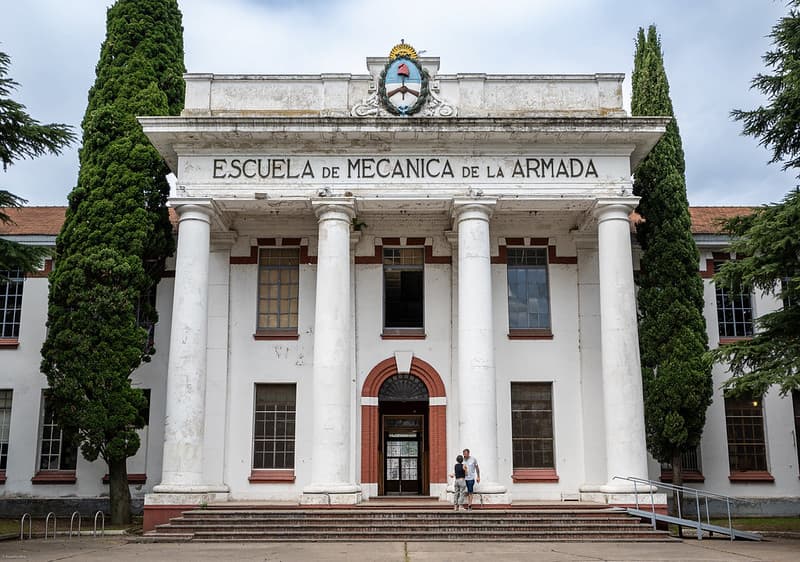
The ESMA Museum and Site of Memory (formerly the Navy School of Mechanics) is a hauntingly significant landmark in Argentina. Located in the heart of Buenos Aires, it serves as a global monument to human rights and a stark reminder of the “Dirty War” that reshaped the nation.
The site is housed within the former Officers’ Quarters of the Navy School of Mechanics. During Argentina’s last civil-military dictatorship (1976–1983), this elegant neoclassical building functioned as a Clandestine Centre of Detention, Torture, and Extermination.
Behind its orderly façade, over 5,000 people were held captive in inhumane conditions. Today, the museum preserves the building in its original state—serving as a piece of judicial evidence in ongoing trials. Visitors can walk through the basement, where prisoners were processed, and the attic (known as “Capuchita”), where the “disappeared” were hooded and shackled, waiting for the “death flights.”
Attraction
Unlike most heritage sites, ESMA is a Site of Conscience. It draws international visitors for its role in global justice:
- A Living Archive: The exhibition is based primarily on the testimonies of survivors. It isn’t just a display of artifacts but a narrative of resilience and the fight for truth.
- The “Grandmothers” Legacy: The site tells the story of the mothers and grandmothers of the disappeared who transformed their grief into a globally recognized movement for human rights.
- Educational Depth: For those interested in political science, history, or law, ESMA offers a raw, unfiltered look at how democratic institutions can be subverted and eventually rebuilt.

(Xiquinho Silva, Flickr/CC BY 2.0).
Heritage
UNESCO inscribed the ESMA Museum in 2023 under Criterion (vi), which identifies sites associated with events of outstanding universal significance.
- Symbol of State Terrorism: It is the primary site representing the systematic plan of “enforced disappearances” that occurred across Latin America during the 1970s and 80s.
- Universal Justice: It stands alongside sites like Auschwitz-Birkenau and Robben Island as a testament to the darkest chapters of humanity, ensuring that “Never Again” (Nunca Más) remains a global imperative.
Gateway
The vibrant capital of Argentina serves as the essential gateway to the site.
- Commercial Airport: Ministro Pistarini International Airport (EZE) handles most international arrivals, while Jorge Newbery Airfield (AEP) serves domestic and regional flights.
- Lodging: Buenos Aires offers a vast range of accommodations, from the luxury hotels of Recoleta to the boutique guesthouses of Palermo and the historic hostels of San Telmo.
- Logistics: The museum is located on Avenida del Libertador in the Núñez neighborhood. It is easily reachable via the Mitre Train Line (Rivadavia Station) or numerous city buses (lines 15, 28, 29, and 130).
When
- Spring (October to November): The city is at its most beautiful as the purple jacaranda trees bloom, and the mild weather makes the walk through the large ESMA campus pleasant.
- Autumn (March to May): Another ideal window with comfortable temperatures and fewer crowds.
- The “Five O’Clock Tour”: On the last Saturday of every month, the museum hosts a special themed tour with guest speakers such as survivors, relatives, or legal experts.
Consideration
- SENSITIVE CONTENT WARNING: The museum’s content is visceral and emotionally taxing. It is not suitable for children under 15 years of age.
- Respectful Conduct: The site is a place of mourning and a crime scene. Respectful behavior is expected, and photography is restricted in certain sensitive areas of the Officers’ Quarters.
- Booking: While entry is free, guided tours are highly recommended to understand the layout and historical context. It is wise to check their official portal for current tour schedules.
- Language: Most of the primary displays are in Spanish, but high-quality English audio guides and translated materials are available for international visitors.
- Physical Distance: The “Espacio para la Memoria” is a large 17-hectare campus. Wear comfortable walking shoes, as you may spend several hours exploring the various buildings.

Resources
- UNESCO World Heritage Centre – ESMA – For the formal technical dossier and global context of the site.
- Museo Sitio de Memoria ESMA (Official) – The primary source for booking tours and current visitor information.
- International Coalition of Sites of Conscience – Insights into how ESMA connects with other global memorial sites.
- Turismo Buenos Aires – The official city guide for logistics, dining, and other historical attractions.
- GetYourGuide – Buenos Aires History Tours – A platform for booking comprehensive history tours that include the ESMA site.
Featured Image
ESMA Museum and Site of Memory (Xiquinho Silva, Flickr/CC BY 2.0).
News Feed
Advertisement


Comments:
Leave a Reply