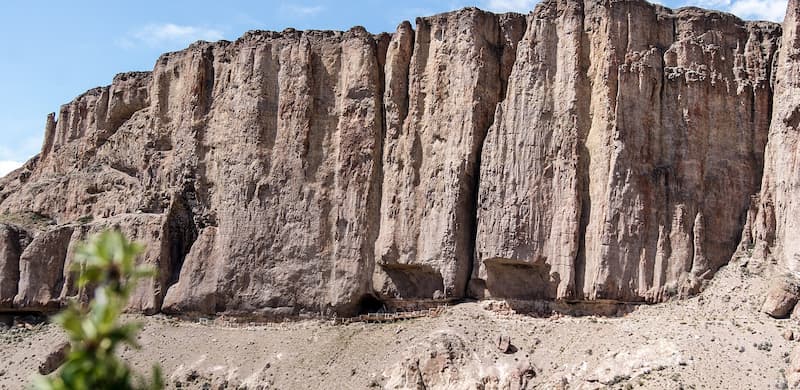
The Cueva de las Manos, Río Pinturas (Cave of the Hands) is one of the most significant and visually arresting archaeological sites in South America. Tucked away in the rugged canyons of Argentine Patagonia, it serves as a profound connection to the hunter-gatherer societies that inhabited the region over 9,000 years ago.
Located in the province of Santa Cruz, the site consists of a series of rock shelters and caves along the walls of the Río Pinturas Canyon. The “cave” itself is actually a deep recessed rock overhang. Its most famous feature is the collection of hundreds of stenciled handprints—mostly left hands—overlapping in vibrant shades of red, ochre, yellow, black, and white.
The art is divided into three distinct chronological groups:
- Group A (approx. 7,300 BC): Features stenciled hands and scenes of hunting guanacos (a wild camelid), depicting the movement and strategy of the hunt.
- Group B (approx. 5,000 BC): Shifting toward more static handprints and less frequent hunting scenes.
- Group C (approx. 1,300 AD): Characterized by geometric patterns and abstract figures, reflecting the later Tehuelche culture ancestors.
Attraction
The site attracts travelers worldwide for its raw, unfiltered look at human prehistory:
- The “Human Connection”: Seeing the actual size and shape of hands from 9,000 years ago creates an immediate, emotional link to the past that few other archaeological sites can match.
- The Patagonian Landscape: The journey to the cave through the desert steppe and the dramatic Río Pinturas Canyon is a spectacular adventure in its own right.
- Color Preservation: Due to the hyper-arid climate and the mineral-based pigments (iron oxides for red, manganese for black), the colors remain startlingly vivid, looking as though they could have been painted recently.

Heritage
UNESCO inscribed the Cueva de las Manos in 1999 under Criterion (iii):
- Exceptional Testimony: It is considered one of the most important expressions of the earliest known human groups in South America. It provides unique evidence of the social and religious practices of hunter-gatherer cultures that existed before the rise of settled civilizations.
- Artistic Quality: The composition of the paintings, the use of perspective in hunting scenes, and the sheer density of the hand stencils represent a peak of early human artistic achievement.
Gateway
The most functional gateway city for this site is Comodoro Rivadavia.
- Commercial Airport: General Enrique Mosconi International Airport (CRD) is a major hub with frequent daily flights from Buenos Aires.
- Lodging: As a significant oil and commercial center, the city offers high-capacity lodging, ranging from international chains like Lucania Palazzo Hotel to modern business apartments.
- The Journey: From Comodoro Rivadavia, travelers typically rent a vehicle to drive the roughly 450 kilometers (about 5-6 hours) south via the iconic Ruta 40 to reach the town of Perito Moreno or Los Antiguos, which serve as the final staging points for the canyon.
When
- Spring/Summer (October to March): This is the prime window. Temperatures are manageable, and the access roads are generally clear of snow.
- The Sweet Spot: November and December offer the best balance of clear skies and fewer crowds before the peak Argentine summer holiday in January.
- Winter (June to August): Travel is generally discouraged. Patagonian winters are brutal, and the gravel access roads to the canyon can become impassable due to ice and snow.

Consideration
- Driving Conditions: The final stretch into the canyon often involves ripio (unpaved gravel roads). A 4WD vehicle is highly recommended, and drivers should carry spare tires and extra fuel.
- Limited Connectivity: There is virtually no cell service or Wi-Fi once you leave the main towns. Downloading offline maps is essential.
- Guided Access: You cannot roam the caves freely. Access is strictly via guided tours provided by the park rangers to protect the fragile pigments from human touch and breath.
- Remote Location: There are no food services at the site. You must bring your own water and supplies for the day.
- Ruta 40 Logistics: Ensure your rental insurance covers gravel road damage, as flying stones are common.

Resources
- UNESCO World Heritage Centre – The official scientific and historical documentation for the site.
- Welcome Argentina: Cueva de las Manos – A practical travel portal with maps and local photography.
- Cueva de las Manos (Official Site) – The site managed by the local foundation, providing the most accurate current opening hours and conservation news.
- Patagonia.com.ar – A regional guide focusing on the geography and history of the Santa Cruz province.
- GetYourGuide – A commercial platform where you can book guided day trips from Perito Moreno or El Calafate.


.jpg)

.jpg)

Comments:
Leave a Reply