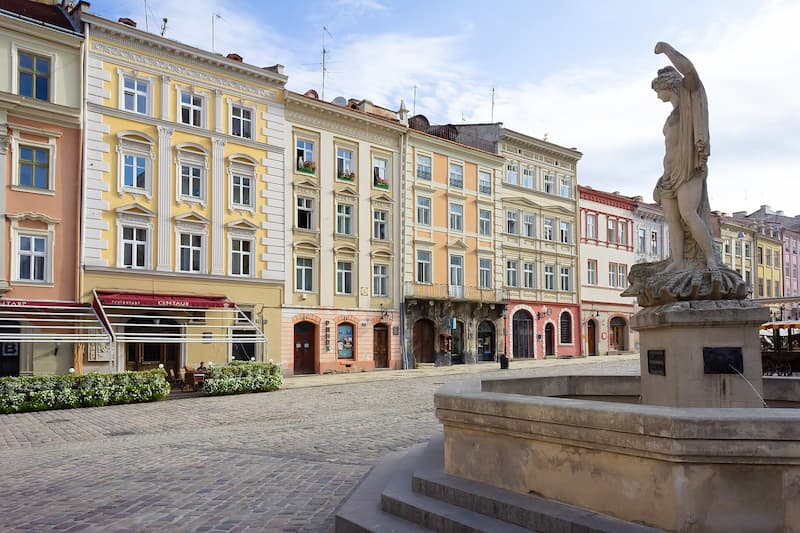
King Daniel of Galicia founded this grand medieval Ukrainian trade crossroads
The UNESCO World Heritage site titled “L’viv – the Ensemble of the Historic Centre” is located in western UKRAINE, serving as the historical capital of the Galicia region. Founded in the mid-13th century by King Daniel of Galicia, L’viv developed into a flourishing administrative, religious, and commercial crossroads along major European trade routes.
Spanning a protected core area of 120 hectares surrounded by a 3,000-hectare buffer zone, the property encompasses three primary historical sectors: the High Castle and Pidzamche (the oldest medieval core), the medieval walled city centered around Market Square (Ploshcha Rynok), and the Ensemble of St. George’s Cathedral (Sobor Svyatoho Yura) on St. George’s Hill. The intact medieval urban topography preserves over two thousand monuments spanning Gothic, Renaissance, Baroque, Neoclassical, and Art Nouveau styles. Prominent landmarks include the Latin Cathedral, the Armenian Cathedral, the Dormition Church complex with its Korniakt Tower, the Bernardine Monastery, and ornate Renaissance merchant burgher houses such as the Black House (Chorna Kamyanytsya).
Attraction
L’viv attracts cultural travelers, architectural enthusiasts, historians, and gastronomy lovers globally who come to explore one of Central and Eastern Europe’s most atmospheric and well-preserved historic cityscapes.
Visitors travel to wander along the cobblestone streets radiating from Market Square, climbing the clock tower of the Town Hall (Ratusha) for sweeping panoramic views over copper domes, church spires, and terracotta rooftops. Tourists explore distinct historical quarters that reflect centuries of multi-ethnic coexistence, admiring the Italian-style arcaded courtyard of the Korniakt Palace, the intricate stone carvings of the Boim Chapel, and the gilded Rococo facade of St. George’s Cathedral. Beyond monumental architecture, L’viv is renowned across Europe for its historic coffeehouse culture, artisanal chocolate workshops, vibrant classical music performances at the L’viv Theatre of Opera and Ballet, and atmospheric themed restaurants tucked into medieval cellars.


World Heritage
Inscribed on the UNESCO World Heritage List in 1998, L’viv – the Ensemble of the Historic Centre is recognized under Cultural Criteria (ii) and (v):
- Criterion (ii) – Synthesis of Architectural Traditions: In its urban fabric and architecture, L’viv is an outstanding example of the fusion of Eastern European architectural and artistic traditions with influences brought from Italy and Germany. Master builders from across Europe worked alongside local artisans to create a distinctive regional architectural vernacular.
- Criterion (v) – Multi-Ethnic Traditional Human Settlement: L’viv’s pivotal political and commercial role attracted diverse ethnic groups with distinct cultural and religious traditions—including Ukrainians, Poles, Armenians, Jews, and Germans. These communities established separate yet interdependent quarters within the fortified city, leaving tangible physical evidence of peaceful coexistence in the modern townscape.
Gateway
Travelers planning a visit to L’viv can access the property via practical western Ukrainian gateway locations within a two-hour travel radius, each featuring public IATA-listed airports searchable directly on IATA’s official directory, complete lodging options, transit links, and tour operator services:
- L’viv (Primary Local Gateway / Nearest Airport Hub):
- Airport: L’viv Danylo Halytskyi International Airport (IATA Code: LWO; ICAO Code: UKLL).
- Infrastructure and Distance: Located approximately 6 to 7 kilometers southwest of the Historic Centre. LWO is a major public international airport listed in IATA’s official directory. As the immediate host city, L’viv offers extensive luxury hotels, historic boutique properties, hostels, trolleybus and taxi links reaching Market Square in under 20 minutes, and licensed walking tour guides.
- Ternopil (Primary Eastern Regional Gateway):
- Airport: Ternopil International Airport (IATA Code: TNL; ICAO Code: UKLT).
- Infrastructure and Distance: Located approximately 130 kilometers east of L’viv. TNL is a public airfield searchable in IATA’s official directory. As a major regional hub in western Ukraine, Ternopil provides comfortable hotel accommodations, car rental services, intercity buses, and direct regional rail connections (Ukrzaliznytsia) reaching L’viv Main Railway Station in 1.5 to 2 hours.
- Ivano-Frankivsk (Primary Southern Regional Gateway):
- Airport: Ivano-Frankivsk International Airport (IATA Code: IFO; ICAO Code: UKLI).
- Infrastructure and Distance: Located roughly 130 to 135 kilometers southeast of L’viv. IFO is an active public airport listed in IATA’s directory. As the gateway to the Carpathian region, Ivano-Frankivsk provides full hotel accommodations, rental car agencies, express buses, and direct regional rail services reaching L’viv in approximately 2 hours.
When
The ideal windows to visit L’viv are during Late Spring (May to June) and Early Autumn (September to October):
- Late Spring (May to June): Highly recommended for comfortable sightseeing. Daytime temperatures are mild and pleasant (18°C to 24°C / 64°F to 75°F), city parks bloom, and outdoor café terraces fill Market Square.
- Early Autumn (September to October): Delivers crisp air, golden foliage across High Castle Park, mild temperatures (14°C to 20°C / 57°F to 68°F), and vibrant cultural festivals including the L’viv Coffee Festival and Book Forum.
- Winter (December to February): Cold (-5°C to 1°C / 23°F to 34°F) with frequent snowfall, creating a festive atmosphere around Christmas markets and cozy indoor coffeehouses.
Consideration
- Uneven Cobblestones and Tram Tracks: L’viv’s Old Town features historic cobblestone streets and active streetcar rails. Wearing sturdy, flat walking shoes is essential, and pedestrians must watch carefully for passing trams and uneven stone curbs.
- Climbing High Castle Hill: Reaching the summit viewpoint of Vysokyi Zamok (High Castle) involves walking up steep wooded pathways and spiral metal stairs.
- Sacred Site Etiquette: L’viv is home to active Roman Catholic, Greek Catholic, Orthodox, and Armenian churches. Visitors should dress modestly, maintain quiet respect, and avoid disrupting liturgical services.
- Language and Signage: Ukrainian is the official language. While English is widely spoken by younger residents, hotel staff, and tour guides in the city center, downloading an offline Ukrainian translation app is helpful for local transit.
- Currency and Payments: The official currency is the Ukrainian Hryvnia (UAH). Contactless credit and debit cards are accepted across hotels, restaurants, and museums, though carrying small UAH banknotes is useful for trams, public restrooms, and outdoor markets.


Resources
- UNESCO World Heritage Centre: Official inscription portal detailing site boundaries, criteria evaluations, and state of conservation reports.
- L’viv Travel Official Portal: Official municipal tourism portal offering walking routes, monument guides, museum schedules, and cultural event calendars. (Website:
lviv.travel) - L’viv City Council Official Website: Official administrative portal providing civic announcements, heritage preservation updates, and municipal transport information.
- Ukraine.ua (Official National Portal): Official national destination website showcasing cultural itineraries, regional travel guides, and architectural features across Ukraine.
- Trip.com: Global online travel marketplace offering bookings for private walking tours, underground cellar excursions, and guided heritage experiences in L’viv.
Featured Image
The Market Square, L’viv (Petar Milosevic, Wikipedia/CC BY-SA 3.0).

News Feed
Advertisement


Comments:
Leave a Reply