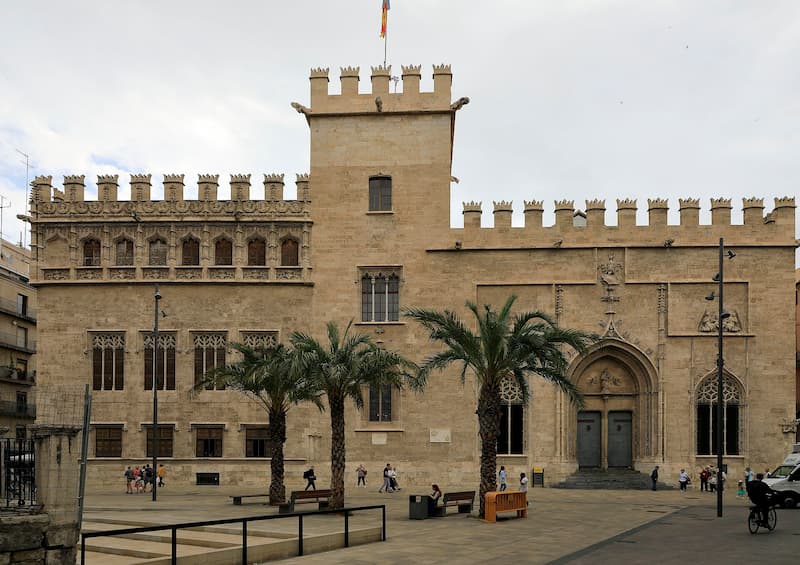
Secular Gothic vaulting crowns Valencia’s historic silk trading hall
“La Lonja de la Seda de Valencia” (Valencian: Llotja de la Seda, English: “Silk Exchange”) is a late Valencian Gothic secular monument situated in the historic center (Ciutat Vella) of Valencia, SPAIN, directly opposite the Central Market on Plaza del Mercado. Constructed primarily between 1482 and 1533 under master stonemason Pere Compte alongside Joan Ivarra, Joan Corbera, and Domingo de Urtiaga, the rectangular complex covers roughly 2,000 square meters and reflects Valencia’s commercial Golden Age as a Mediterranean mercantile powerhouse.
The ensemble comprises four main sections: the grand Sala de Contratación (Trading Hall), a central tower housing a ground-floor chapel and upper-level debtors’ prison, the Consulado del Mar (Maritime Consulate Pavilion) featuring the gilded coffered ceiling of the Cambra Daurada, and the fragrant Patio de los Naranjos (Orange Tree Courtyard).
Attraction
La Lonja de la Seda attracts architecture admirers, historians, photographers, and cultural travelers globally as one of Europe’s finest surviving examples of secular late Gothic civil architecture.
Visitors step inside the soaring Sala de Contratación, where eight slender helical stone columns nearly 16 meters tall twist upward like stone palm trees into ribbed cross-vaults above a polychrome Alcublas marble floor. Travelers also read the Latin inscription encircling the upper walls exhorting merchants to trade honestly without usury, inspect whimsical exterior gargoyles and carved Gothic window tracery, admire the richly gilded wooden ceiling of the Maritime Consulate, and relax beside the fountain and bitter-orange trees of the courtyard.

World Heritage
Inscribed on the UNESCO World Heritage List in 1996 under Criteria (i) and (iv), La Lonja de la Seda is celebrated for its architectural virtuosity and historical testimony to Mediterranean commerce:
- Masterpiece of Secular Late Gothic Architecture (Criterion i): Its soaring twisted columns, self-supporting spiral stone staircase without a central axis, and Flamboyant Gothic ornamentation represent the pinnacle of late 15th-century European construction engineering.
- Monument to Mercantile Power and Ethics (Criterion iv): Built specifically to house the silk trade, the municipal bank (Taula de Canvis), and Spain’s first maritime merchant tribunal, the complex vividly illustrates the wealth, civic autonomy, and commercial ethics of a great Mediterranean port city.
Gateway
Because La Lonja de la Seda stands in the heart of central Valencia, travelers enter directly via Valencia’s metropolitan airport or two proximate eastern Spanish aviation hubs—each verified in IATA’s official directory and offering overnight lodging, rail or highway links, and licensed guides:
- Valencia / Manises (Primary Local & International Gateway / Nearest Airport Hub):
- Airport: Valencia Airport (IATA Code: VLC; ICAO Code: LEVC).
- Infrastructure and Distance: Located at Manises west of central Valencia, roughly 8 to 10 kilometers (about 20 minutes via Metrovalencia Lines 3 or 5 to Xàtiva or Colón stations followed by a 10-minute walk, or 20 to 30 minutes by road) west of La Lonja de la Seda. VLC is an active public international airport indexed in IATA’s directory, backed by extensive city hotels, car rentals, metro and bus networks, and accredited local guides.
- Castellón de la Plana / Vilanova d’Alcolea (Primary Northern Valencian Community Gateway):
- Airport: Castellón–Costa Azahar Airport (IATA Code: CDT; ICAO Code: LECH).
- Infrastructure and Distance: Located north of Castellón de la Plana, roughly 95 to 105 kilometers (about 1.15 to 1.3 hours by road via the AP-7 motorway, or roughly 1.5 hours combining airport transfer and Renfe regional rail to Valencia Nord) north of central Valencia. CDT is an active public airport listed in IATA’s directory, supported by coastal and city hotels, car rentals, and rail links.
- Alicante / Elche (Primary Southern Valencian Community International Gateway):
- Airport: Alicante–Elche Miguel Hernández Airport (IATA Code: ALC; ICAO Code: LEAL).
- Infrastructure and Distance: Located at El Altet south of Alicante, roughly 175 to 190 kilometers (about 1.75 to 2 hours by road via the A-7/AP-7 motorways, or roughly 2 to 2.25 hours via airport bus to Alicante Terminal and Renfe Euromed/Intercity train to Valencia Nord) south of La Lonja. ALC is a major active public international airport indexed in IATA’s directory, offering abundant hotels, car rentals, rail links, and regional excursion operators.
When
The ideal window to visit La Lonja de la Seda is during Spring (March to May) and Autumn (September to November):
- Spring and Autumn (March to May & September to November): Recommended for pleasant city walking temperatures of 18°C to 25°C (64°F to 77°F), soft sunlight streaming through the high Gothic windows, and lively cultural energy around Valencia’s March Fallas festival.
- Summer and Winter (June to August & December to February): Summer brings hot Mediterranean weather often above 30°C (86°F)—making the cool stone interior a welcome midday refuge—while winter offers mild daytime temperatures and uncrowded sightseeing.
Consideration
- Check Opening Hours and Sunday Free Admission: La Lonja typically opens Monday through Saturday from 10:00 AM to 7:00 PM, and Sundays and public holidays from 10:00 AM to 2:00 PM. Standard admission is €2 (or free on Sundays, public holidays, and with the Valencia Tourist Card), with audio guides available on-site for a small fee.
- Note Restricted Access to the Spiral Tower: While the Trading Hall, Maritime Consulate, chapel, and courtyard are open daily, Pere Compte’s central spiral tower staircase opens only on select special occasions or guided visits.
- Combine with Neighboring Old Town Landmarks: Because the monument sits directly opposite the Mercado Central and steps from Santos Juanes Church and Valencia Cathedral, plan a morning walk combining all three before the Central Market closes around 3:00 PM.
- Currency and Dress: Spain uses the Euro (EUR); modest, comfortable attire and grippy shoes are recommended for polished stone and marble floors.

Resources
- UNESCO World Heritage Centre (La Lonja de la Seda de Valencia): Official UNESCO portal detailing Outstanding Universal Value, inscription criteria, historical synthesis, and maps.
- Visit Valencia Official Portal (The Silk Exchange): Municipal tourism authority guide providing current opening hours, ticket prices, accessibility details, and architectural highlights.
- Spain Official Tourism Portal (Valencia Silk Exchange): National destination page summarizing monument history, visitor schedules, and nearby cultural routes.
- Valencia City Council Cultural Heritage Portal (Ajuntament de València): Official municipal administration resource detailing public monument regulations and local cultural programming.
- GetYourGuide: Online travel booking marketplace offering bookings for Valencia Old Town walking tours, fast-track La Lonja guided visits, and city passes.


Comments:
Leave a Reply