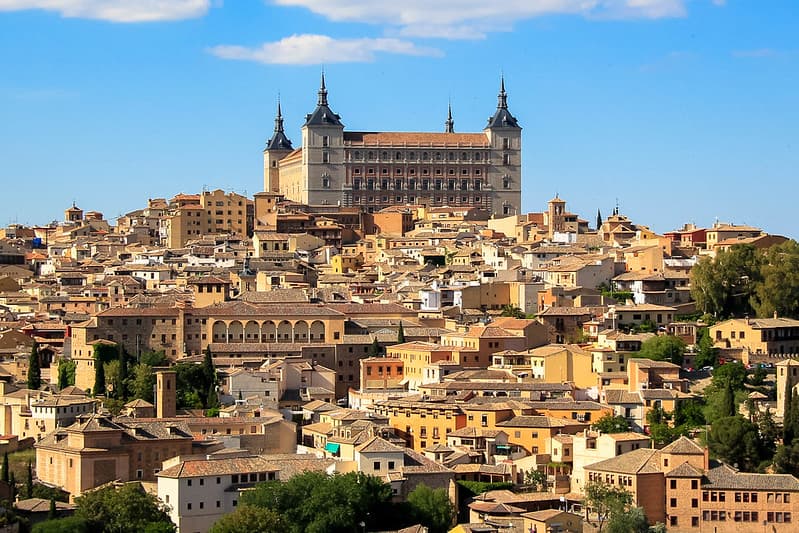
The Historic City of Toledo, situated in central SPAIN‘s Castilla-La Mancha region, sits dramatically atop a rocky granite promontory surrounded on three sides by a deep meander of the Tagus River (Río Tajo). Located roughly 70 kilometers south-southwest of Madrid, Toledo is widely celebrated as the “City of the Three Cultures” (La Ciudad de las Tres Culturas), reflecting more than two millennia of continuous settlement and cultural synthesis among Christian, Islamic, and Jewish communities.
The site’s historic urban footprint is defined by a dense labyrinth of medieval cobblestone alleys, steep stone stairways, hidden courtyards, and ancient fortified walls punctuated by imposing gateways such as the Puerta de Bisagra and Puerta del Sol. Architectural landmarks dominating the skyline include the monumental Alcázar fortress perched at the city’s highest point, the imposing Toledo Cathedral (Catedral Primada de España)—a masterpiece of High Gothic design—and surviving Mudéjar mosques and synagogues, such as the Mosque of Cristo de la Luz and the Synagogues of Santa María la Blanca and El Tránsito.
Attraction
Toledo draws travelers globally through its remarkable living history, artistic legacy, and romantic medieval ambiance. Walking through its ancient streets feels like stepping onto a living historical set, where centuries of architectural traditions blend seamlessly. Art enthusiasts worldwide flock to Toledo to experience the works of Doménikos Theotokópoulos, universally known as El Greco. The master painter lived and worked in Toledo during the late 16th and early 17th centuries, leaving behind world-renowned masterpieces such as The Burial of the Count of Orgaz inside the Church of Santo Tomé, alongside extensive collections housed in the El Greco Museum.
Additionally, Toledo captivates tourists with its famed traditional craft heritage, particularly intricate damascene steelwork—inlaying gold and silver thread into blackened steel—and its centuries-old reputation for legendary sword making. Visitors also enjoy dramatic panoramic viewpoints like the Mirador del Valle, vibrant traditional festivals such as the solemn Corpus Christi procession, and authentic regional gastronomy featuring hand-crafted marzipan (mazapán), stewed partridge, and aged Manchego cheeses.

World Heritage
In 1986, UNESCO inscribed the Historic City of Toledo on the World Heritage List under cultural criteria (i), (ii), (iii), and (iv).
- Unique Artistic Achievement (Criterion i): Toledo represents an extraordinary artistic achievement that maintains an uninterrupted succession of architectural masterpieces spanning Visigothic churches, Islamic mosques, Mudéjar synagogues, Gothic cathedrals, and Renaissance or Baroque palaces.
- Widespread Cultural Influence (Criterion ii): The city exerted profound political and artistic influence both during the Visigothic era, when it served as the royal capital of Hispania, and during the Renaissance, when it became a central artistic hub of the Spanish Empire.
- Exceptional Civilizational Testimony (Criterion iii): Toledo bears exceptional physical testimony to past civilizations. It preserves evidence of the unique coexistence (convivencia) and intellectual exchange among Judaism, Christianity, and Islam, best embodied by the 12th- and 13th-century Toledo School of Translators that transmitted classic philosophy and science to Western Europe.
- Outstanding Architectural Ensemble (Criterion iv): The city retains outstanding 15th- and 16th-century architectural ensembles that illustrate critical historical developments in Iberian history, such as the Monastery of San Juan de los Reyes and the Hospital de Tavera.
Gateway
The primary gateway city serving Toledo within Spain is Madrid. Situated approximately 70 kilometers north of Toledo, Spain’s capital serves as the primary international transport, logistics, and accommodation hub for visitors traveling to the historic city.
Madrid is served directly by Adolfo Suárez Madrid–Barajas Airport (IATA Code: MAD), Spain’s largest international aviation facility. Barajas operates extensive commercial direct flights connecting Spain with major global hubs across Europe, North America, Latin America, Asia, and the Middle East. From central Madrid, travelers reach Toledo swiftly in just 33 minutes via Renfe Avant high-speed trains departing from Madrid Atocha Station, or in roughly 50 minutes via direct express buses departing from Plaza Elíptica transit hub. As a major world capital, Madrid provides abundant lodging options across all categories, including luxury five-star hotels, historic boutique guesthouses, serviced apartments, and budget hostels.
When
The best time to visit Toledo is during Spring (April to June) and Autumn (September to October).
- Spring (April to June): Offers bright, sunny days with comfortable temperatures averaging 18°C to 24°C (64°F to 75°F). Spring blooms beautify the surrounding Tagus River valley, providing ideal conditions for outdoor walking tours.
- Autumn (September to October): Delivers pleasant temperatures, warm afternoon sun, and lighter tourist crowds than mid-summer, making sightseeing comfortable.
- Summer (July to August): Extremely hot, with mid-afternoon temperatures regularly exceeding 38°C (100°F), making walking along unshaded stone streets challenging.
- Winter (November to February): Cold and quiet, with nighttime temperatures occasionally dropping near freezing, though lower tourist numbers allow peaceful exploration.
Considerations
- Footwear and Terrain: Toledo is constructed on a steep, rugged hill characterized by cobblestone streets, polished flagstones, and frequent staircases. Wearing sturdy, cushioned walking shoes with good traction is essential.
- Day-Trippers vs. Overnight Stays: Thousands of day-trippers arrive from Madrid between 10:00 AM and 5:00 PM, causing temporary congestion at major sites. Staying overnight allows visitors to experience quiet evening streets and floodlit monuments after day crowds depart.
- Accessibility Challenges: The steep topography and historic paving present mobility barriers for travelers with wheelchairs or strollers. Utilizing public escalators (such as the Safont escalators) helps ease ascent into the upper city.
- Ticketing and Site Access: Major attractions like the Cathedral require paid entry. Purchasing a combined tourist bracelet (Pulsera Turística) provides access to seven key monuments at a discounted rate.

Resources
- UNESCO World Heritage Centre: Official UNESCO portal containing official inscription records, technical criteria, and conservation reports.
- Spain.info: The official national tourism website of Spain providing regional travel guides, transportation options, and cultural itineraries.
- Turismo de Toledo: Official municipal tourism board site providing local event schedules, museum opening hours, and official walking routes.
- Turismo Castilla-La Mancha: Official regional tourism platform detailing historic sights, nature reserves, and culinary routes across the region.
- Trip.com: Major global travel review and booking platform featuring community reviews, hotel reservations, and guided excursion bookings.
Featured Image
Toledo, with Alcazar fortress at the top (Mussi Katz, Flickr/PDM 1.0).
News Feed
Advertisement


Comments:
Leave a Reply