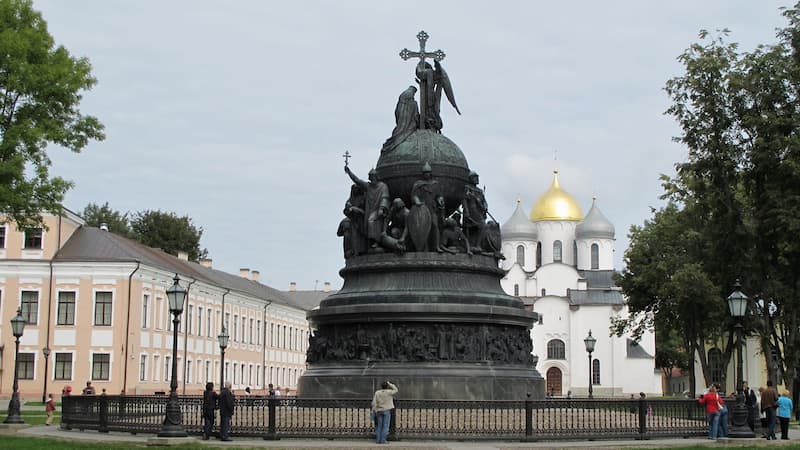
Visit Veliky Novgorod: A Journey Through History
The UNESCO World Heritage property “Historic Monuments of Novgorod and Surroundings” encompasses an exceptional collection of medieval architectural monuments, religious complexes, and archaeological sites in and around Veliky Novgorod, situated along the Volkhov River in northwestern RUSSIA. Founded in the 9th century AD, Novgorod was the first capital of ancient Rus’ and later became the capital of the powerful Novgorod Republic—a prosperous medieval merchant democracy that operated outside traditional feudal monarchies.
The World Heritage property comprises dozens of individual structures scattered across the city center and the surrounding rural landscapes:
- Novgorod Kremlin (Detinets): The administrative and spiritual heart of the city, enclosed by massive 15th-century red-brick defensive walls and towers along the Volkhov River.
- Saint Sophia Cathedral: Located within the Kremlin, constructed between 1045 and 1050 AD. It is the oldest surviving church building in Russia, renowned for its golden helmet-shaped dome, 12th-century bronze Magdeburg Gates, and ancient frescoes.
- Yuryev Monastery and Saint George’s Cathedral: One of Russia’s oldest monastic houses, situated south of the city near Lake Ilmen, featuring monumental 12th-century Romanesque-influenced timber-and-stone architecture.
- Yaroslav’s Court and the Ancient Market: A historic quarter on the Commercial Side of the river containing a dense cluster of 12th- to 16th-century churches, including the Cathedral of St. Nicholas.
- Church of the Transfiguration of Our Savior on Ilina Street: Globally celebrated for housing the only surviving, fully authentic interior frescoes painted by the Byzantine master Theophanes the Greek in 1378.
- Nereditsa and Kovalevo Churches: Celebrated medieval churches located in surrounding rural meadows, preserving invaluable examples of early Novgorodian architectural design.
Attraction
Veliky Novgorod attracts global travelers because it serves as the physical birthplace of the Russian state and offers an authentic, uncrowded window into medieval East Slavic culture, orthodox spirituality, and art. Unlike cities heavily altered by modern industrialization, Veliky Novgorod retains a quiet, historical scale where ancient white-stone churches capped with onion domes rise naturally along peaceful riverbanks.
Visitors travel from around the world to marvel at the sheer age of Saint Sophia Cathedral, view original 14th-century frescoes by Theophanes the Greek, and inspect rare archaeological discoveries. Novgorod’s waterlogged soil famously preserved thousands of birch bark manuscripts (gramoty)—everyday written notes, letters, and business records crafted by ordinary medieval citizens, revealing an unprecedented level of historical literacy. Furthermore, the Vitoslavlitsy Museum of Wooden Architecture, located near Yuryev Monastery, allows tourists to wander among historic timber churches, windmills, and peasant homesteads reassembled in a scenic open-air environment.

World Heritage
In 1992, UNESCO inscribed the Historic Monuments of Novgorod and Surroundings on the World Heritage List under cultural criteria (ii), (iv), and (vi).
- Interchange of Architectural and Artistic Values (Criterion ii): Novgorod served as a supreme center of East Slavic cultural expression. Its architects and icon painters synthesized Byzantine traditions with indigenous Northern European techniques, creating a distinct Novgorodian school of architecture and painting that profoundly influenced Russian art for centuries.
- Outstanding Architectural Ensemble (Criterion iv): The property forms an outstanding ensemble illustrating the evolution of Russian architectural heritage from the 11th through the 17th centuries, preserving rare stone fortresses, early monastic complexes, and parish churches.
- Direct Association with Historic Events (Criterion vi): The site is directly linked to foundational events in East European history—the establishment of the Rurik Dynasty in 862 AD, the emergence of medieval Russian literacy, and the creation of the Novgorod Republic, one of Europe’s earliest democratic institutions.
Gateway
The primary gateway city serving the site is Saint Petersburg, the federal city and major cultural hub of northwestern Russia. Saint Petersburg is located approximately 180 kilometers northwest of Veliky Novgorod. Travelers reach Veliky Novgorod from Saint Petersburg quickly and comfortably via direct high-speed Lastochka express trains departing from Moskovsky Railway Station, completing the journey in roughly 2 hours and 50 minutes.
Saint Petersburg is served by Pulkovo Airport (IATA Code: LED; ICAO Code: ULLI), a major international aviation facility handling extensive regional and domestic air traffic.
Saint Petersburg and Veliky Novgorod both offer abundant overnight lodging options across all categories, including luxury historic hotels, international chain properties, mid-range business hotels, traditional guesthouses, and self-catering apartments.
When
The best time to visit Veliky Novgorod is during Late Spring to Early Autumn (May to September).
- Summer (June to August): Brings pleasant, mild weather with average temperatures ranging from 17°C to 24°C (63°F to 75°F). This period coincides with the famous “White Nights,” when long evening twilight extends outdoor sightseeing along the Volkhov River.
- Late Spring and Early Autumn (May & September): Offer comfortable walking temperatures (12°C to 18°C / 54°F to 64°F), vivid spring greenery or golden fall foliage framing white-stone churches, and lower tourist numbers.
- Winter (December to February): Winters are cold and snowy, with temperatures averaging –5°C to –12°C (23°F to 10°F). While winter travel requires heavy clothing, the snow-covered Kremlin walls and frozen river present a picturesque, traditional winter landscape.
Considerations
- Dispersed Site Locations: While the Kremlin and Yaroslav’s Court sit within easy walking distance in the city center, outlying monuments—such as Yuryev Monastery, Vitoslavlitsy, and the Church of Nereditsa—are located several kilometers outside town. Renting a bicycle, using local city buses, or booking short taxi rides is necessary to access rural sites.
- Fresco Preservation Restrictions: Delicate medieval wall paintings, particularly those at the Church of the Transfiguration on Ilina Street, are strictly protected. Access to indoor fresco viewings may be restricted or suspended during rainy or high-humidity weather to prevent moisture damage to fragile plaster.
- Active Religious Sites: Many historic cathedrals and monastic churches are active places of worship for the Russian Orthodox Church. Visitors should dress modestly (covering shoulders and knees; women are often expected to wear headscarves inside active sanctuaries) and respect ongoing religious services.
- Train Schedule Planning: Express Lastochka trains between Saint Petersburg and Veliky Novgorod operate on specific daily schedules. Booking train tickets in advance ensures preferred departure times.

Resources
- UNESCO World Heritage Centre: Official UNESCO web portal containing technical inscription records, site criteria, and conservation documentation.
- Novgorod Museum-Reserve Official Website: Official authority governing the Kremlin, museum exhibits, and historical monuments.
- Visit Novgorod Official Tourism Portal: Official regional tourism website offering city guides, event calendars, and transit details.
- Visit Russia (National Portal): National tourism board portal offering travel guides, visa advice, and cultural itineraries.
- Trip.com: Major global travel platform providing user reviews, travel forums, hotel choices, and tour bookings.


.jpg)
Comments:
Leave a Reply