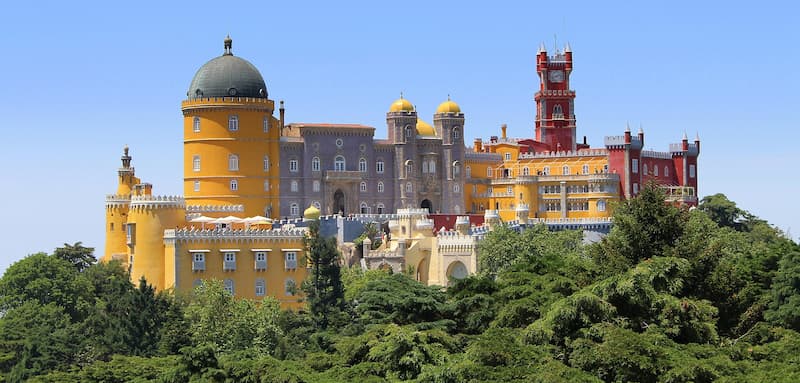
A lush Atlantic enclave blending medieval walls with Romantic whimsy
The UNESCO World Heritage site titled “Cultural Landscape of Sintra” (Paisagem Cultural de Sintra) encompasses a mountainous, forested enclave located on the Serra de Sintra coastal range in western PORTUGAL, roughly 25 kilometers west of Lisbon. Covering over 960 hectares, the site represents a pioneering 19th-century European park and architectural landscape where Romantic movement architecture harmoniously merges with exotic botanical gardens, rugged granite peaks, and dense temperate pine forests overlooking the Atlantic Ocean.
The landscape is anchored by a remarkable collection of royal palaces, aristocratic villas (quintas), and historic monastic ruins. Prominent monuments include the National Palace of Pena (Palácio Nacional da Pena), a fairytale-like eclectic castle combining Neo-Gothic, Neo-Manueline, Neo-Islamic, and Neo-Renaissance styles perched atop the highest peak; the medieval National Palace of Sintra (Palácio Nacional de Sintra) with its iconic twin conical chimneys; the enigmatic Quinta da Regaleira featuring its famous subterranean Initiation Well; the romantic Monserrate Palace with its botanical gardens; and the ancient 8th-century Moorish Castle (Castelo dos Mouros) straddling a rocky ridge.
Attraction
The Cultural Landscape of Sintra draws millions of global travelers, architects, historians, and nature lovers seeking an enchanting retreat filled with romantic grandeur and botanical splendor. The town’s cool, misty microclimate and lush hillside settings create a fairytale environment that inspired famous writers and poets, including Lord Byron, who famously declared Sintra a “glorious Eden.”
Visitors flock to Sintra to wander through the brightly painted towers and terraces of Pena Palace, descend the winding spiral staircase inside Quinta da Regaleira’s underground Initiation Well, and hike along medieval stone battlements at the Moorish Castle for sweeping views toward Cape Roca (Cabo da Roca), the westernmost point of continental Europe. Travelers also explore the historic town center (Sintra Vila), enjoying traditional Portuguese pastries—such as pillow-shaped travesseiros and sweet cheese tarts (queijadas)—while discovering hidden garden estates, fern-filled ravines, and scenic hiking trails.

World Heritage
Inscribed on the UNESCO World Heritage List in 1995 under Cultural Criteria (ii), (iv), and (v), Sintra was the first location in Europe inscribed specifically as a cultural landscape:
- Criterion (ii) – Masterpiece of Romantic Influence: Sintra represents a major turning point in European landscape planning. King Ferdinand II’s creation of Pena Palace and its surrounding parkland served as a pioneering prototype for Romanticism across 19th-century Europe, combining eclectic historicist architecture with exotic botanical acclimatization gardens.
- Criterion (iv) – Outstanding Architectural Ensemble: The property showcases an extraordinary collection of royal and aristocratic residences that illustrate the evolution of European landscape architecture and romanticism, seamlessly integrating Gothic, Moorish, Renaissance, and exotic styles.
- Criterion (v) – Harmonious Land-Use Harmony: Sintra displays an exceptional interaction between human creative landscape design and a sensitive natural environment, where indigenous flora and exotic botanical species harmonize with the dramatic granite topography of the Serra de Sintra.
Gateway
Travelers planning a visit to the Cultural Landscape of Sintra can enter through two practical Portuguese gateway locations featuring public IATA-listed commercial airports, extensive overnight accommodation options, public transport links, and local tour guide services:
- Lisbon (Primary Regional Gateway):
- Airport: Humberto Delgado Airport (IATA Code: LIS; ICAO Code: LPPT).
- Infrastructure and Distance: Located approximately 30 kilometers east of Sintra. As Portugal’s primary international gateway, LIS operates direct global flights from North America, Europe, South America, and Africa. Lisbon offers a complete range of accommodations, from five-star luxury hotels to boutique guesthouses. Excellent public transport connects Lisbon directly to Sintra: frequent Comboios de Portugal (CP) suburban trains run continuously from Rossio Station and Oriente Station directly to Sintra Railway Station in 40 minutes. Rental cars, private charters, and guided tour buses operate daily.
- Cascais (Secondary Local Gateway):
- Airport: Cascais Airport (IATA Code: CAT; ICAO Code: LPCS).
- Infrastructure and Distance: Situated 12 kilometers south of Sintra. CAT operates general aviation, regional, and seasonal commercial flights. Cascais provides seaside resort lodging, rental cars, and direct municipal bus connections (Carris Metropolitana) running north into Sintra in 25 minutes.
When
The ideal windows to visit the Cultural Landscape of Sintra are during Spring (April to June) and Autumn (September to October), offering mild temperatures and manageable crowds:
- Spring (April to June): Features comfortable temperatures (15°C to 22°C / 59°F to 72°F), lush green parklands, and blooming flowers across Monserrate and Pena gardens.
- Autumn (September to October): Delivers clear, pleasant days (16°C to 23°C / 61°F to 73°F) with lower tourist density than summer, ideal for mountain hiking and palace exploration.
- Summer (July to August): Warm (22°C to 28°C / 72°F to 82°F) with high tourist traffic, long entry queues, and traffic congestion along narrow palace roads.
- Winter (November to March): Mild but cool and damp (9°C to 15°C / 48°F to 59°F) with frequent mountain fog, rain showers, and shorter daylight hours.
Consideration
- Advance Timed-Entry Tickets Required: Major attractions, especially Pena Palace and Quinta da Regaleira, enforce strict timed-entry slot systems. Booking entry tickets online weeks in advance is mandatory to avoid being turned away at entrance gates.
- Avoid Driving in Historic Center: Road access to the Serra de Sintra and Pena Palace is restricted for private vehicles. Driving causes extreme traffic delays and parking shortages. Visitors should take the train to Sintra and use local Scotturb buses (like Route 434) or ride-hailing services.
- Steep Terrain and Footwear: Navigating palace grounds, cobble streets, and dirt park trails requires significant uphill walking. Wearing sturdy, comfortable walking shoes with non-slip soles is essential.
- Microclimates and Layers: The Serra de Sintra mountain range creates cool, damp, and windy conditions even when nearby Lisbon is sunny and warm; bringing a warm outer jacket or windbreaker is strongly recommended.
- Currency and Financial Services: Transactions use the Euro (EUR). Credit cards are universally accepted at ticket counters and restaurants, but cash is helpful for small souvenir stalls and cafes.

Resources
- UNESCO World Heritage Centre: Official inscription portal detailing site boundaries, criteria evaluations, and state of conservation reports.
- Parques de Sintra Official Portal: Official management portal for purchasing timed-entry tickets and checking opening hours for Pena Palace, Moorish Castle, and Monserrate.
- Visit Portugal Official Tourism Portal: Official national tourism board website providing travel planning tools, transit advice, and regional guides.
- Visit Lisboa Official Portal: Official regional tourism website offering Lisbon-to-Sintra transit routes, itineraries, and accommodation directories.
- GetYourGuide: Popular online travel marketplace offering bookings for guided day trips, skip-the-line palace entry packages, and transfer services from Lisbon to Sintra.


Comments:
6 responses to “Cultural Landscape of Sintra”
-
We flag off our city tour by nipping up to the Moorish-meets-Manueline-style Sintra National Palace, its twin chimneys scraping the sky. Goggle-eyed, we tour through the palace’s Arabesque courtyards admiring its elegant courtrooms inlaid with beautiful 15th- and 16th-century ceramic tiles. The ceilings – displaying paintings of gold-collared swans, magpies, court scenes, gossipy ladies – are breathtaking in detail.
-
The Pena Palace isn’t quite as colourful inside (not that it matters) but is still pretty special! (What did surprise me though was how small some of the rooms in here were – I just always assumed they would as big as the palace looked on the outside).
-
I don’t know about you, but I love myself a good ceiling. The inside of Pena Palace is just breathtaking in every way possible. From floor to ceiling, everything is hand painted, hand carved, and every room is completely different from the rest. Different colours in every room! Every nook and cranny has a change in decor. An absolute stunner and probably the worst place for a minimalist to venture to.
-
The Park and Palace of Pena make up the most important part of Sintra’s cultural landscape. Arriving to this architectural marvel, it’s easy to understand why. The brightly colored palace is a balance of nature meets 19th century Portuguese Romanticism. In a word, stunning! We spent the rest of the afternoon discovering the elaborate interior while marveling at the exterior facades. What an extraordinary work of art!
-
Whether you visit in rain or shine, Pena Palace and Sintra are must-sees during a trip to Lisbon.
-
Sintra makes for a great day trip from Lisbon. After a business conference, I am glad I took out time to see both the colourful Pena Palace and walk up the Moorish castle. I hadn’t known about the Quinta da Regaleira back then.


Leave a Reply