Centuries of royal salt mining transformed into underground sacred art
The UNESCO World Heritage site titled “Wieliczka and Bochnia Royal Salt Mines” (Kopalnie Soli w Wieliczce i Bochni) is a monumental underground industrial complex located in the Lesser Poland (Małopolska) region of southern POLAND, situated beneath the historic towns of Wieliczka and Bochnia. Representing over seven centuries of continuous rock salt extraction from the 13th century until the late 20th century, the property encompasses two expansive subterranean mining systems alongside the surface-level Wieliczka Saltworks Castle (Zamek Żupny), which historically served as the administrative headquarters for the royal mining enterprise.
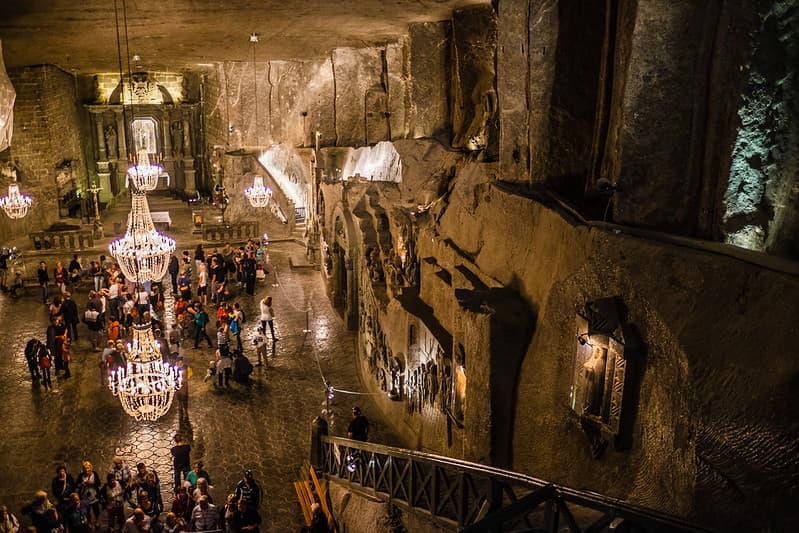
The subterranean network spans hundreds of kilometers of excavated galleries, vertical shafts, and vast carved chambers reaching depths down to 327 meters. Extracted entirely by generations of miners, these rock salt caverns contain a preserved array of historic timber support structures, brine lakes, and early mechanical hoisting machinery. Beyond the technical infrastructure, the mines feature dozens of underground chapels and sanctuaries meticulously carved out of natural salt rock. The most prominent is the Chapel of Saint Kinga (Kaplica Świętej Kingi) in Wieliczka, a subterranean cathedral measuring over 54 meters long, illuminated by salt-crystal chandeliers and decorated with intricate altarpieces and biblical bas-reliefs.
Attraction
The Wieliczka and Bochnia Royal Salt Mines attract naturalists, historians, underground adventurers, and cultural travelers globally. Visitors travel to experience an extraordinary subterranean world where industrial mining engineering transforms into sacred art and cultural heritage.
Tourists descend down timber staircases to walk through illuminated salt galleries, explore underground salt-water lakes, and marvel at life-sized statues of historical figures—such as Nicolaus Copernicus and King Casimir III the Great—carved directly out of salt blocks. The Chapel of Saint Kinga hosts subterranean classical music concerts and religious services. In Bochnia, visitors can ride an underground electric train, slide down wooden mining chutes, and navigate salt chambers via boat trips across subterranean brine lakes. Additionally, both mines operate underground health sanatoriums, utilizing the microclimate of the salt chambers—rich in microelements and free of allergens—for specialized respiratory therapies.

(Kj, Wikimedia/CC BY-SA 4.0).
World Heritage
Inscribed on the World Heritage List in 1978 (Wieliczka) and expanded in 2013 to include Bochnia and the Saltworks Castle under Cultural Criterion (iv), the site is recognized for its technical, administrative, and artistic significance:
- Criterion (iv) – Outstanding Industrial Ensemble: The serial property represents an exceptional industrial establishment illustrating the major historical stages of mining technology development in Europe from the Middle Ages to the modern era. The preserved subterranean chambers, technical equipment, timbering systems, and administrative Saltworks Castle provide outstanding physical testimony to a highly organized socio-technical system that funded the Polish royal state for centuries.
Gateway
Travelers planning an excursion to the Wieliczka and Bochnia Royal Salt Mines can access the site via two practical Polish gateway locations featuring public IATA-listed commercial airports, lodging, transport infrastructure, and tour services:
- Kraków (Primary Regional Gateway):
- Airport: Kraków John Paul II International Airport (IATA Code: KRK; ICAO Code: EPKK).
- Infrastructure and Distance: Situated approximately 25 kilometers northwest of Wieliczka and 50 kilometers west of Bochnia. As the capital of the Małopolska Voivodeship, Kraków features Poland’s second-busiest international airport with extensive global connections. The city provides comprehensive lodging choices ranging from luxury boutique hotels to budget hostels. Travelers reach Wieliczka in 20 minutes via direct Koleje Małopolskie commuter trains running from Kraków Main Station (Kraków Główny) directly to “Wieliczka Rynek-Kopalnia” station. Frequent regional trains and buses also connect Kraków directly to Bochnia. Certified local tour agencies offer daily guided transfer packages.
- Katowice (Secondary Regional Gateway):
- Airport: Katowice Wojciech Korfanty Airport (IATA Code: KTW; ICAO Code: EPKT).
- Infrastructure and Distance: Located roughly 110 kilometers northwest of Wieliczka. KTW operates international commercial flights and rental car facilities. Express buses and regional rail routes connect Katowice directly to Kraków and onward to the salt mines.
When
Because the underground environment maintains a constant climate year-round, the mines can be comfortably visited in any season:
- Subterranean Microclimate (Year-Round): Underground temperatures inside the mine galleries remain constant at approximately 14°C to 16°C (57°F to 61°F) regardless of external weather conditions.
- Late Spring to Early Autumn (May to September): The best season for combining underground mine visits with surface sightseeing in Kraków and Lesser Poland. Days are warm (18°C to 26°C / 64°F to 79°F), though surface tourist lines at ticket offices are longer.
- Winter Season (November to March): Outside temperatures drop (-3°C to 5°C / 27°F to 41°F), but underground conditions remain mild and unchanged. Winter offers significantly smaller tour groups and shorter wait times.
Consideration
- Physical Demands and Stair Climbing: Entering the mine involves descending over 800 steps (including an initial 380-step wooden shaft descent at Wieliczka). Returning to the surface is handled by industrial mining elevators. Comfortable, non-slip walking shoes are mandatory.
- Underground Temperature and Attire: Because galleries stay at 14°C to 16°C, carrying a warm jacket or fleece is necessary even during summer visits.
- Guided Tour Structure: Visitors cannot enter the mines independently. Exploration occurs exclusively in organized groups accompanied by licensed guide technicians. Standard tourist routes take roughly 2.5 to 3 hours to walk over a 3-kilometer path.
- Claustrophobia and Accessibility: While the chambers are vast and well-ventilated, individuals with severe claustrophobia should be aware of the deep underground environment. Wheelchair-accessible routes are available at specific shafts in Wieliczka but require mandatory advance reservations.
- Advance Ticketing: Due to high visitor volume, purchasing timed-entry tickets online in advance is essential to guarantee access and select preferred language tours.

Resources
- UNESCO World Heritage Centre: Official designation page providing administrative boundaries, criteria summaries, and conservation reports.
- Wieliczka Salt Mine Official Site: Official portal for tourist route booking, miner’s route tickets, and visitor guidelines.
- Bochnia Salt Mine Official Site: Official website featuring tour schedules, boat ride info, and overnight stay options in Bochnia.
- Poland Official Travel Portal: National tourist board site detailing regional transportation routes, lodging, and cultural itineraries across Małopolska.
- GetYourGuide: Travel marketplace providing booking options for guided tours, skip-the-line tickets, and transfer packages from Kraków to Wieliczka and Bochnia.
Featured Image
Wieliczka Royal Salt Mines (David Staedtler, Flickr/CC BY 2.0).
News Feed
Advertisement


Comments:
2 responses to “Wieliczka and Bochnia Royal Salt Mines”
-
The only warning about visiting the mines is that there are hundreds of steps to descend when entering the mine. The guide was very knowledgeable and the tour was taken at a good pace enabling those who wanted to take photographs time to do so. The chambers themselves were amazing and made the trip a must see. The work carried out by the miners is a sight to see. The highlight is the chamber containing the chapel which is still functioning to this day. The trip ends with a return to the surface on the minors elevator, this is cramped by only lasts for a short time.
-
I’ve seen some impressive sites before, but never heard raving reviews about a salt mine so I wasn’t sure what to expect. The size of the mine was inconceivable until I had actually descended the 378 steps to get to the first of nine levels, 64 metres deep. Our 3-kilometre tour took us deep into the mine, although there was so much more that we didn’t see. Highlights included licking many walls and seeing the salty Pope John Paul II statue in the mines cathedral. It wasn’t just a normal workplace. Horses lived down there transporting salt without ever seeing daylight, workers prayed in the many churches and artists worked to carve impressive sculptures and paintings. The mine goes down to 327m below ground level which is deeper than the height of the Eiffel Tower. Luckily there is an elevator up to ground level after eventually reaching 135m below ground level, otherwise I may have had to book into the Salt Mine hotel for the night.


.jpg)
Leave a Reply