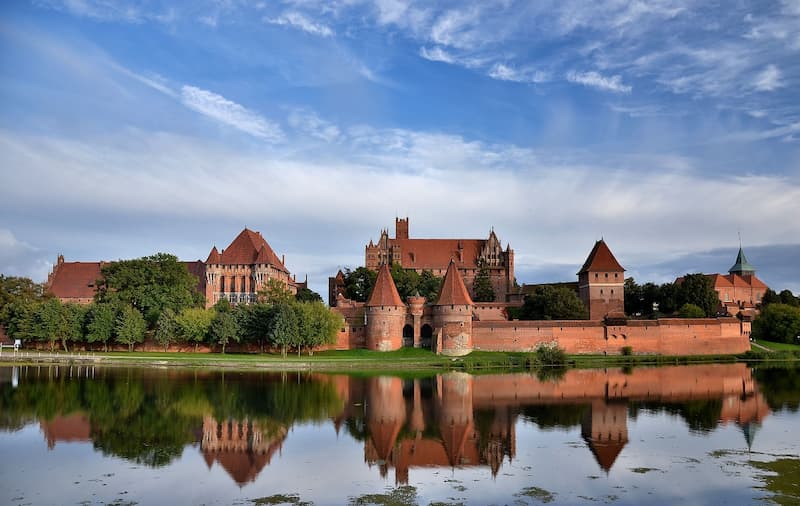
The Ultimate Monastic Citadel: Masterpiece of Medieval Brick Gothic Engineering
The UNESCO World Heritage site titled “Castle of the Teutonic Order in Malbork” (Zamek w Malborku) is located in northern POLAND in the town of Malbork, situated along the east bank of the Nogat River. Constructed by the Teutonic Knights beginning in the late 13th century, this medieval fortress served as the monastic headquarters for the Grand Master of the Teutonic Order following their relocation from Venice in 1309. Originally named Marienburg in honor of the Virgin Mary, patron saint of the order, the complex developed over centuries into the largest castle in the world measured by land surface area, covering approximately 18 hectares.
The fortress is a masterpiece of medieval Brick Gothic architecture (Backsteingotik). The complex is divided into three distinct defensive sectors surrounded by multi-tiered brick walls, dry moats, towers, and fortified gates. The High Castle (Zamek Wysoki) forms the central monastic core, featuring a four-sided courtyard, a high tower, and the Church of Saint Mary. The Middle Castle (Zamek Średni) encompasses the Grand Master’s Palace, magnificent vaulted reception halls such as the Grand Refectory, and administrative quarters. The Lower Castle (Zamek Niski) houses outer bailies, armories, granaries, stables, and auxiliary quarters, forming a self-contained medieval administrative city.
Attraction
Malbork Castle attracts hundreds of thousands of international history enthusiasts, architecture lovers, and travelers each year who are drawn by its colossal architectural scale and historical legacy. As the world’s largest brick fortification, the sheer sight of its reddish-brown walls rising above the Nogat River creates an imposing visual spectacle.
Visitors come to experience an authentic journey back to medieval Europe. Walking across drawbridges, dark passageways, and vaulted chambers allows guests to immerse themselves in the everyday life, military might, and religious discipline of the crusading Teutonic Order. Inside the castle’s restored museum halls, visitors inspect vast historical collections, including original medieval armor, weaponry, stained glass, coins, and amber artifacts collected along Baltic trade routes. The state-of-the-art multilingual audio guide system leads visitors through intricate castle layouts while providing rich historical storytelling. Additionally, summer visitors can witness historical re-enactments, such as the annual “Siege of Malbork,” featuring medieval jousting, artisan markets, night illuminations, and battle stagings.

World Heritage
Inscribed on the UNESCO World Heritage List in 1997 under Cultural Criteria (ii), (iii), and (iv), Malbork Castle is recognized for its historical, architectural, and conservation significance:
- Criterion (ii) – Architectural Influence: The castle represents an exceptional architectural creation of the Teutonic Order state in Prussia, blending advanced brick masonry techniques with innovative defensive military engineering that heavily influenced future castle construction across Baltic and Eastern European regions.
- Criterion (iii) – Testimony to Historical Epochs: It stands as a physical manifestation of the Baltic Crusades, the forced Christianization of Baltic tribes, and the political expansion of monastic knightly states in medieval Europe.
- Criterion (iv) – Outstanding Ensemble and Conservation Mastery: The site is a supreme architectural ensemble of a medieval fortified monastery. Furthermore, following devastating destruction during World War II, its meticulous restoration established pioneering scientific techniques in historical conservation and architectural restoration that set international benchmarks.
Gateway
Travelers planning a visit to Malbork Castle can access the site via two convenient Polish gateway cities offering public IATA-listed airports, overnight lodging options, transport infrastructure, and tour guide services:
- Gdańsk (Primary Regional Gateway):
- Airport: Gdańsk Lech Wałęsa Airport (IATA Code: GDN; ICAO Code: EPGD).
- Infrastructure and Distance: Situated approximately 60 kilometers northwest of Malbork. As part of the coastal Tricity metropolitan area, Gdańsk is Poland’s primary northern entry point. GDN airport operates extensive commercial international flights. Frequent direct express and regional PKP Intercity trains connect Gdańsk Główny station to Malbork station in 30 to 50 minutes. Gdańsk features thousands of accommodation choices ranging from luxury hotels to historic Old Town boutique pensions, along with rental car agencies and tour operators running daily excursions.
- Bydgoszcz (Secondary Gateway):
- Airport: Bydgoszcz Ignacy Jan Paderewski Airport (IATA Code: BZG; ICAO Code: EPBY).
- Infrastructure and Distance: Located roughly 140 kilometers south-southwest of Malbork. BZG operates regular domestic and European commercial flights. The city offers hotels, car rentals, and direct northbound train links to Malbork taking roughly 75 to 90 minutes.
When
The optimal period to visit Malbork Castle is during Late Spring through Early Autumn (May to September), with specific advantages depending on travel preferences:
- Late Spring and Early Autumn (May, June, and September): Delivers optimal conditions with mild temperatures (15°C to 22°C / 59°F to 72°F) and lower visitor density, allowing for a comfortable exploration of the extensive courtyards and interiors.
- Peak Summer (July and August): Warm temperatures (20°C to 28°C / 68°F to 82°F) and extended daylight hours. July features the famous “Siege of Malbork” festival, though visitor numbers and ticket queues peak during this period.
- Winter and Late Autumn (November to March): Cold conditions (-2°C to 6°C / 28°F to 43°F). Crowds drop dramatically, providing a quiet atmosphere, though daylight hours are short and outdoor courtyards can be drafty.
Consideration
- Advance Ticket Reservations: Due to high visitor demand, reserving entry passes and specific time slots online via the official museum portal is strongly advised to avoid long ticket lines.
- Time Allocation: The expansive site requires at least 3 to 4 hours to complete the basic audio-guided route through the High, Middle, and Lower castles.
- Physical Demands: Visiting involves continuous walking over uneven medieval cobbles, narrow stone staircases, and gravel pathways. Comfortable, sturdy walking shoes are essential.
- Audio Guide Usage: A multilingual audio guide unit is included with most standard admission tickets and is essential for navigating the complex and understanding exhibit contexts.
- Weather Clothing: Large portions of the tour route pass through open courtyards, unheated brick corridors, and riverfront ramparts; wearing layered clothing and carrying rain gear is recommended.

Resources
- UNESCO World Heritage Centre: Official site outlining inscription criteria, conservation reports, and boundary documentation.
- Malbork Castle Museum Official Site: Official portal for ticket purchases, opening hours, exhibition details, and tour info.
- Poland Official Travel Portal: National tourist board website providing travel itineraries, transit options, and regional guides.
- Pomerania Travel Portal: Regional tourism platform offering regional travel advice, transport maps, and local accommodation listings.
- GetYourGuide: Travel marketplace providing booking options for day tours, skip-the-line passes, and transport from Gdańsk to Malbork.


Comments:
Leave a Reply