Where Free-Roaming Bison Reign in Europe’s Oldest Forest
The UNESCO World Heritage site titled “Białowieża Forest” (Puszcza Białowieska) is a vast primeval woodland complex straddling the international border between eastern Poland and western Belarus, situated across the ecological watershed separating the Baltic and Black Sea drainage basins. In POLAND, the site lies within Podlaskie Voivodeship and encompasses Białowieża National Park (Białowieski Park Narodowy), safeguarding Europe’s largest remaining primeval lowland temperate forest.
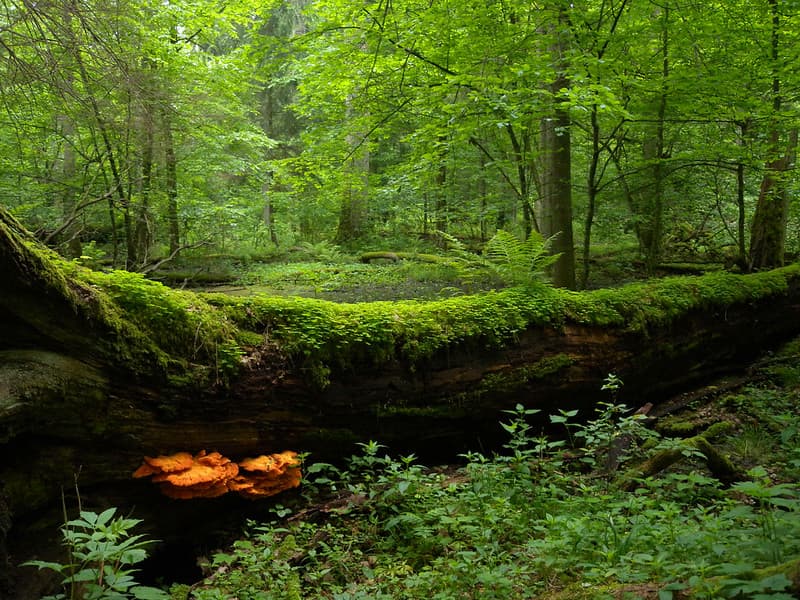
The ecosystem features centuries of undisturbed natural development with multi-tiered canopies of ancient pedunculate oaks, hornbeams, spruces, limes, and pines, with giant oaks exceeding 40 meters in height. A defining feature is the immense volume of standing and fallen deadwood at all stages of decay. This biomass nourishes fertile organic soils, sustains mycorrhizal fungal networks, and provides habitats for thousands of rare saproxylic beetles, lichens, mosses, and cavity-nesting forest birds, preserving intact lowland forest dynamics.
Attraction
Białowieża Forest attracts naturalists, ecotourists, wildlife photographers, and wilderness enthusiasts globally seeking an authentic encounter with Europe’s ancient natural heritage. Its chief international claim to fame is its thriving wild population of free-roaming European bison (żubr), the continent’s largest land mammal. Nearly extinct in the early 20th century, the bison was saved through captive breeding and reintroduction programs centered in Białowieża, making it a world-renowned symbol of successful species conservation.
Visitors explore the Strict Nature Reserve (Obszar Ochrony Ścisłej), where forestry management has been banned for over a century, offering the sensation of entering prehistoric Europe. Ecotourists enjoy world-class birdwatching for rare species like the white-backed woodpecker, Eurasian pygmy owl, and collared flycatcher. The forest also harbors elusive predators, including grey wolves and Eurasian lynx. Networked gravel trails accommodate scenic hiking, cycling, and winter cross-country skiing, while Białowieża village displays traditional wooden architecture and the historic tsarist Palace Park (Park Pałacowy).

World Heritage
Inscribed in 1979 and expanded in 1992 and 2014 as a transboundary property with Belarus, Białowieża Forest meets UNESCO Natural Criteria (ix) and (x):
- Criterion (ix) – Ongoing Ecological Processes: The property protects an outstanding, complete example of undisturbed lowland temperate forest dynamics. Free from commercial logging, it exhibits continuous natural forest evolution, canopy gap replacement, natural tree regeneration, and decay cycles supporting complex food webs.
- Criterion (x) – In Situ Biodiversity Conservation: The site is a vital sanctuary for European biological diversity, sheltering over 12,000 animal species, representing nearly 60 percent of Poland’s terrestrial fauna. Crucially, it protects the world’s largest free-roaming population of wild European bison (Bison bonasus), along with Eurasian lynx, wolves, otters, and specialized saproxylic organisms.
Gateway
Travelers can access Białowieża Forest via two principal Polish gateway cities featuring public IATA-listed commercial airports, lodging options, and transport connections:
- Warsaw (Primary International Gateway):
- Airports: Warsaw Chopin Airport (IATA Code: WAW; ICAO Code: EPWA) and Warsaw Modlin Airport (IATA Code: WMI; ICAO Code: EPMO).
- Infrastructure and Distance: Located 230 kilometers west of Białowieża Forest, Warsaw is Poland’s main international hub with global flight connections and extensive hotel options. Travelers can rent cars at either airport or take trains from Warszawa Centralna station to Hajnówka, connecting to local buses bound for Białowieża village. Tour agencies in Warsaw provide guided day trips.
- Lublin (Secondary Regional Gateway):
- Airport: Lublin Airport (IATA Code: LUZ; ICAO Code: EPLB).
- Infrastructure and Distance: Situated roughly 250 kilometers south-southwest of Białowieża Forest. Lublin Airport operates scheduled flights from domestic and European destinations. Lublin features hotel options, car rentals, and rail connections northward toward Hajnówka and Białowieża, serving as an accessible regional gateway.
When
The optimal period to explore Białowieża Forest depends on visitor interests, with Spring (April to June) and Autumn (September to October) strongly recommended:
- Spring (April to June): Features mild weather (12°C to 20°C / 54°F to 68°F), blooming wildflowers, and fresh foliage. Excellent for birdwatching and bison viewing before foliage thickens.
- Autumn (September to October): Offers crisp days (10°C to 16°C / 50°F to 61°F) and vibrant fall foliage. Coincides with the annual bison mating season (rut) and mushroom foraging.
- Winter (December to February): Cold weather (-5°C to 2°C / 23°F to 36°F) with snow cover provides ideal animal tracking conditions across white landscapes.
- Summer (July to August): Warm temperatures (20°C to 26°C / 68°F to 79°F) allow long outdoor hikes, though biting insects are most active.
Consideration
- Strict Reserve Guide Requirement: Entering the core Strict Nature Reserve (Obszar Ochrony Ścisłej) is strictly forbidden without a licensed national park guide and an official permit.
- Border Zone Security: The forest borders Belarus along a secure boundary fence. Visitors must carry valid identification at all times and strictly obey border guard warning signs and restricted perimeter rules.
- Wild Bison Safety: European bison are massive wild animals that can charge if threatened. Keep a safe distance of at least 50 meters, avoid calves, and keep pets leashed.
- Insect and Tick Protection: Mosquitoes and Lyme-carrying ticks are prevalent during warm months. Wear long sleeves, tucked trousers, sturdy boots, and effective insect repellent.
- Local Mobility and Currency: Public transit between forest villages is limited on weekends; renting a vehicle or bicycle is recommended. Transactions use Polish Złoty (PLN); carrying cash is advisable for small local vendors.

Resources
- UNESCO World Heritage Centre: Official page for boundary information, criteria, and conservation reports.
- Białowieża National Park Official Site: Official park management portal for guide bookings, entry permits, and visitor regulations.
- Poland Official Travel Portal: Official national tourism board site providing accommodation directories and travel routes.
- Podlaskie Regional Tourism Organization: Regional travel portal offering local transit schedules and regional trail maps.
- GetYourGuide: Travel booking marketplace offering affiliate-supported guided tours, wildlife excursions, and transfers from Warsaw.


Comments:
2 responses to “Białowieża Forest *[PL]”
-
Białowieża is a haven for biodiversity – unparalleled on this continent.
-
If you look under the bark, there’s a lot of beetles, a lot of spiders — everything, whatever you want, and this is how it works. This is why I compare the Bialowieza Forest to coral reef — because in coral reef, a lot of life is based also on the dead corals. So this works like that.

Leave a Reply