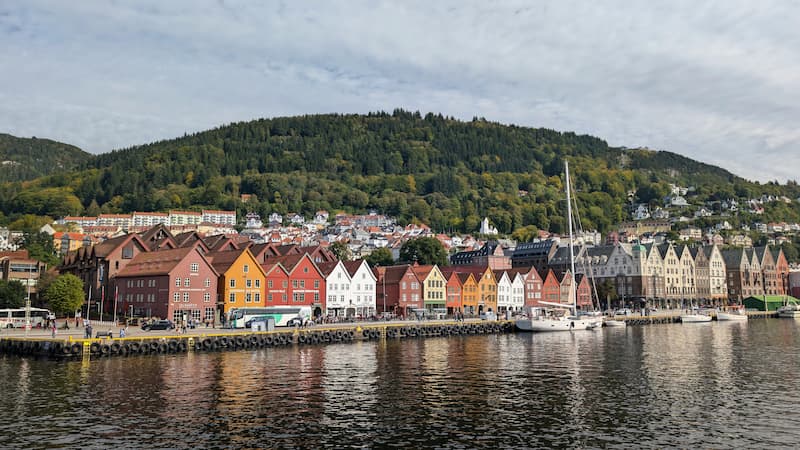
Colorful Wooden Harbor Of Bergen And Its Hanseatic Past
The UNESCO World Heritage property titled “Bryggen” (Norwegian for “the wharf”), historically known as Tyskebryggen (“the German Wharf”), is a historic Hanseatic commercial harbor quarter situated along the eastern shore of Vågen bay in central Bergen, NORWAY. Established around 1070 by King Olav Kyrre, the wharf developed into the primary maritime trading hub of western Norway. Between 1360 and 1754, Bryggen served as the Norwegian Kontor (foreign trading post) for the German Hanseatic League, controlling northern Europe’s lucrative trade in dried cod (stockfish) harvested from northern Norway and exported across Europe in exchange for Baltic grain, beer, and manufactured commodities.
The protected heritage district covers 1.2 hectares and encompasses 62 surviving historic wooden buildings and stone storage cellars (sjøstuer). The iconic facade features narrow gabled wooden houses painted in traditional shades of ochre red, mustard yellow, and white .Behind the colorful harbor front lies a dense, compact medieval urban layout comprising long, narrow rows of timber tenements (gårder) separated by dark, wood-planked passages and elevated galleries. Heavy timber construction, traditional joinery, and deep stone fireproof cellars reflect centuries of rebuilding in vernacular Scandinavian style following catastrophic city fires—most notably the great fire of 1702.
Attraction
Bryggen draws international tourists, history lovers, and photographers with its rare blend of authentic medieval atmosphere, vibrant local culture, and scenic coastal settings. Walking into the narrow, creaking timber passages behind the painted gables offers visitors an immersive journey into 14th-century merchant life, where leaning wooden walls, uneven floorboards, and centuries-old hand-carved wooden symbols remain preserved in daily use.
Unlike static outdoor museum monuments, Bryggen remains a living, working urban district. The historic timber buildings house independent craft workshops, textile studios, goldsmiths, local art galleries, boutique shops, and cozy cafes serving traditional Norwegian pastries. Visitors can explore the nearby Bryggens Museum, constructed over 12th-century archaeological remains, or visit Schøtstuene, the preserved assembly halls where Hanseatic merchants gathered for communal meals and educational lessons. Located steps from the bustling Fish Market (Torget) and the Fløibanen funicular up Mount Fløyen, Bryggen serves as the quintessential cultural starting point for travelers embarking on scenic Norwegian fjord cruises.

World Heritage
Inscribed on the UNESCO World Heritage List in 1979, Bryggen was designated as a Cultural World Heritage Site fulfilling UNESCO Criterion (iii):
- Criterion (iii) – Exceptional Cultural Testimony: Bryggen preserves unique physical testimony to the social organization, economic dominance, and spatial layout of the Hanseatic League’s trading empire in Northern Europe during the late Middle Ages. It represents an unequaled surviving example of a northern fondaco—a self-contained foreign merchant enclave where unmarried German traders lived and worked under strict regulations. Furthermore, Bryggen is an extraordinary survivor of traditional Northern European wooden urban architecture. Despite suffering recurrent catastrophic fires across its 900-year history, the wharf was consistently rebuilt using traditional timber framing and medieval spatial plans, preserving the original urban footprint, property boundaries, and vernacular building methods intact.
Gateway
Travelers bound for Bryggen can access the site via two practical gateway cities within Norway, both offering active IATA-coded airports, high-capacity transit links, lodging options, and local guides:
- Bergen (Direct Host Gateway):
- Airport: Bergen Airport, Flesland (IATA Code: BGO; ICAO Code: ENBR).
- Infrastructure and Distance: Situated 18 kilometers southwest of Bryggen, Flesland is Norway’s second-largest aviation hub, providing direct domestic and European flights. The modern Bybanen light rail (Line 1) and Flybussen airport express coaches connect the airport directly to central Bergen in 30 to 45 minutes. Bergen offers extensive accommodations ranging from waterfront luxury hotels to historic boutique guesthouses, along with licensed walking tour guides and fjord tour departures directly from Vågen harbor.
- Oslo (National Capital Gateway):
- Airport: Oslo Airport, Gardermoen (IATA Code: OSL; ICAO Code: ENGM).
- Infrastructure and Distance: Located 460 kilometers east of Bergen, Oslo serves as Norway’s primary international hub. Travelers can connect to Bergen via a 50-minute domestic flight or take the world-famous Bergensbanen scenic railway across mountain plateaus directly to Bergen Central Station, a short 10-minute walk from Bryggen.
When
The optimal time to visit Bryggen is during Summer (June to August) and Late Spring (May):
- Summer (June to August): Brings warm, pleasant weather with daily averages between 15°C and 22°C (59°F to 72°F). Extended daylight hours under the Midnight Sun allow long evening walks along the waterfront, outdoor harbor dining, and full access to museums and fjord cruises.
- Late Spring (May) and Early Autumn (September): Feature comfortable temperatures (10°C to 16°C / 50°F to 61°F), fewer cruise tourist crowds, blooming spring flowers, or colorful autumn foliage around Mount Fløyen.
- Winter (November to March): Cool and damp (0°C to 5°C / 32°F to 41°F). While daylight hours are short, winter brings quiet streets, festive Christmas markets, and snow-draped timber gables.
Consideration
- Rainy Coastal Weather and Layering: Bergen is famous for heavy annual rainfall. Visitors should dress in breathable layers and bring windproof rain jackets, waterproof outerwear, and reliable umbrellas regardless of the season.
- Cruisewear and Off-Peak Hours: Large cruise ships disembark thousands of passengers daily during summer peak hours (10:00 AM to 3:00 PM). Visiting before 9:00 AM or in the late afternoon offers a far quieter atmosphere.
- Walking Surface and Footwear: The historic alleyways feature uneven cobblestones, raised timber planks, and narrow wooden stairs. Sturdy, flat walking shoes are essential.
- Limited Wheelchair Accessibility: Due to the historic preservation of wooden structures, many shops, upper-floor galleries, and narrow passages have limited wheelchair accessibility.
- Fire Safety Regulations: As an all-wooden cultural monument, Bryggen enforces strict anti-fire regulations; smoking and open flames are strictly prohibited throughout the entire district.
- Digital Cashless Payments: Norway operates almost entirely on cashless digital transactions. Credit cards, debit cards, and contactless mobile payments are accepted everywhere; carrying large amounts of physical cash is unnecessary.

Resources
- UNESCO World Heritage Centre: Official property listing detailing inscription criteria, boundary maps, and conservation updates.
- Visit Bergen: Official local tourism portal offering city guides, event schedules, transit info, and museum updates.
- Visit Norway: Official national tourism website providing travel planning resources, accommodation links, and weather forecasts.
- Museum Vest (The Hanseatic Museum): Official venue site providing historical background, exhibition hours, and guided tour schedules for Schøtstuene.
- Trip.com: Leading global travel marketplace featuring customer reviews, hotel options, and affiliate booking services for Bergen guided walking tours and cruises.


Comments:
9 responses to “Bryggen”
-
Bergen has so much to do and see. I was only there as a port stop on a cruise so I didn’t get to do all the fabulous things. I really enjoyed Bryggen and the fish market.
-
The wood alleyways are really unique. I’m sure it feels like stepping back in time!
-
The Hanseatic wharf Bryggen is where you’ll find the oldest buildings in Bergen – and the prettiest.
I enjoyed learning about the German merchants who lived in the region between 1360 and 1754 at the nearby Hanseatic Museum, then taking a stroll between the colourful, crooked buildings where traditional knitwear sellers, tiny art galleries and unique craft stores are hidden away in narrow alleyways just waiting to be discovered.
Bryggen has a place on the UNESCO World Heritage List, so it’s a must-see for all visitors.
-
One of the most enjoyable things to do in Bergen is to simply wander the streets and soak up the welcoming atmosphere – taking in the pretty houses and the bustling fish and flower market, before perhaps popping into one of the intriguing museums you’ll stumble across along the way. A ride on the cable cars – which offer sweeping views over the city – is not to be missed, as are sights including the Maria Church, King Håkon’s Hall and the Rosenkrantz Tower.
-
I decide to see the Bryggen immediately after landing at Flesland airport. I walk along the docks, and get to the center of the Hanseatic League: narrow streets, wooden sidewalks, tall buildings that once were used as warehouses. The wood creaking under my steps, the rain hammering on the roofs make me go back to the past, among wood planks smelling of moist and moss, among ancient workshops and small inns with rickety floorboards. From here, I walk towards Håkonshallen, the fortress were the royal family used to live. Rosenkrantztarnet, the tower where king Eirik Magnusson lived until his death, stands close-by. When the king passed away, the tower was used a prison until 1800. It’s worth climbing to the top and get a good view of the city before going to the Fisketorget on the main harbor. The fish market is the historical meeting point for fishermen, fishmongers, merchants and cooks. From one of the stalls I buy my first fiskeboller: they look like meatballs but are made with cod, rolled in breadcrumbs and deep-fried.
-
We were captivated by Bryggen before we ever set foot in Bergen, and finally seeing the UNESCO World Heritage site in person did not disappoint. Bryggen is the oldest—and possibly most colorful—section of the city, with footprints dating back to the 1200s. The current 58 buildings date from after a fire that devastated the city in 1702. From the front, you would never know that these narrow buildings lead to a maze that includes workshops, specialty stores, boutiques, and more. It’s easy to lose yourself in the history, architecture, and shopping here.
-
The narrow passageways were great places to stroll through and we never knew what pleasant surprises greeted us at the end. In addition to shops, there were also several galleries, craft stores and cafes within the area. There were plenty of tables and chairs outside to enjoy the waterfront area or to rest after all the exploring.
-
You’ll have a great time walking past this harbor. Just take your time and try to go in all the little streets and you’ll be surprised to see colorful wooden buildings, gift shops, cafes, restaurants, museums, and historic buildings. It will be a lovely way to spend your time in the city without costing you so much.
-
[…] The Hanseatic League’s Influence on Bryggen […]

Leave a Reply