Discover Italy’s Coastal Treasures: Cinque Terre and Portovenere
The UNESCO World Heritage property titled “Portovenere, Cinque Terre, and the Islands (Palmaria, Tino and Tinetto)” is a scenic coastal cultural landscape in the Liguria region of northwestern ITALY. Inscribed in 1997, the property spans 15 kilometers of rugged, cliff-bound coastline and encompasses three distinct geographical zones:
- Cinque Terre: The five historic coastal fishing villages of Monterosso al Mare, Vernazza, Corniglia, Manarola, and Riomaggiore, wedged between steep mountain cliffs and the sea.
- Portovenere: A historic medieval port town situated at the southern tip of the peninsula guarding the Gulf of La Spezia, featuring colorful harbor houses, the 12th-century Church of San Pietro, and Doria Castle.
- The Islands of Palmaria, Tino, and Tinetto: An archipelago located across the narrow strait from Portovenere, preserving early monastic ruins, defensive fortresses, and pristine Mediterranean garrigue flora.
Attraction
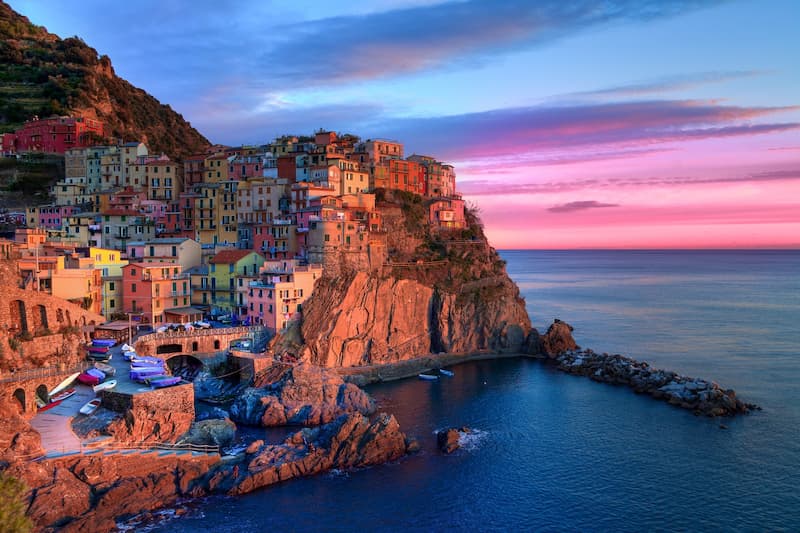
This site draws global travelers due to its iconic beauty, dramatic natural scenery, and vibrant coastal culture. The image of colorful medieval houses clinging to steep rocky cliffs overlooking crystalline turquoise waters is world-famous.
Visitors come to hike the celebrated network of coastal trails, such as the Sentiero Azzurro (Blue Trail) and Via dell’Amore (Path of Love), which offer panoramic views of the sea and terraced vineyards. The area provides an immersive taste of authentic Italian Riviera lifestyle, where travelers can enjoy fresh seafood, famous local Pesto alla Genovese, and sweet Sciacchetrà dessert wine in sunlit piazzas. Additionally, boat excursions around the coast and islands allow travelers to appreciate sea caves, secluded bathing coves, and historical fortresses from the water.

World Heritage
Inscribed on the UNESCO World Heritage List in 1997, the property satisfies three cultural criteria (ii, iv, and v):
- Criterion (ii) – Interchange of Human Values: The site illustrates a notable harmonious interaction between human settlement and a rugged, challenging natural environment over more than a millennium, creating a distinct coastal lifestyle and architectural tradition.
- Criterion (iv) – Outstanding Cultural Landscape: It constitutes an exceptional cultural landscape where human ingenuity engineered over 7,000 kilometers of dry-stone wall terraces (fasce) along mountain slopes to enable agriculture, fundamentally reshaping the topography into a functional artistic masterpiece.
- Criterion (v) – Traditional Human Settlement: The site represents an outstanding example of traditional land-use and human settlement in an inhospitable coastal environment. The dry-stone terraced vineyards and compact village layouts demonstrate a continuous, sustainable adaptation that protects coastal hillsides from erosion and landslides.
Gateway
Travelers visiting the site can utilize three practical Italian gateway cities equipped with active IATA-coded airports, lodging options, transit infrastructure, and tour services:
- La Spezia (Direct Municipal Gateway):
- Airport: La Spezia Rail/Transit Hub (IATA Code: QLP).
- Infrastructure: Located at the eastern entrance to the site. La Spezia serves as the primary operational base for visitors, offering extensive hotel inventory, direct passenger ferries to Portovenere and Cinque Terre, the frequent Cinque Terre Express train, car rental agencies, and licensed tour guides.
- Pisa (Primary Regional Gateway):
- Airport: Pisa Airport “Galileo Galilei” (IATA Code: PSA; ICAO Code: LIRP).
- Infrastructure: Located 78 kilometers southeast. Direct regional trains run frequently from Pisa Centrale to La Spezia and Cinque Terre in under 75 minutes. Pisa offers extensive lodging, car rentals, and tour operators running day trips.
- Genoa (Northern Regional Gateway):
- Airport: Genoa Airport “Cristoforo Colombo” (IATA Code: GOA; ICAO Code: LIMJ).
- Infrastructure: Located 100 kilometers northwest. Direct regional trains connect Genoa to Monterosso and La Spezia in 75 minutes, supported by high-capacity accommodation and excursion operators.
When
The optimal periods to visit Portovenere, Cinque Terre, and the islands are Spring (April to June) and Autumn (September to October).
- Spring: Delivers comfortable daytime temperatures ranging between 16°C and 23°C (61°F to 73°F), blooming wildflowers along cliffside paths, long daylight hours, and pleasant weather for hiking and village exploration.
- Autumn: Features warm sea temperatures for swimming, agreeable air temperatures (18°C to 24°C / 64°F to 75°F), lower visitor density, and regional wine harvest celebrations across terraced vineyards.
- Summer (July to August): Brings hot, humid conditions exceeding 30°C (86°F), intense sun exposure on open trails, heavy tourist crowding, and long queues for trains and ferries.
- Winter (November to March): Experiences cool, rainy weather (6°C to 13°C / 43°F to 55°F) with frequent trail closures and reduced ferry schedules.
Considerations
- Strict Vehicle Prohibitions: Driving inside the five villages and Portovenere is virtually impossible due to narrow pedestrian streets and driving bans. Park vehicles in La Spezia or Levanto and utilize trains or ferry boats.
- Hiking Permits and Footwear: Walking main coastal trails (Sentiero Azzurro) requires purchasing a Cinque Terre Card. Open-toed shoes, flip-flops, and sandals are legally forbidden on hiking trails, with fines enforced for improper footwear.
- Trail Closures: Heavy rain and landslides cause unexpected trail closures. Check current trail status updates at local National Park information offices before starting a hike.
- Luggage and Accessibility: Villages feature steep stone staircases and narrow alleys without elevators. Travel light or utilize luggage storage services at train stations.
- Ferries vs. Trains: Trains provide the fastest connection between villages, whereas passenger boats offer scenic coastal views and direct sea access to Portovenere and Palmaria Island.

Resources
- UNESCO World Heritage Centre: Official website detailing site criteria, spatial boundaries, and conservation documentation.
- Parco Nazionale delle Cinque Terre: Official national park portal providing real-time trail status, card purchasing, and conservation guides.
- Pro Loco Portovenere: Official local tourism platform offering ferry schedules, island excursions, and historical landmark details.
- Italia.it: Official Italian National Tourism Board platform featuring practical travel advice and regional Ligurian itineraries.
- GetYourGuide: Global online travel booking marketplace offering guided hiking tours, boat charters, wine tastings, and affiliate booking packages.


Comments:
11 responses to “Portovenere, Cinque Terre, and the Islands (Palmaria, Tino and Tinetto)”
-
There are a lot of ups and downs on the Cinque Terre, so that’s worth taking into consideration for your knee. There’s no climbing per se though, it’s more walking on trails :). However the Cinque Terre can also be enjoyed by non-walkers. There are trains between all the villages, and you can get a day ticket and take trains between villages, stop whenever you like, stroll around towns, and then continue to the next village.
-
My favorite among the Cinque Terre was Vernazza. As soon as I arrived this town unfolded in a picturesque labyrinth of cobbled lanes and stairways wide enough for barely two people to pass at a time. The magic was alluring and I soaked in its atmosphere, all spruced up for the Christmas season. Hobbit-like houses leaned over narrow paved stairways and steep alleys were festooned with laundry hanging from the windows, almost as if to assert their Italian style.
-
Walking the Cinque Terre track is not tramping as we know it in New Zealand. Parts of the track are steep and narrow, but most of it is a meander along pathways through orchards and small settlements. A highlight was watching the local folk working in the vineyards and olive groves, perched on impossibly-narrow terraces, or rather ledges, which have been carved into the hillsides over the centuries.
We dawdled along the 10km path in the spring sunshine, sampling the local delicacies of anchovies, pesto, farinata and focaccia, cooling off in the heat of the day with gelato made from Corniglia honey, and refreshing plunges in the ocean.
The track could easily be walked in a day but if you want to absorb the beauty and the atmosphere of the region, spend at least three days in one of the little villages and explore some of the hinterland and history of the region.
-
Manarola was my personal favourite, colourful houses stacked on top of one another cling to the rock face and create a colourful mosaic which you just can’t resist photographing. We enjoyed lunch at a cafe and watched fellow tourists enjoying the sunshine and a cooling swim at the rocky foreshore while local fishermen went about their business.
-
Some of our favorite things to do in the Cinque Terre (besides walking):
• Sit on the square in Manarola, watching the local kids race their foot-powered scooters around the plaza as parents cheer them on. Stop by the toy stand there, where you can buy an Italian comic book about Texans working in the oil field.
• Grab a bottle of wine and take the stroll out Via dell’Amore, the walkway between Manarola and Riomaggiore. Even though it was closed when we were there, we could walk partway out, sit on a bench and watch the sunset.
• For spectacular photos of Manarola, walk north of town on the main trail, stopping just below the little pocket park, where the sidewalk curves with the coast. At dusk, the buildings practically glow in the most beautiful light.
• If the coastal path between Manarola and Corniglia is closed (and even if it’s not), take the high road instead, climbing up to the village of Volastra. Grab a lemonade at the tiny grocery and peek into the beautiful chapel.
• In Vernazza, dine at Ristorante Belforte and order the steamed mussels or grilled octopus. If you’re lucky, you’ll get to sit on one of the terraces clinging to the cliff.
• Walk beneath a stone arch at the foot of Vernazza to a gravel beach created during the devastating floods of 2011. Then dive into the ocean.
• Rent a beach umbrella in Monterosso.
• Eat gelato in Corniglia — it was some of the best we found during our 10-day trip to Italy.
• Eat dinner — and order the seafood antipasti — at Billy’s in Manarola. http://www.trattoriabilly.com
• Stay at least two nights. High season runs from mid-June to mid-September. Day trippers flood the towns, but by dusk most of the crowds are gone.
-
After a night spent relaxing on the boat, we set our alarms early, put on our hiking clothes and caught the first train from our hotel in La Spezia to trek one portion of the five trails – from Vernazza to Corniglia. The guide books say you can complete the entire trek, across all five villages, in six to eight hours – which we considered overly ambitious. If you prefer a leisurely pace, stopping for lunch, gelato and picture breaks, pick one or two portions of the trail and expect the abbreviated trek to take three to four hours.
There are two trails, the red and blue. Blue is is the easier – though still quite challenging for those who simply want to stroll. There are steep hills and craggy steps, but it’s the kind of hike that will leave you tired and thirsty at the end, but feeling so glad you did it.
And as noted above, bring your swimsuit in your daypack and cool off with a dive into the bay. Don’t attempt the challenging red trail unless you are a seasoned trekker, and bring along enough water and snacks to get you through.
Take note, the train will save you. It makes a stop at each of the five villages, making it easy to call it a day at any village along the and head back home– or to a restaurant for a scenic meal.
-
I visited all five towns in the cluster and, while Monterroso al Mare, one train stop to the north, has a longer, more crowded beach and a livelier nightlife, Vernazza was, to me, clearly the most appealing of the five. After days of scouring the art museums of Florence, it was a pleasant contrast to visit here. A visit to Vernazza should include an exploration of the few back alleys to get a sense of the rhythm of the relaxed local lifestyle. To explore the surrounding area, buy a Cinque Terre pass that allows for hiking and train travel between the five towns. The latter can get quite crowded midday during high season. Some of the hiking trails were closed during my visit. I recommend that, even if you don’t hike the trail between the five towns, at least hike up the steep trail overlooking Vernazza for a magnificent view. It’s a particularly striking sight in the early morning.
-
Each comes with its own personality, and the best way to see the lot is to pick one as a home base (we’ve chosen Manarola because it’s smaller and quieter than the others), then spend a few days hiking between them, eat grilled octopus and cool off with a swim in the sea. We’re in no hurry. Here in the Cinque Terre, it’s all about walking, relaxing and soaking up the views. Make sure you have proper footwear before you strike out. Some of the trails (especially the one from Vernazza to Monterosso) are extremely narrow and crowded. In sections, passage is only single file, so if you meet someone coming the other direction you’ll have to wait your turn.
And the steps! The Vernazza to Monterosso section of the trail has as many as a skyscraper — hike it northbound or your quads will stage a protest. And only attempt the walk if you’re reasonably fit.
Happily, Vernazzo and Monterosso offer fine swimming, too, so once you’ve worked up a sweat hiking you can cool off in the sea. We braved the tiny gravel beach in Vernazza in our hiking duds — and it was totally worth it.
If you walk from one town to the next and don’t feel like hiking back, you can catch the train for a few euros. Even better, hop on a ferry boat for a different perspective of the Cinque Terre.
Some of our favorite things to do in the Cinque Terre (besides walking):
• Sit on the square in Manarola, watching the local kids race their foot-powered scooters around the plaza as parents cheer them on. Stop by the toy stand there, where you can buy an Italian comic book about Texans working in the oil field.
• Take the stroll out Via dell’Amore, the walkway between Manarola and Riomaggiore. Even though it was closed when we were there, we could walk partway out, sit on a bench and watch the sunset.
• For spectacular photos of Manarola, walk north of town on the main trail, stopping just below the little pocket park, where the sidewalk curves with the coast. At dusk, the buildings practically glow in the most beautiful light.
• If the coastal path between Manarola and Corniglia is closed (and even if it’s not), take the high road instead, climbing up to the village of Volastra. Grab a lemonade at the tiny grocery and peek into the beautiful chapel.
• In Vernazza, dine at Ristorante Belforte and order the steamed mussels or grilled octopus. If you’re lucky, you’ll get to sit on one of the terraces clinging to the cliff.
• Walk beneath a stone arch at the foot of Vernazza to a gravel beach created during the devastating floods of 2011. Then dive into the ocean.
• Rent a beach umbrella in Monterosso.
• Eat gelato in Corniglia — it was some of the best we found during our 10-day trip to Italy.
• Eat dinner — and order the seafood antipasti — at Billy’s in Manarola. http://www.trattoriabilly.com
• Stay at least two nights. High season runs from mid-June to mid-September. Day trippers flood the towns, but by dusk most of the crowds are gone.
-
WHAT SHOULD I BRING WITH ME? Not too much! Chances are you’ll have to climb a huge hill or a flight of stairs to reach your accommodation, so try to bring as little as possible. If you’re walking then don’t forget decent shoes as well as a hat of scarf in summer, as there’s not a lot of shade along the paths. Also pack a water bottle as there are free water taps in each village where you can refill it.
Although Monterosso’s the only village with a real beach, you can swim from each of the villages – amazing after a sweaty day walking – so bring your swimmers. If you forget things like sunscreen there are shops in each village, but because it’s a touristy area they do charge a premium. And if you get stuck English is widely spoken around the Cinque Terre.
-
Each of the five villages is connected by railway, water taxi and a network of hiking trails, so it’s easy to get from one to another. Each village is unique, with its own restaurants and shops and overall atmosphere, despite the fact that they are only separated by a few kilometres. When you visit, just choose one village as your base — you can’t pick wrongly — and day-trip to the others.
We spend three days exploring the Cinque Terre, which was not nearly enough for some parts of my body, and way too much for others. Leaving this quiet, beautiful part of the world is as easy as arriving — just two train rides and we are back in in the hustle and bustle of Rome.
-
One of my favourite views in Cinque Terre has to be of Manarola that can be seen from the Manarola Scenic Viewpoint. Honestly, I think it’s one of the things to do in Cinque Terre for a truly stunning view, plus it’s a great photo spot! The walk to the viewpoint is only about 200 metres or so from the harbourfront, so it’s easy to see when you’re in the town itself.

.jpeg)
Leave a Reply