Urbino: The Birthplace of Raphael and Renaissance Art
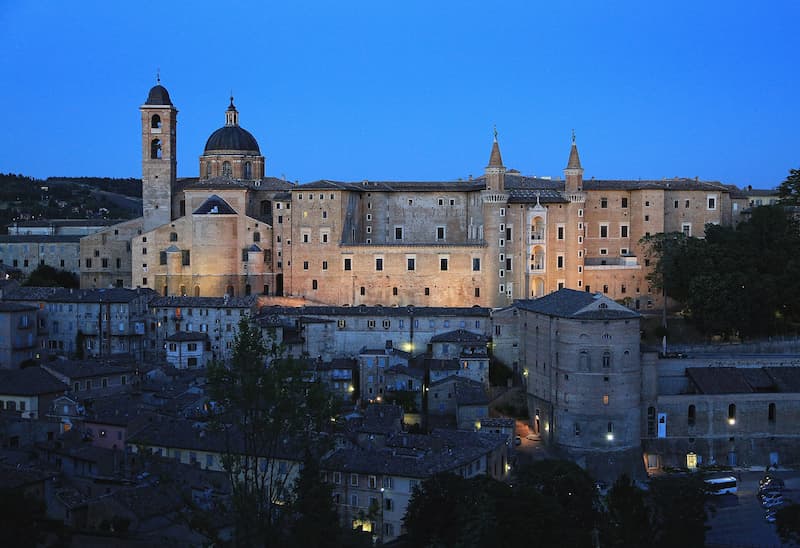
The Historic Centre of Urbino is a preserved Renaissance hill town in central ITALY’s Marche region. Perched atop a sloping hill, the town is enclosed by 16th-century defensive walls. In the 15th century, under Duke Federico da Montefeltro, Urbino evolved from a medieval fortress into a vibrant capital of the Italian Renaissance.
At Urbino’s heart stands Palazzo Ducale (Ducal Palace), designed by Luciano Laurana and Francesco di Giorgio Martini. Featuring twin slender towers (Torricini), grand internal courtyards, and the famous Studiolo (a private study lined with intricate intarsia wood paneling), the palace dominates the skyline. Surrounding the palace, steep alleys (piole), staircases, and brick structures lead to landmarks including Urbino Cathedral (Duomo di Urbino), the Oratory of St. John the Baptist (Oratorio di San Giovanni Battista), Raphael’s birth house (Casa Natale di Raffaello), and Albornoz Fortress (Fortezza Albornoz).
Attraction
Urbino captivates global travelers as a cradle of High Renaissance art, architecture, and humanist scholarship. Unlike larger Italian tourist hubs like Florence or Rome, Urbino offers an intimate experience of an early modern ideal city, where historic buildings remain intact without modern urban sprawl. Art enthusiasts visit the Ducal Palace, housing the Galleria Nazionale delle Marche (National Gallery of the Marche). The museum displays masterpieces including Piero della Francesca’s Madonna of Senigallia and Flagellation of Christ, alongside Raphael’s Mute Woman (La Muta).
Furthermore, Urbino attracts international visitors due to its legacy as the birthplace of Raphael (Raffaello Sanzio), one of history’s greatest painters. Tourists can step inside his childhood home to view early frescoes and personal artifacts. Home to the University of Urbino (Università degli Studi di Urbino Carlo Bo), founded in 1506, the town features an energetic student population, fostering a lively atmosphere with trattorias, wine bars, and artisan workshops along medieval streets.

World Heritage
In 1998, UNESCO inscribed the Historic Centre of Urbino on the World Heritage List under cultural criteria (ii) and (iv).
- Influence on Renaissance Culture and Architecture (Criterion ii): During the reign of Duke Federico da Montefeltro (1444–1482), Urbino attracted leading humanists, poets, mathematicians, and artists. The architectural concepts developed in Urbino—specifically the harmonious integration of classical proportion, humanism, and defensive engineering within the Palazzo Ducale—exerted a profound influence on urban development across Western Europe.
- Outstanding Example of an Ideal Renaissance City (Criterion iv): Urbino represents an exceptional, exceptionally preserved example of a Renaissance hill town that successfully adapted classical humanist architectural principles to a challenging topography. The townscape embodies the 15th-century concept of the “ideal city” (città ideale), where civic governance, artistic expression, intellectual inquiry, and public architecture were unified into a single cohesive urban environment.
Gateway
Travelers bound for Urbino can utilize three practical Italian gateway cities equipped with IATA-coded airports, lodging, transit links, and tour operators:
- Ancona (Primary Regional Gateway):
- Airport: Ancona Falconara Airport (IATA Code: AOI; ICAO Code: LIPY).
- Infrastructure: Located 100 kilometers southeast. Ancona offers direct regional trains to Pesaro (40 minutes), where direct bus Line 46 reaches Urbino in 45 minutes. Features hotels, rental cars, and tour guides.
- Rimini (Northern Coastal Gateway):
- Airport: Federico Fellini International Airport (IATA Code: RMI; ICAO Code: LIPR).
- Infrastructure: Located 60 kilometers north. Connected via train to Pesaro (25 minutes) and shuttle bus to Urbino, or via the SS73bis highway. Offers extensive coastal lodging and tour agencies.
- Bologna (Major International Gateway):
- Airport: Bologna Guglielmo Marconi Airport (IATA Code: BLQ; ICAO Code: LIPE).
- Infrastructure: Located 170 kilometers northwest. High-speed trains link Bologna to Pesaro in under 90 minutes, connecting smoothly with regional buses to Urbino. Provides abundant hotels and tour operators.
When
The best time to visit Urbino is during the spring and early autumn months, specifically from April to June and September to October. During these periods, daytime temperatures are pleasantly mild for navigating the city’s steep, hilly streets, rainfall is moderate, and visitor crowds are far lighter than in mid-summer.
- Summer (July to August): Summers can be warm and humid, with elevated tourist numbers. However, summer brings vibrant local events, including open-air concerts and historical reenactments such as the Duke’s Festival (Festa del Duca) in August.
- Winter (November to March): Winters are cool, quiet, and occasionally snowy, transforming the brick townscape into a tranquil retreat. While days are shorter, winter offers discounted lodging rates and line-free museum visits, though visitors should check seasonal hours for smaller sites.
Considerations
- No Direct Railway Station: Urbino lacks a train station. The nearest major station is in Pesaro (35 kilometers away). Public transit travelers must take the Adriabus Line 46 bus from Pesaro station directly to Urbino. Sunday public transit bus service between Pesaro and Urbino operates on a reduced schedule.
- Steep Terrain and Footwear: The town is built across steep hills with cobblestones and staircases. Comfortable walking shoes are required, and travelers with limited mobility may face navigation challenges.
- Strict Traffic Restrictions (ZTL): Driving inside the historic center is forbidden for non-residents. Drivers must park in perimeter garages outside city walls, such as Parcheggio Borgo Mercatale, featuring elevators ascending to the center.
- Advance Museum Booking: Visiting top attractions like the Galleria Nazionale delle Marche inside Palazzo Ducale requires advance online ticket reservations during peak weekend travel periods.

Resources
- UNESCO World Heritage Centre: The official UNESCO portal offering historical context, architectural maps, and formal inscription reports for Urbino.
- Turismo Marche: The official regional tourism authority portal providing travel planning guides, regional maps, and event calendars for Urbino and surrounding areas.
- Trip.com: A major global travel booking portal featuring user reviews, affiliate hotel links, price comparisons, and tour bookings.
- Galleria Nazionale delle Marche: The official website for the Ducal Palace museum, providing exhibition details, ticket prices, and opening schedules.
- Italia.it: The official national tourism portal of Italy, offering cultural overviews, transportation tips, and heritage itineraries across the country.


Comments:
Leave a Reply