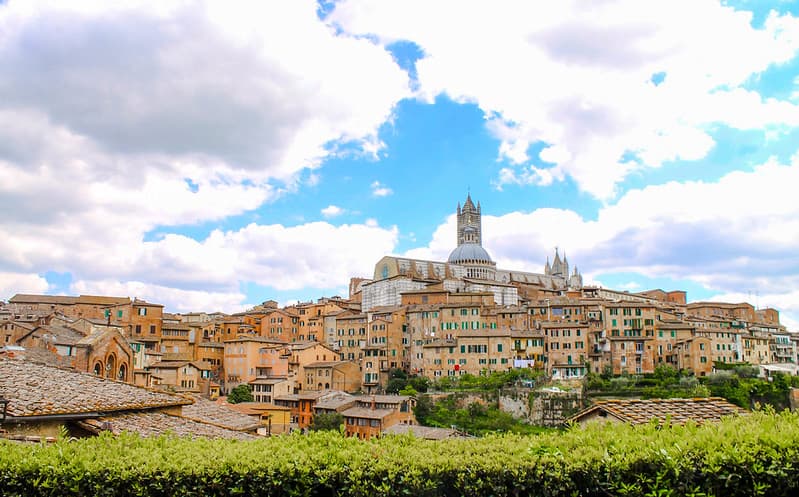
Explore Siena: A Medieval Marvel of Tuscany
The Historic Centre of Siena is an exceptionally preserved medieval city situated in the heart of Tuscany, ITALY. Built across three prominent hills connected by three historic arterial roads, the town retains its late-medieval urban planning from the 12th through 15th centuries. Encircling the city is a continuous 7-kilometer ring of ancient brick defensive walls punctuated by fortified gates, creating a compact historical core that feels remarkably frozen in time.
At the physical and social heart of Siena lies the Piazza del Campo, a famous shell-shaped public square paved with red brick and divided into nine distinct segments. Overlooking this square stands the Gothic Palazzo Pubblico, which houses the town hall and the towering 102-meter Torre del Mangia bell tower. Radiating outward from the square, narrow cobblestone alleys weave between lofty brick palazzi, leading up to the Siena Cathedral (Duomo di Siena) with its black-and-white striped marble facade.
Attraction
Siena attracts millions of international travelers each year due to its preserved medieval atmosphere, celebrated artistic legacy, and vibrant cultural traditions. Unlike many European cities that underwent heavy modern redevelopment, Siena retains a living historic environment. Its city life is organized into seventeen historical neighborhood districts known as contrade, each possessing its own flag, heraldic symbol, fountain, and local museum.
The international renown of Siena is further elevated by the Palio di Siena, a bareback horse race held twice every summer in the Piazza del Campo. Visitors travel from around the world to witness this passionate spectacle, as well as to view Renaissance masterpieces by Sienese artists such as Duccio, Simone Martini, and Ambrogio Lorenzetti. Additionally, Siena serves as a premier base for exploring Tuscan culinary culture, Chianti wine tasting, and scenic countryside landscapes.

World Heritage
UNESCO inscribed the Historic Centre of Siena as a World Heritage Site in 1995 under multiple cultural criteria. First, Siena represents an outstanding masterpiece of human creative genius, where civic architecture was intentionally integrated into the natural contours of the surrounding Tuscan landscape. The urban layout, centered upon the fan-shaped Piazza del Campo, established an influential standard for medieval urban planning and public space design.
Second, Siena exerted a profound impact on Italian and European art and architecture between the 13th and 16th centuries. The Sienese School of painting pioneered innovative techniques in perspective, color, and narrative representation that rivaled contemporary Florence. Finally, the city stands as an exceptional architectural ensemble illustrating a crucial era in history, demonstrating how a wealthy medieval mercantile republic managed municipal governance, defensive infrastructure, and civic art patronage.
Gateway
Travelers accessing Siena can utilize four practical Italian gateway cities equipped with IATA-coded airports, lodging options, transit infrastructure, and tour services:
- Siena (Direct Municipal Gateway):
- Airport: Siena-Ampugnano Airport (IATA Code: SAY; ICAO Code: LIQS).
- Infrastructure: Located nine kilometers southwest. Siena serves as the immediate base for visitors, offering hotels, B&Bs, local buses, bike rentals, and licensed tour guides.
- Florence (Primary Regional Gateway):
- Airport: Florence Airport “Amerigo Vespucci” (IATA Code: FLR; ICAO Code: LIRQ).
- Infrastructure: Located 70 kilometers north. Express buses (Tiemme/SITA) link Florence to central Siena in 75 minutes, alongside regional trains. Florence provides extensive lodging, car rentals, and tour packages.
- Pisa (Coastal Regional Gateway):
- Airport: Pisa International Airport “Galileo Galilei” (IATA Code: PSA; ICAO Code: LIRP).
- Infrastructure: Located 100 kilometers northwest. Regional trains connect Pisa to Siena (via Empoli) in 105 minutes, supported by coastal hotels and tour agencies.
- Rome (Capital International Gateway):
- Airports: Rome Leonardo da Vinci–Fiumicino Airport (IATA Code: FCO) and Rome Ciampino Airport (IATA Code: CIA).
- Infrastructure: Located 230 kilometers south. Long-distance express buses and trains connect Rome to Siena in 2.5 to 3 hours.
When
The best time to visit Siena is during the shoulder seasons of Spring (April to May) and Autumn (September to October). During these months, daytime temperatures are pleasantly mild for walking up and down the city’s hilly terrain, rainfall is moderate, and visitor crowds are significantly smaller than during the peak summer season.
Summers (July and August) bring high heat, strong sunshine, and dense tourist crowds. However, travelers specifically seeking to experience the exhilarating atmosphere of the Palio di Siena horse race must visit on or around July 2 or August 16. Winters (November to February) are cool and quiet, offering cheap accommodation rates and the opportunity to tour world-class museums without waiting in lines.
Considerations
- Vehicular Restrictions (ZTL): The entire historic core of Siena is designated as a strict Zona a Traffico Limitato (Limited Traffic Zone). Unauthorized private vehicles face heavy automated fines if they enter the city gates. Drivers must leave their cars in paid parking garages outside the perimeter walls, such as Parcheggio Stadio or Santa Caterina, and enter on foot.
- Hilly and Cobblestone Terrain: Siena is constructed on three steep hills featuring steep inclines, long stairways, and uneven cobblestone streets. Sturdy, comfortable walking footwear is mandatory. Visitors with mobility constraints should map routes using municipal public elevators and escalators, which connect lower parking areas to upper historic districts.
- Palio Festival Booking: Visiting during the Palio horse race in July or August requires booking hotels and grandstand tickets many months in advance. Accommodation prices peak during these dates, and street access around Piazza del Campo is strictly regulated during race preparations.
- Cathedral Dress Code and Schedules: Visitors entering Siena Cathedral must adhere to a respectful dress code covering shoulders and knees. Furthermore, those wishing to view the cathedral’s famous inlaid marble floor should check the official schedule, as the floor panels are uncovered only during select summer and autumn months.

Resources
- UNESCO World Heritage Centre: The official UNESCO portal providing detailed historical archives, global selection criteria, and official conservation documents for Siena.
- Visitsiena.it: The official municipal tourism website of Siena, providing local event calendars, museum opening hours, and official walking routes.
- Trip.com: A major global travel booking portal featuring hotel links, tour booking options, travel reviews, and community forums.
- Opera della Metropolitana di Siena: The official ticketing and cultural management portal for Siena Cathedral, the Piccolomini Library, and the Cathedral Museum.
- Italia.it: The official national tourism portal of Italy, offering regional guides, transportation guidance, and cultural overviews for visiting Tuscany.


Comments:
Leave a Reply