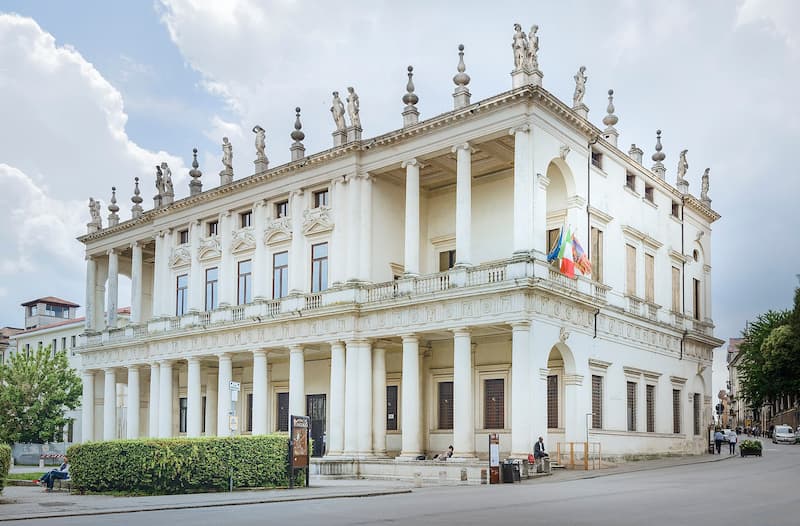
Visiting Vicenza: Architectural Wonders of Palladio
The UNESCO World Heritage property “City of Vicenza and the Palladian Villas of the Veneto” is an exceptional collection of 16th-century architectural masterpieces located across the Veneto region of northeastern ITALY. Inscribed by UNESCO, the site comprises the urban historic center of Vicenza—which contains 23 monumental palaces and civic structures designed by the revolutionary Renaissance master Andrea Palladio—alongside 24 rural Palladian villas scattered across the surrounding countryside and provinces of the Veneto. Andrea Palladio (1508–1580) transformed urban and rural architectural design by synthesizing classical Roman proportions with practical Renaissance function.
Inside Vicenza, key Palladian landmarks include the Basilica Palladiana with its grand loggia overlooking Piazza dei Signori, Palazzo Chiericati, and the world-famous Teatro Olimpico—the oldest surviving covered wooden theater of the modern era, featuring a fixed perspective stage set depicting ancient streets. Outside the city center, the rural villas were constructed as functional agricultural estates that doubled as elegant country retreats for wealthy Venetian noble families. Celebrated rural estates include Villa Almerico Capra (La Rotonda), a symmetrical square structure crowned by a central dome and four temple porticoes, Villa Foscari (La Malcontenta) along the Brenta Canal, Villa Barbaro at Maser, and Villa Emo at Vedelago.
Attraction
The site draws visitors globally because it serves as the birthplace of “Palladianism”—an architectural philosophy that fundamentally reshaped Western architecture for centuries, inspiring iconic structures worldwide, including Thomas Jefferson’s Monticello and the United States Capitol. Architecture enthusiasts, art historians, and travelers gather in the Veneto to study Palladio’s groundbreaking use of symmetry, mathematical proportions, temple facades, and harmonic integration into natural landscapes.
Beyond architectural study, tourists are drawn by the seamless blend of high culture and idyllic countryside leisure. Exploring the rural villas allows travelers to experience the serene beauty of the Venetian hinterland, framed by manicured gardens, vineyards, and winding historic waterways. Visitors can attend live theatrical or classical music performances inside the wooden auditorium of the Teatro Olimpico, cycle along scenic countryside routes connecting individual estates, and sample renowned regional products such as Prosecco wine and traditional Venetian gastronomy in historic village taverns.

World Heritage
In 1994, UNESCO inscribed the City of Vicenza on the World Heritage List, expanding the property in 1996 to include the Palladian villas scattered across the Veneto region.The site fulfills cultural criteria (i) and (ii).
- Masterpiece of Human Creative Genius (Criterion i):Vicenza represents an exceptional artistic achievement through the numerous architectural contributions of Andrea Palladio integrated into its historic urban fabric.The scattered rural villas demonstrate the master’s constant typological experimentation and creative genius in reinterpreting classical Roman architectural patterns.
- Profound Global Influence (Criterion ii):Palladio’s works inspired a global architectural movement named after him—Palladianism—which spread rapidly across Europe, North America, and beyond. His architectural treatise, I Quattro Libri dell’Architettura (The Four Books of Architecture), along with his built works, fundamentally shaped architectural theory and urban design for over three centuries.
Gateway
Travelers accessing the site can utilize four practical Italian gateway cities equipped with IATA-coded airports, lodging inventory, transit links, and tour operators:
- Venice (Primary Regional Gateway):
- Airport: Venice Marco Polo Airport (IATA Code: VCE; ICAO Code: LIPZ).
- Infrastructure: Located 60 kilometers east. Direct Trenitalia trains run from Venice to Vicenza in 30 to 45 minutes. Venice offers extensive lodging, car rentals, and tour packages.
- Verona (Western Regional Gateway):
- Airport: Verona Villafranca Airport (IATA Code: VRN; ICAO Code: LIPX).
- Infrastructure: Located 50 kilometers west. Direct trains run from Verona Porta Nuova to Vicenza in under 30 minutes, supported by plentiful hotels and tour options.
- Treviso (Secondary Regional Gateway):
- Airport: Treviso Airport “Antonio Canova” (IATA Code: TSF; ICAO Code: LIPH).
- Infrastructure: Located 60 kilometers northeast. Rail and bus networks connect Treviso to Vicenza and northern villas in under an hour.
- Vicenza (Direct Municipal Gateway):
- Airport:Vicenza Airport “Tommaso Dal Molin” (IATA Code: VIC; ICAO Code: LIPT).
- Infrastructure: Located directly within Vicenza municipality, holding an official IATA code. Vicenza provides abundant lodging, transit options, and local tour guides.
When
The ideal time to explore Vicenza and the Palladian Villas is during Spring (April to June) and Autumn (September to October).
- Spring and Autumn: These shoulder seasons offer delightful weather with comfortable average daytime temperatures ranging between 16°C and 23°C (61°F to 73°F). Pleasant sunshine and moderate humidity make walking urban cobblestone streets and driving through rural estate landscapes very enjoyable. Blooming gardens in spring and colorful vineyard foliage in autumn add extraordinary scenic beauty.
- Summer (July to August): Temperatures frequently exceed 32°C (90°F) with high humidity, making afternoon sightseeing demanding, though warm summer evenings host vibrant open-air cultural festivals.
- Winter (November to March): Winters are cool and foggy with temperatures ranging between 2°C and 10°C (36°F to 50°F). While tourist crowds are sparse, several rural villas operate on reduced opening schedules or close temporarily for maintenance.
Considerations
- Scattered Villa Locations and Transit: While the 23 urban Palladian monuments in Vicenza can be explored easily on foot, the 24 rural villas are scattered across several provinces. Renting a car, hiring a private driver, or booking organized tour excursions is highly recommended to visit multiple countryside villas efficiently.
- Varied Opening Schedules and Private Ownership: Many Palladian villas remain privately owned family residences. Some estates open to the public only on specific days of the week, require advance ticket reservations, or restrict entry strictly to garden grounds.
- Combined Sightseeing Passes:Visitors exploring Vicenza should purchase the official municipal museum pass (Vicenza Card), which provides discounted access to major sights including the Teatro Olimpico, Basilica Palladiana, and Palazzo Chiericati.
- Footwear and Accessibility: Sightseeing involves walking across historic stone paving, gravel garden walkways, and steep staircases without modern elevator infrastructure.

Resources
- UNESCO World Heritage Centre: Official UNESCO repository containing technical inscription records, site boundaries, and criteria documentation.
- Consorzio Turistico Vicenzaè: Official tourist board portal offering comprehensive villa itineraries, event schedules, and transit advice.
- Palladian UNESCO Heritage Digital Archive: Curated regional archive providing detailed architectural profiles, interactive villa filters, and visiting guides.
- Istituto Regionale Ville Venete (IRVV): Regional institutional network portal providing official historical records and visitor guidelines for Veneto villas.
- Trip.com: Major global travel platform featuring user reviews, community travel advice, hotel reservations, and local tour booking options.


Comments:
Leave a Reply