The Last Supper: History and Art at Santa Maria delle Grazie
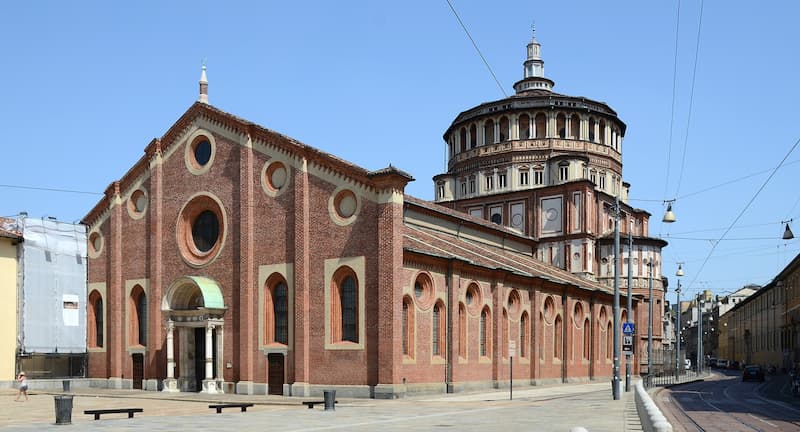
The “Church and Dominican Convent of Santa Maria delle Grazie with ‘The Last Supper’ by Leonardo da Vinci” is an extraordinary religious and artistic complex situated in the heart of Milan, Lombardy, in northern ITALY. Constructed during the second half of the 15th century, the site stands as a supreme architectural monument of the Italian Renaissance. The original Gothic church nave was commissioned by Duke Francesco I Sforza and designed by architect Guiniforte Solari, completed around 1469. Later, Duke Ludovico Sforza (“Il Moro”) transformed the complex into a grand mausoleum for the Sforza dynasty. To achieve this vision, he commissioned the celebrated architect Donato Bramante, who added a majestic Renaissance drum, a hemispherical dome, a delicate cloister (Chiostrino delle Rane), and a grand, light-filled tribune.
The defining jewel of this complex is located in the refectory (Cenacolo) of the Dominican convent, adjacent to the main basilica. On the end wall of this monastic dining hall, Leonardo da Vinci painted his monumental masterpiece, The Last Supper (Il Cenacolo), between 1495 and 1498. Measuring approximately 4.6 by 8.8 meters, the mural captures the exact psychological reaction of Christ’s twelve apostles immediately following his revelation that one of them would betray him. Opposite Leonardo’s mural sits another magnificent artwork: a massive fresco depicting The Crucifixion, painted in 1495 by the Lombard artist Giovanni Donato da Montorfano.
Attraction
This site attracts global travelers because it houses one of the most famous, influential, and universally recognized works of art in human history. Leonardo da Vinci’s The Last Supper fundamentally transformed Western art by introducing radical innovations in linear perspective, natural lighting, and emotional realism. Rather than painting static figures, Leonardo grouped the apostles into dynamic clusters of three, capturing a wide spectrum of human expressions—ranging from shock and horror to grief and defense. The trompe-l’œil perspective extends the real space of the refectory into a fictional room, drawing viewers directly into the dramatic sacred event.
Beyond the singular lure of Leonardo’s masterpiece, visitors are drawn to the architectural brilliance of the complex itself. The transition between Solari’s traditional Gothic brickwork nave and Bramante’s sublime Renaissance tribune provides art lovers with an unparalleled visual lesson in Italian architectural history. Tourists are also fascinated by the sheer survival story of the refectory, which narrowly escaped complete destruction during World War II Allied bombing raids in August 1943 thanks to protective sandbags piled against the wall. Observing the masterpiece in its original monastic setting creates a profound, once-in-a-lifetime cultural journey.

World Heritage
In 1980, UNESCO inscribed the Church and Dominican Convent of Santa Maria delle Grazie with “The Last Supper” by Leonardo da Vinci on the World Heritage List under cultural criteria (i) and (ii).
- Masterpiece of Human Creative Genius (Criterion i): UNESCO recognized The Last Supper as a unique, incomparable artistic achievement. Leonardo broke with traditional fresco techniques by applying tempera and oil directly onto dry plaster, allowing him to achieve subtle shading (sfumato) and fine psychological detail. The mural heralded a brand-new phase in the history of art, marking the birth of the High Renaissance.
- Profound Artistic Influence (Criterion ii): The work exerted a decisive influence on European art for centuries. Leonardo’s groundbreaking spatial composition, expressive figure drawing, and mastery of perspective set new artistic benchmarks that influenced generations of painters, sculptors, and architects throughout Europe. Additionally, the architectural complex reflects the harmonious collaboration between master builders Solari and Bramante during a pivotal historical period in Milan.
Gateway
Travelers bound for Santa Maria delle Grazie can utilize several practical Italian gateway cities equipped with active IATA-coded airports, comprehensive lodging options, public transit infrastructure, and tour operators:
- Milan (Primary Direct Gateway):
- Airports: Milan Malpensa Airport (IATA Code: MXP), Milan Linate Airport (IATA Code: LIN), and Orio al Serio / Bergamo Airport (IATA Code: BGY).
- Infrastructure: Situated directly inside the metropolitan area. Milan offers high-speed rail connections at Milano Centrale and Milano Cadorna, extensive metro lines (M1/M2 stopping at Conciliazione or Cadorna), tram links, thousands of hotels and guesthouses across all budgets, and licensed tour guides.
- Bergamo (Eastern Lombardy Gateway):
- Airport: Orio al Serio International Airport / Milan Bergamo Airport (IATA Code: BGY).
- Infrastructure: Located 50 kilometers east of Milan. Frequent direct airport shuttle buses and regional trains connect Bergamo to central Milan in under 50 minutes. Bergamo provides historical lodging options, car rentals, and regional tour agencies.
- Turin (Western Piedmont Gateway):
- Airport: Turin Airport “Sandro Pertini” (IATA Code: TRN).
- Infrastructure: Located 140 kilometers west of Milan. High-speed trains (Frecciarossa and Italo) run constantly from Turin Porta Nuova to Milano Centrale in 45 to 50 minutes, providing a practical secondary gateway with ample accommodation choices.
When
The ideal time to visit Milan and the Santa Maria delle Grazie complex is during Spring (April to May) and Autumn (September to October).
- Spring and Autumn: These shoulder seasons feature pleasant, comfortable weather with daytime temperatures averaging 15°C to 22°C (59°F to 72°F). The mild conditions make walking through Milan’s historic neighborhoods enjoyable while avoiding extreme summer temperatures.
- Summer (July to August): Temperatures frequently exceed 32°C (90°F) with high humidity, and many local family-run businesses close during the August Ferragosto holiday period.
- Winter (November to March): Brings cool, misty, and foggy conditions with temperatures ranging from 2°C to 10°C (36°F to 50°F). However, winter provides quiet street atmospheres and lower hotel prices across the city.
Considerations
- Strict Ticket Reservations: Access to The Last Supper is notoriously difficult. To protect the fragile painting from humidity and dust, entry is strictly limited to small groups of roughly 25 to 30 people every 15 minutes. Official tickets sell out months in advance within minutes of release; advance booking is mandatory.
- Time Limits inside the Refectory: Visitors are permitted a strict maximum of 15 minutes inside the refectory viewing room. Guests must pass through air-filtered decontamination chambers before entering.
- Religious Decorum and Dress Code: Santa Maria delle Grazie is an active Catholic church. Modest clothing covering shoulders and knees is required when entering the main basilica.
- Strict Photography Regulations: Photography inside the refectory is strictly regulated (no flash, tripod, or commercial filming gear allowed).

(Francecsco Sgroi, Flickr/CC BY 2.0).
Resources
- UNESCO World Heritage Centre: Official UNESCO portal detailing technical inscription records, criteria, and preservation reports.
- Museo del Cenacolo Vinciano: Official museum website providing official ticket releases, visiting hours, and restoration details.
- YesMilano (Official Tourism Board): Official tourism portal for the City of Milan featuring neighborhood guides, transit maps, and event calendars.
- Italia.it: Official Italian national tourism portal offering practical travel advice and cultural background for Lombardy.
- Trip.com: Leading global travel review platform offering community reviews, hotel bookings, and guided tour packages.
Featured Image
Church of Santa Maria delle Grazie (Marcin Bialek, Wikimedia/CC BY-SA 3.0).
News Feed
Advertisement


Comments:
Leave a Reply