Explore Castel del Monte: Italy’s Geometric Treasure
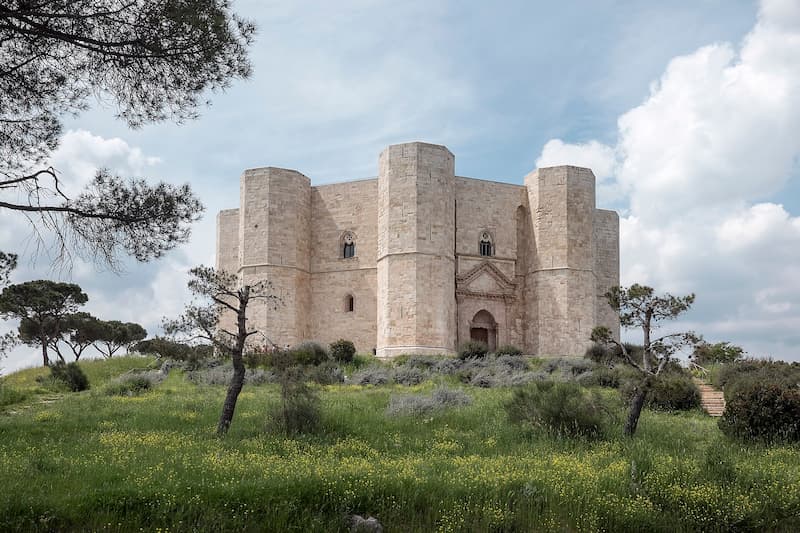
Castel del Monte is a extraordinary 13th-century medieval citadel standing prominently atop a solitary 540-meter limestone hill in the Alta Murgia region of Apulia (Puglia), southern ITALY. Erected around 1240 by the Holy Roman Emperor Frederick II of Hohenstaufen, this architectural marvel is celebrated globally for its rigorous geometric design and mathematical symmetry. Constructed from local pale limestone and breccia stone, the structure features a perfect octagonal plan with eight octagonal towers positioned at each corner.
The interior layout consists of sixteen trapezoidal rooms arranged across two levels surrounding an open octagonal courtyard. Unlike traditional medieval castles of its era, Castel del Monte was built without typical defensive military features such as a surrounding moat, drawbridge, arrow slits, or defensive battlements. Historical scholars suggest that Frederick II—an enlightened monarch renowned for his passion for science, philosophy, falconry, and mathematics—conceived the edifice not as a defensive fortress, but rather as an imperial hunting lodge, an astronomical retreat, or a symbolic monument celebrating cosmic order and royal majesty.
Attraction
Castel del Monte captivates international travelers through its mysterious origins, mathematical precision, and striking visual presence on the Apulian landscape. Often called the “Crown of Apulia,” its prominent position makes the pale stone octagonal crown visible from miles away across surrounding olive groves and vineyards. Visitors are intrigued by the heavy esoteric symbolism embedded within its design, where the recurring number eight—symbolizing the infinity of the heavens and the connection between earth and divinity—dictates every structural element.
The site attracts lovers of history, architecture, and astronomy who flock to experience the unique light play created inside the upper chambers during solstice and equinox cycles. Photographers and sightseers are drawn to the dramatic contrast between the stark, austere stone walls and the sweeping panoramas of the Adriatic coastline and Apulian countryside. Furthermore, its iconic status in Italian heritage is recognized by millions worldwide, as the castle’s octagonal outline is depicted on the reverse side of the Italian one-cent Euro coin.

World Heritage
In 1996, UNESCO inscribed Castel del Monte on the World Heritage List under cultural criteria (i), (ii), and (iii).
- Masterpiece of Human Creative Genius (Criterion i):UNESCO recognized the castle as a unique architectural masterpiece due to the mathematical and astronomical perfection of its layout. It represents an unparalleled fusion of exact geometry, aesthetic harmony, and scientific knowledge during the High Middle Ages.
- Intercultural Synthesis (Criterion ii):The structure demonstrates a harmoniously balanced synthesis of diverse cultural and artistic traditions.It seamlessly blends classical Roman antiquity (visible in the main entrance portal), Islamic architectural principles and hydraulic engineering (reflected in the bath systems and floor geometry), and Northern European Cistercian Gothic masonry techniques.
- Exceptional Cultural Symbolism (Criterion iii): The monument offers an exceptional physical testimony to the personality, humanistic vision, and cosmopolitan court culture of Emperor Frederick II, serving as a rare surviving physical expression of medieval political and intellectual philosophy.
Gateway
Travelers bound for Castel del Monte can utilize three primary gateway cities within Italy equipped with active IATA-coded airports, established accommodation options, highway access, and tour services:
- Bari (Primary Regional & International Gateway):
- Airport: Bari Karol Wojtyła Airport (IATA Code: BRI; ICAO Code: LIBD).
- Infrastructure: Located 55 kilometers east of Castel del Monte. Bari is Apulia’s regional capital, offering high-speed rail, regional Ferrotramviaria train services connecting to Andria and Barletta, car rentals, and extensive lodging options. Licensed tour operators run direct shuttle excursions to the castle.
- Foggia (Northern Gateway):
- Airport: Foggia “Gino Lisa” Airport (IATA Code: FOG; ICAO Code: LIBF).
- Infrastructure: Situated roughly 75 kilometers northwest. Connected via the A14 motorway and Trenitalia regional rail stopping in Barletta, Foggia offers hotel options, car rentals, and regional transit links accessing the northern Apulian countryside.
- Brindisi (Southern Coastal Gateway):
- Airport: Brindisi Salento Airport (IATA Code: BDS; ICAO Code: LIBR).
- Infrastructure: Located 170 kilometers southeast. Connected by coastal rail lines and the SS16 highway, Brindisi serves as an alternate gateway for travelers pairing visits to Castel del Monte with coastal Salento itineraries.
When
The ideal time to visit Castel del Monte is during Spring (April to June) and Autumn (September to October).
- Spring and Autumn: These shoulder seasons offer pleasant, temperate weather with average daytime temperatures ranging between 18°C and 25°C (64°F to 77°F). The mild climate is ideal for walking up the hill and exploring the open-air grounds. Spring coats the surrounding plateau in wild blossoms, while autumn brings local grape and olive harvest activities across Apulia.
- Summer (July to August): Temperatures frequently exceed 35°C (95°F) with intense sun exposure on the exposed hill, accompanied by heavy tour bus crowds and longer wait times.
- Winter (November to March): Brings cool, windy weather with occasional rain and fog, though visitor numbers drop significantly, allowing for quiet exploration.
Considerations
- Shuttle Bus and Hill Access: Private vehicles and public buses park at a designated parking facility located roughly one kilometer from the castle gates. Visitors must either walk up a paved incline or take the small local electric shuttle bus that operates between the parking area and the monument entrance.
- Ticket Reservations: Entry ticket reservations with designated time slots are mandatory or strongly encouraged during peak travel months to manage visitor capacity inside the rooms.
- Footwear and Accessibility: The site involves walking along stone paths, inclines, and interior spiral staircases made of worn stone. Sturdy walking shoes with reliable traction are strongly recommended.
- Limited Amenities on Site: Facilities immediately adjacent to the castle are minimal. Visitors should carry drinking water, sun protection, and hats, particularly during warm months when shade on the hill is sparse.

Resources
- UNESCO World Heritage Centre: Official UNESCO portal detailing technical inscription history, criteria details, and conservation documentation.
- Ministero della Cultura – Castel del Monte: Official Italian Ministry of Culture portal providing official ticket bookings, opening hours, and visitor protocols.
- Viaggiare in Puglia: Official Apulian regional tourism authority platform offering travel advice, transport links, and regional cultural itineraries.
- Italia.it: Official Italian national tourism portal detailing historical context, travel routes, and regional attraction guides.
- Trip.com: Major global travel platform featuring user reviews, community travel advice, hotel reservations, and local tour booking options.
Castel del Monte: Visitor Guide
1. Site Description
The UNESCO World Heritage site titled “Castel del Monte” is a 13th-century fortress situated in the municipality of Andria, within the Apulia (Puglia) region of southeastern Italy.Perched atop an isolated rocky peak 540 meters above sea level in the Alta Murgia National Park, the castle was constructed in 1240 under orders of Holy Roman Emperor Frederick II of Hohenstaufen.
The fortress is famous globally for its strict mathematical layout based entirely on a regular octagonal plan.The main structure features an eight-sided perimeter flanked at each of its eight corners by an octagonal tower.Inside, the layout consists of sixteen trapezoidal rooms—eight on the ground floor and eight on the upper level—arranged symmetrically around an octagonal central open courtyard.Constructed from local limestone, coral breccia, and white marble accents, Castel del Monte displays a unique synthesis of architectural traditions.It harmoniously integrates Northern European Cistercian Gothic structural principles, Islamic decorative and hydraulic systems, and classical Roman antiquity motifs.
2. What Makes it an Attraction to Tourists Worldwide?
Castel del Monte fascinates international visitors due to its extraordinary geometric perfection, symbolic design, and mysterious historical origins.The recurring motif of the number eight—symbolizing the intermediate shape between the square (representing Earth) and the circle (representing the heavens)—endows the fortress with profound astronomical and mathematical intrigue.
The site’s exact historical purpose remains a subject of ongoing scholarly debate.Lacking traditional defensive features such as a moat, drawbridge, or arrow slits, and being too small for a full royal court residence, theories suggest it served as a hunting lodge, an astronomical observatory, a wellness bathhouse, or a symbolic monument celebrating imperial power.Furthermore, its solitary crown-like position on a hill delivers 360-degree panoramic views across rolling Apulian olive groves to the Adriatic coastline.The castle’s iconic aesthetic status is so culturally resonant in Italy that its silhouette is featured on the reverse of the Italian one-cent Euro coin.
3. Why the Site is a UNESCO World Heritage Site
UNESCO inscribed Castel del Monte on the World Heritage List in 1996 under cultural criteria (i), (ii), and (iii):
- Criterion (i) – Human Creative Genius:The fortress represents a unique masterpiece of medieval architecture due to its formal geometric perfection and the seamless integration of classical antiquity, Islamic Oriental design, and Cistercian Gothic structural engineering.
- Criterion (ii) – Interchange of Human Values:The structure is inseparably tied to Emperor Frederick II of Hohenstaufen, illustrating the cosmopolitan intellectual environment of his reign.By bringing together Greek, Arab, Jewish, and Latin scholars at court, Frederick II created a cultural syncretism that prefigured modern humanism.
- Criterion (iii) – Exceptional Cultural Testimony:Castel del Monte serves as an exceptional physical testament to the broad Mediterranean policy and enlightened humanistic vision of a Germanic emperor who harmonized diverse artistic traditions from across Western and Middle Eastern civilizations.
4. Gateway Cities with IATA-Coded Airports
5. Best Time to Visit
The optimal periods to experience Castel del Monte are Spring (April to June) and Autumn (September to October).
- Spring: Features pleasant daytime temperatures ranging from 16°C to 24°C (61°F to 75°F), clear weather, and green landscapes blooming across the surrounding Murgia plateau.
- Autumn: Delivers comfortable weather between 18°C and 25°C (64°F to 77°F) with lower humidity and smaller tourist crowds following the peak summer vacation rush.
- Summer (July to August): Brings scorching temperatures frequently exceeding 35°C (95°F) with intense sun exposure on the exposed hill, alongside longer queue lines.
- Winter (November to March): Characterized by cool temperatures (5°C to 13°C / 41°F to 55°F) and strong winds on the peak, though crowd levels are minimal.
6. Key Considerations Before Visiting
- Transport and Parking Logistics: Driving or booking a guided tour is recommended. Vehicles must park in a designated parking lot at the foot of the hill. Visitors take an electric shuttle bus or complete a 10-to-15-minute uphill walk to the castle entrance.
- Interior Furnishings:Centuries of abandonment led to the stripping of internal marble wall cladding, tapestries, and sculptures.Visitors should manage expectations: the appeal lies in architectural geometry, vaulted ceilings, and spatial proportions rather than furnished rooms.
- Ticket Reservations: Entry is limited by hourly capacity caps. Purchasing timed entry tickets online in advance is essential during spring weekends and peak summer months.
- Sun and Wind Protection: The isolated hilltop position leaves the exterior exposed to elements. Carry water, sunscreen, hats in warm months, and windproof outer garments in cooler seasons.
7. Recommended Informational Websites
- UNESCO World Heritage Centre: Official site outlining property criteria, boundaries, and conservation documentation. (Website:
whc.unesco.org) - Direzione Regionale Musei Puglia: Official government portal detailing visitor opening hours, entry pricing, and historical background. (Website:
museipuglia.cultura.gov.it) - Italia.it: Official Italian National Tourism Board portal featuring Apulian travel itineraries and cultural guides. (Website:
www.italia.it) - Viaggiare in Puglia: Official regional tourism website providing local transportation, event calendars, and regional maps. (Website:
www.viaggiareinpuglia.it) - GetYourGuide: Popular online travel marketplace offering guided tours, transport packages, and affiliate booking options. (Website:
[www.getyourguide.com](https://www.getyourguide.com))
Total Word Count: 971 words


Comments:
Leave a Reply