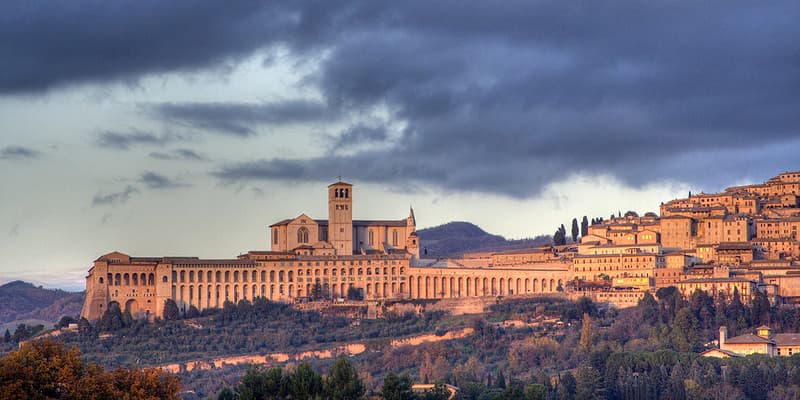
Exploring UNESCO Heritage: Assisi and the Franciscan Legacy
The UNESCO World Heritage site titled “Assisi, the Basilica of San Francesco and Other Franciscan Sites” is situated on the slopes of Mount Subasio in the Umbria region of central ITALY. The property encompasses the medieval hilltop city of Assisi along with key religious sanctuaries spread across the surrounding valley, celebrating the spiritual legacy of Saint Francis (1182–1226) and Saint Clare (1194–1253).
The designated property includes:
- The Basilica of San Francesco: A sanctuary consisting of two layered churches. The Lower Basilica features low vaulted ceilings decorated with frescoes by Pietro Lorenzetti and Simone Martini, leading to Saint Francis’s tomb. The Upper Basilica boasts soaring Gothic architecture lit by stained-glass windows and adorned with Giotto’s 28-panel fresco cycle depicting Saint Francis’s life.
- The Basilica of Santa Maria degli Angeli: A massive 16th-century basilica in the valley encapsulating the Porziuncola, the chapel where Francis established the Franciscan Order, and the Transit Chapel where he died.
- The Basilica of Santa Chiara: Built in Italian Gothic style, housing Saint Clare’s tomb and the historic San Damiano Crucifix.
- San Damiano Sanctuary: A rural monastery where Francis experienced his conversion and Clare founded the Poor Clares.
- Eremo delle Carceri: A mountain hermitage in dense oak forests on Mount Subasio, used by Francis for solitary prayer.
- Rivo Torto: A valley sanctuary preserving rustic stone hovels that served as the earliest Franciscan shelter.
- Historic Center of Assisi: Features medieval stone architecture, the ancient Roman Temple of Minerva, and the hilltop fortress of Rocca Maggiore.
Attraction
Assisi attracts millions of global visitors each year by offering a rare, harmonious convergence of world-class medieval art, extraordinary gothic architecture, and profound spiritual tranquility. Art historians and cultural enthusiasts consider the Basilica of San Francesco an essential destination because its interior walls display one of the most celebrated fresco cycles in Western art history. Legendary masters of the 13th and 14th centuries, including Giotto, Cimabue, Pietro Lorenzetti, and Simone Martini, revolutionized European painting here by shifting away from stylized Byzantine iconography toward expressive, humanistic storytelling.
Beyond its artistic treasures, Assisi serves as an enduring global beacon for spiritual pilgrims, interfaith dialogue, and peace advocates. Millions travel to pray at the tomb of Saint Francis or to experience the peaceful, stone-paved streets that radiate an atmosphere of contemplation and historical continuity. The town’s preserved medieval character, sweeping vistas of olive groves, regional Umbrian culinary traditions, and vibrant religious observances—such as the Feast of Saint Francis and solemn Easter processions—combine to deliver a deeply moving and memorable travel experience.

World Heritage
In 2000, UNESCO inscribed “Assisi, the Basilica of San Francesco and Other Franciscan Sites” on the World Heritage List under cultural criteria (i), (ii), (iii), (iv), and (vi).
- Masterpiece of Creative Genius (Criterion i): Assisi represents an extraordinary ensemble of artistic masterpieces. The decorative fresco cycles within the Basilica of San Francesco created by Giotto and other medieval masters stand as monumental achievements of human creativity that fundamentally altered the development of Western painting.
- Interchange of Values (Criterion ii): The artistic and spiritual movement originating in Assisi facilitated a major international exchange of ideas. The Franciscan Order’s architectural style and decorative programs profoundly influenced art and building traditions across Europe.
- Unique Civilizational Testimony (Criterion iii): Assisi provides an exceptional example of a sanctuary-city maintaining physical and spiritual continuity within its natural setting from Roman and medieval times to the present day.
- Outstanding Architectural Ensemble (Criterion iv): The religious complexes and urban layout present an outstanding ensemble illustrating key developmental stages in European medieval religious architecture.
- Association with Universal Beliefs (Criterion vi): The city is directly associated with the life and universal message of peace, tolerance, and environmental brotherhood established by Saint Francis and Saint Clare.
Gateway
Travelers accessing Assisi can utilize three main gateway cities within Italy featuring IATA-coded airports, lodging options, public transit, and tour operators:
- Perugia (Immediate Regional Gateway):
- Airport: Perugia San Francesco d’Assisi – Umbria International Airport (IATA Code: PEG).
- Infrastructure: Located 15 kilometers west of Assisi. PEG provides regional flights, car rentals, and shuttle bus links to Assisi. Perugia offers hotels and guided excursion options.
- Rome (Capital & International Gateway):
- Airports: Rome Leonardo da Vinci–Fiumicino Airport (IATA Code: FCO) and Rome Ciampino Airport (IATA Code: CIA).
- Infrastructure: Located 170 kilometers south. Trenitalia trains connect Rome Termini to Assisi / Santa Maria degli Angeli station in roughly two hours. Rome provides extensive lodging, car rentals, and tour packages.
- Florence (Tuscan Gateway):
- Airport: Florence Airport, Amerigo Vespucci (IATA Code: FLR).
- Infrastructure: Located 180 kilometers northwest. Direct trains connect Florence to Assisi in two and a half hours, offering lodging, car rentals, and tour connections.
When
The best time to visit Assisi is during Spring (April to June) and Autumn (September to October).
- Spring and Autumn: These shoulder seasons offer comfortable weather with daily temperatures averaging 16°C to 23°C (61°F to 73°F), ideal for walking up steep limestone inclines. Spring brings lush green vegetation across the Subasio valley, while autumn offers golden foliage, harvest festivals, and wine tastings. Crowds are lighter than in peak summer, making visits to sacred chapels peaceful.
- Summer (July to August): Temperatures often exceed 32°C (90°F), and major holy sites experience dense tour group traffic.
- Winter (November to March): Quiet and crisp, with daytime temperatures around 8°C to 12°C. While cold, winter offers a solemn atmosphere and minimal lines at major basilicas, except around Christmas and New Year.
Considerations
- Religious Decorum and Dress Code: Active places of worship strictly enforce dress standards. Shoulders and knees must be covered, hats must be removed inside basilicas, and silent respect is expected near tombs and crypts.
- Photography Restrictions: Photography and videography are strictly prohibited inside the Upper and Lower Basilicas of San Francesco to protect fragile medieval frescoes and maintain a prayerful environment.
- Topography and Footwear: The historic city is built on a steep hill with uneven stone paving, steep stairways, and high inclines. Comfortable, non-slip walking shoes are required.
- Traffic Restrictions (ZTL): Driving inside Assisi’s historic core is restricted to residents. Visitors arriving by vehicle must utilize paid public parking garages outside the city gates (such as Mojano or Matteotti) and access the center on foot or via public escalators.

Resources
- UNESCO World Heritage Centre: Official UNESCO repository containing technical inscription records, criteria details, and state-of-conservation reports for Assisi.
- San Francesco d’Assisi Official Portal: Official sanctuary website maintained by the Sacred Convent, providing service schedules, fresco details, and pilgrim resources.
- Italia.it: Official Italian national tourism portal offering cultural itineraries, travel logistics, and regional guidebooks for Umbria.
- Umbria Tourism: Regional tourism platform offering information on events, transportation, and Franciscan trekking routes.
- Trip.com: Leading global travel platform featuring user reviews, hotel reservations, guided tour bookings, and practical visitor feedback.


Comments:
Leave a Reply