The Majestic Caserta Palace: History, Gardens, and Aqueduct
The UNESCO World Heritage site titled “18th-Century Royal Palace at Caserta with the Park, the Aqueduct of Vanvitelli, and the San Leucio Complex” is located in the Campania region of southern ITALY, 30 kilometers north of Naples. Inscribed on the World Heritage List in 1997, this ensemble represents an exceptional realization of 18th-century Enlightenment urban planning and royal grandeur. Commissioned by Bourbon King Charles III and designed by architect Luigi Vanvitelli, the complex comprises three interconnected components:
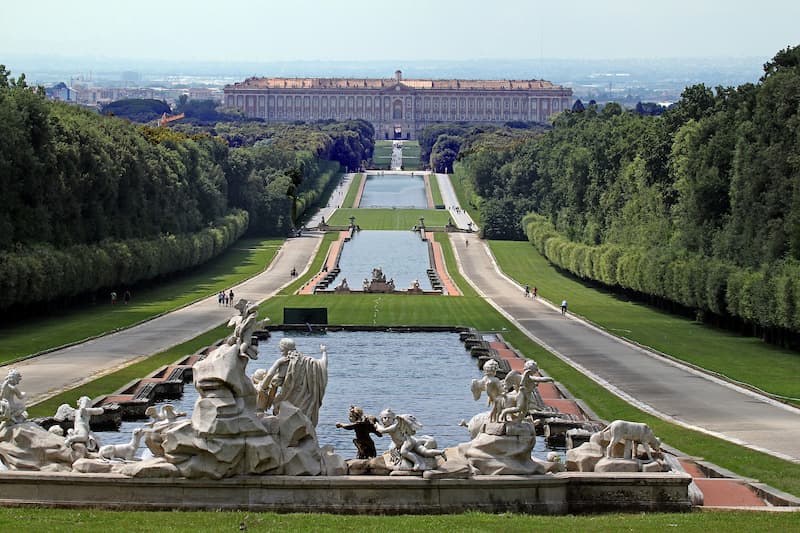
- The Royal Palace (Reggia di Caserta) and Park: The world’s largest former royal residence by volume contains 1,200 rooms, 34 staircases, 1,742 windows, the Grand Staircase of Honour, a Palatine Chapel, a historic Palatine Library, and a Court Theatre modeled after Naples’ Teatro San Carlo. The palace opens onto a 120-hectare Royal Park extending three kilometers along a water axis (Via d’Acqua). It features Baroque fountains inspired by classical mythology—including the Fountain of Diana and Actaeon—fed by cascades, and an English Garden established in 1786.
- The Aqueduct of Vanvitelli (Acquedotto Carolino): A 38-kilometer hydraulic engineering marvel constructed to transport water from Mount Taburno to feed palace fountains, park cascades, gardens, and local mills. Its defining landmark is the triple-tiered arched bridge spanning the Pontano Valley (Ponti della Valle) in Valle di Maddaloni.
- The San Leucio Complex: A royal silk-weaving colony created by Ferdinand IV. San Leucio combined industrial textile facilities with worker housing, schools, and an egalitarian code of laws based on social welfare and industrial merit.
Attraction
The Caserta complex attracts international travelers through its breathtaking scale, opulent Late Baroque and Neoclassical art, and harmonious synthesis of architecture, nature, and engineering. Visitors are awestruck by the grand Staircase of Honor (Scalone d’Onore), a massive double-flight marble staircase flanked by majestic lion sculptures that leads into the octagonal Upper Vestibule and the gilded Throne Room. The Royal Apartments display pristine period furnishings, intricate frescoes, gilded stuccoes, and the magnificent Court Theatre—a miniature replica of Naples’ famed Teatro San Carlo.
Outside, tourists can stroll or take horse-drawn carriage rides along the central water axis, culminating at the grand Fountain of Diana and Actaeon beneath a dramatic rushing waterfall. The English Garden offers tranquil winding paths through exotic botanical collections, artificial ruins, and romantic grottos. Furthermore, visitors can explore the Aqueduct’s soaring arches at the Ponti della Valle near Valle di Maddaloni, or tour the Silk Museum and historic looms at San Leucio to discover 18th-century industrial history.

World Heritage
In 1997, UNESCO inscribed the complex on the World Heritage List under cultural criteria (i), (ii), (iii), and (iv).
- Masterpiece of Creative Genius (Criterion i): The complex is a supreme masterpiece created by Luigi Vanvitelli, demonstrating an unparalleled integration of monumental architecture, grand parkland design, regional urban planning, and advanced hydraulic engineering into a single unified vision.
- Interchange of Human Values (Criterion ii): The site demonstrates a profound interchange of architectural and landscape concepts across Enlightenment Europe. It synthesizes French landscape design, Italian Late Baroque drama, and early Neoclassical urbanism into a model that influenced royal residences worldwide.
- Testimony to 18th-Century Civilization (Criterion iii): The ensemble offers an exceptional physical testimony to the courtly culture, political ambition, and Enlightenment ideals of the Bourbon Dynasty, illustrating how royal power was projected through monumental public works.
- Outstanding Architectural Ensemble (Criterion iv): The property represents an outstanding architectural ensemble that successfully combines a royal administrative palace, a vast engineered landscape, a regional water supply infrastructure, and a pioneering social-industrial utopian community at San Leucio.
Gateway
Travelers visiting the site can conveniently use three gateway cities in Italy with IATA-coded airports, lodging, transport infrastructure, and tours:
- Naples (Primary Regional Gateway):
- Airport: Naples International Airport (IATA Code: NAP; ICAO Code: LIRN).
- Infrastructure: 30 kilometers south. Direct regional trains run continuously from Napoli Centrale to Caserta station (opposite the palace gate) in 30 to 40 minutes. Naples offers extensive hotels, public transit, and licensed guides.
- Rome (Primary National Gateway):
- Airports: Rome Leonardo da Vinci–Fiumicino Airport (IATA Code: FCO) and Rome Ciampino Airport (IATA Code: CIA).
- Infrastructure: High-speed trains depart from Roma Termini directly to Caserta in approximately 1 hour and 10 minutes, making day trips or overnight stays seamlessly accessible.
- Salerno (Secondary Regional Gateway):
- Airport:Salerno Costa d’Amalfi Airport (IATA Code: QSR; ICAO Code: LIRI).
- Infrastructure: 85 kilometers south. Salerno provides a coastal urban base with direct rail and highway links to Caserta, abundant lodging, and tour operators.
When
The best time to visit the Caserta complex is during Spring (April to June) and Autumn (September to October).
- Spring: Spring offers ideal weather conditions with mild temperatures and sunny skies. The Royal Park and English Garden are in full bloom, making walking or cycling along the 3-kilometer park axis comfortable and visually striking.
- Autumn: Autumn features pleasant weather, lower seasonal humidity, and fewer tourist crowds, allowing for relaxed exploration of the Royal Apartments and the San Leucio silk complex.
- Summer (July to August): Summers can be intense, with temperatures frequently exceeding 35°C (95°F). Navigating the unshaded outdoor park grounds during midday can be physically exhausting.
- Winter (November to March): Winters are mild but bring frequent rainfall and shorter daylight hours, which may limit outdoor exploration of the expansive garden grounds.
Considerations
- Extensive Walking and Ground Cover: The park stretches over three kilometers from the palace facade to the Great Waterfall. Visitors should wear comfortable, supportive walking shoes. Onsite shuttles, bicycle rentals, and electric golf carts are available for those with limited mobility.
- Advance Ticket Reservations: Due to high visitor volumes, purchasing timed-entry tickets online in advance is strongly recommended, especially for weekend visits and summer peak months.
- Multi-Site Logistics: The Aqueduct of Vanvitelli (Ponti della Valle) and the San Leucio Complex are located several kilometers away from the main palace grounds. Travelers relying on public transit should plan local bus routes or taxi connections ahead of time.
- Closure Days: The Royal Palace of Caserta is traditionally closed to the public on Tuesdays. Travelers should verify opening hours prior to planning their itinerary.


Resources
- UNESCO World Heritage Centre: The official UNESCO portal offering formal inscription documents, boundary maps, and conservation assessments.
- Reggia di Caserta Official Website: The official museum management portal providing ticket bookings, opening hours, exhibition updates, and visitor guidelines.
- Trip.com: A major global travel marketplace featuring traveler reviews, hotel bookings, guided tour packages, and regional transport advice.
- Italia.it (Official Italian Tourism Board): The official national travel site offering regional itineraries, historical context, and Campania travel guides.
- Visit Naples: A comprehensive regional tourism guide detailing train connections, combined tickets, and day-trip itineraries from Naples to Caserta.
Featured Image
Royal Palace of Caserta (Carlo Pelagalli, Wikipedia/CC BY-SA 3.0).

News Feed
Advertisement


Comments:
Leave a Reply