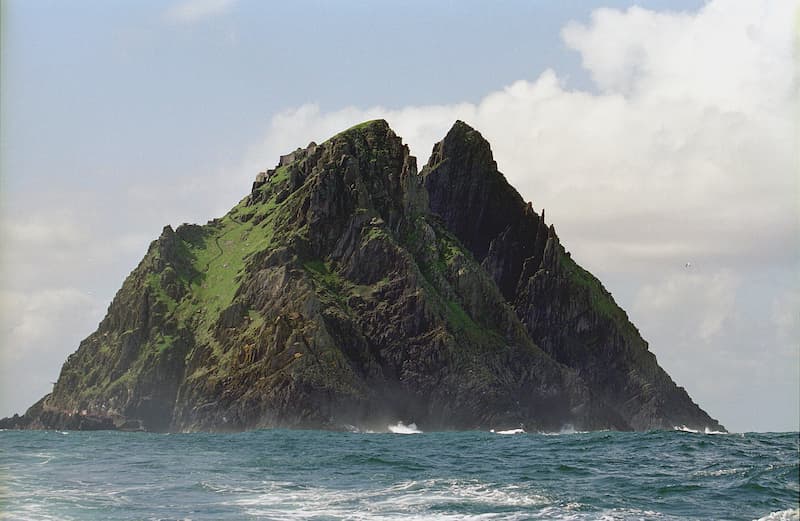
Sceilg Mhichíl, or Skellig Michael, is a rugged, pyramidal sea crag rising abruptly from the Atlantic Ocean, located approximately 12 kilometers off the Iveragh Peninsula in County Kerry, southwestern IRELAND. Composed of Devonian red sandstone, the island reaches a peak of 218 meters above sea level. It is the larger of the two Skellig Islands—the other being the smaller, uninhabited “Little Skellig” (Sceilig Bheag), which serves as a massive gannet colony.
The island is world-renowned for its perfectly preserved early Christian monastic settlement, perched precariously on a narrow terrace near the island’s north-eastern peak, 170 meters above the water. Founded between the 6th and 8th centuries by ascetic monks seeking total isolation, the site features six dry-stone “beehive” huts (clocháns), two oratories, a cemetery, and a small medieval church. These structures, built without mortar, have withstood over a millennium of harsh Atlantic storms. The monastery is reached via 618 steep, uneven, and unprotected stone steps carved directly into the cliffside by the original inhabitants.
Attraction
Skellig Michael offers one of the most singular experiences in global tourism: the rare opportunity to step directly into a functioning monastic environment from the early medieval world. For many, the appeal lies in the sheer physical drama of the site—the combination of dizzying ocean heights, centuries of spiritual devotion, and the raw, untamed beauty of the Irish coastline.
In recent years, the island has seen a surge in international fame as a primary filming location for the planet “Ahch-To” in the Star Wars sequel trilogy (The Force Awakens and The Last Jedi). Fans travel from across the globe to see the iconic stone steps where characters Luke Skywalker and Rey trained. Beyond historical and cinematic interests, the island is a vital nature reserve. From May to August, the cliffs host tens of thousands of nesting seabirds, most notably the Atlantic Puffin, whose colonies can be observed at remarkably close range along the walking paths.

World Heritage
UNESCO inscribed Skellig Michael as a World Heritage Site in 1996, recognizing it as an “outstanding example of a major early medieval religious settlement.” It was selected under two specific cultural criteria:
- Criterion (iii): The site bears exceptional testimony to the early Christian civilization of Ireland. It represents an extreme form of eremitic monasticism—a lifestyle dedicated to solitude and prayer—that flourished in the early medieval period. The island’s structures are unique in their ability to illustrate the daily life, engineering resourcefulness, and spiritual discipline of a community living on the absolute edge of the known world.
- Criterion (iv): The monastery is an outstanding architectural ensemble that illustrates a significant stage in human history. The “beehive” huts demonstrate a sophisticated understanding of dry-stone masonry, where stones are laid at a slight outward angle to shed rainwater, ensuring the huts remain watertight despite being built in one of Europe’s most exposed environments.
Gateway
The primary gateway city to Skellig Michael is Killarney, located in County Kerry. While Killarney does not have a major international hub, it is serviced by Kerry Airport (IATA Code: KIR), located in Farranfore, roughly 20 minutes from Killarney town center.
Kerry Airport provides regional connections, particularly to Dublin, London (Stansted/Luton), and various seasonal European destinations. Killarney serves as the ideal base for tourists, offering a massive variety of high-quality hotels, guesthouses, and restaurants, as well as easy access to the village of Portmagee—the tiny fishing hub where all licensed boats to the Skelligs depart. For those requiring larger international flight options, Cork Airport (ORK) is a three-hour drive away.
When
The official landing season for Skellig Michael runs from mid-May to the end of September. Because the island is a protected wilderness, no visitors are permitted outside of this window due to hazardous sea conditions and the need to protect nesting bird colonies.
- Peak Season (June–August): This is the best time for wildlife viewing, particularly for seeing the iconic Atlantic Puffins. However, it is also the busiest period, requiring bookings to be made 4–6 months in advance.
- Shoulder Season (May & September): These months offer a slightly quieter experience and better availability, though the Atlantic weather is notably more unpredictable, increasing the statistical likelihood of boat cancellations.
Considerations
- High Risk of Cancellation: Access is entirely dependent on sea and weather conditions. Approximately 30–40% of all scheduled landings are canceled due to heavy swells. Always build “buffer days” into your itinerary in case your boat is grounded.
- Physical Demands: A visit requires climbing over 600 steep, narrow, and uneven stone steps. There are no handrails or safety barriers on the precipitous cliffs. It is not suitable for young children, those with vertigo, or individuals with mobility issues.
- No Facilities: There are no toilets, shops, water sources, or waste bins on the island. You must bring your own food and water in a backpack, leaving your hands free for the climb.
- Respect the Rules: The site is a National Monument. Climbing on dry-stone walls, touching archaeological carvings, or disturbing nesting birds is strictly prohibited and carries legal penalties.

Resources
- UNESCO World Heritage Centre: The official source for the site’s historical inscription reports, preservation status, and global significance.
- SkelligMichael.com: An independent, comprehensive guide to booking landing tours, historical background, and wildlife safety.
- Trip.com: Useful for comparing licensed boat operators and reading real-time passenger reviews regarding sea conditions and tour quality.
- Heritage Ireland (OPW): The official government portal for the Office of Public Works, providing essential safety guidelines and monument closures.
- Discover Ireland: The national tourism authority website, offering travel itineraries for the Ring of Kerry and local accommodation advice.


Comments:
9 responses to “Sceilg Mhichíl”
-
There is nothing like it in the rest of the world.
-
It’s a relaxing place, it’s very special, it’s very spiritual.
-
I’ve not been to Skelling Michael but I have seen some photos and it looks like a really interesting and picturesque place to visit. The rounded domes of those dry wall-style buildings are fascinating!
-
It was fantastic, the monastery, the wildlife, everything. And we even saw dolphins on the way back.
-
The Bass Rock [in Scotland’s Firth of Forth] is a mere lump in comparison: both the Skelligs are pinnacled, crocketed, spired, arched, caverned, minaretted; and these gothic extravagances are not curiosities of the islands: they are the islands: there is nothing else. I tell you the thing does not belong to any world that you and I have lived and worked in. It is part of our dream world.
-
This was my favorite adventure in Ireland. You take a small boat out and the ride is intense, definitely not for those who get seasick easily. When you get to the island you walk up steep stairs filled with puffins to the top where a monastery awaits. I feel so lucky that I got to experience this.
-
At first, Skellig Michael appeared as a minuscule bump on the horizon. It gradually grew and by the time we were alongside the quay it loomed above us, a jagged, sheer-walled monolith of black-gray rock, crusty orange lichen and bright green grasses exploding upward out of the sea. I craned my neck but could not see the summit.
Once you hop onto land, there is a path to the stairs. My fellow passengers and I navigated them at our own pace, and eventually our clutch of wanderers thinned, allowing for solitary exploration. I took my time, focusing on the steps rather than the view to reduce vertigo. I wasn’t the only sufferer. On one particularly exposed run of stairs, I come upon a strapping man in his 20s descending in a seated position one step at a time. I feared that I would have to borrow his technique on the way back down.
As I stood amid the monastic ruins, I realized that for all the isolation and deprivation endured by Skellig Michael’s monks, they must also have felt the seductive power of the island’s raw, elemental beauty: a vermilion sunset; the delicate, perfectly ovoid shell of a seabird egg; a diaphanous curtain of approaching rain. For these men whose lives were stripped of all nonessentials, distilled to a purity I cannot imagine, everything on this crag must have sung of their god’s magnificent creation.
After an hour, I picked my way back down the stairs and to the quay with far less terror than expected. We were a quieter group on the return trip, until we encountered dolphins, an entire pod that cruised alongside us and leapt out of the water in high arcs.
After disembarking at Derrynane Harbour, during the hourlong drive back to the house where I was staying, I couldn’t shake the sense that I’d just awakened from a dream. One populated with ancient monks and dolphins and a swirling ocean mist that lingered long after my trip across the turbulent sea.
-
Visitors need to be in good condition to mount the 600 steps — no railings! — to the top. And, of course, what goes up must come down. We brought our trusty hiking poles, and they helped with both the ascent and descent.
-
When you are going to land on Skellig Michael you should have your hands free to climb out of the boat. If you need to go to the toilet go on the boat, because there is no public toilet on the island. You have not so much time on the Island, about 2.5 hours. When you are on the Island do not rush. There are people on the island anyway and you will not miss one thing. I recommend going up to the Monastery first. Do not stay too long on the other places at the beginning. If you see a puffin it will not be the last. Plan the most for the way back. You will see the scenery better from above on the way down. On the way up you are also faster out of breath and the groups on the stairs are bigger.


.jpg)
Leave a Reply