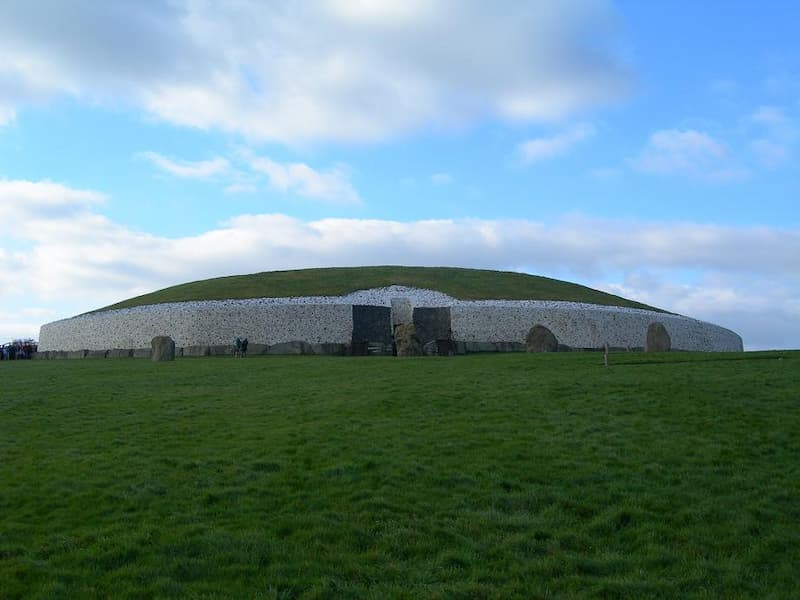
Brú na Bóinne, translated from Irish as the “Palace or Mansion of the Boyne,” is a prehistoric landscape situated within a dramatic loop of the River Boyne in County Meath, eastern IRELAND, approximately 50 kilometers north of Dublin. Spanning roughly 780 hectares of fertile agricultural countryside, this complex is one of Western Europe’s most significant Neolithic landscapes. It contains approximately 90 recorded ancient monuments created over 5,000 years ago during the late Stone Age, predating both the Egyptian pyramids at Giza and Stonehenge in England.
The landscape is dominated by three colossal passage tombs: Newgrange, Knowth, and Dowth. Each mound was built atop a natural ridge overlooking the river valley and consists of a massive stone-and-turf earthwork encasing internal stone passages leading to central burial chambers. Surrounding these primary monuments are dozens of smaller satellite passage graves, standing stones, earthen henges, wood enclosures, and prehistoric cursus tracks. The stones framing these monuments feature intricate carvings of prehistoric megalithic art, including spirals, concentric circles, chevrons, and lozenges, reflecting a sophisticated Neolithic society deeply attuned to engineering, ritual, and astronomy.
Attraction
Brú na Bóinne captures international imagination due to its monumental scale, mysterious ritual purpose, and brilliant astronomical alignment. The primary magnet for global visitors is the main chamber of Newgrange during the winter solstice. Designed with precise solar alignment around 3200 BC, Newgrange features a specialized aperture above its entrance known as the “roof-box.” Every year between December 18 and 23 at sunrise, a narrow beam of sunlight shines directly through the roof-box, traveling down the 19-meter stone passage to illuminate the inner cruciform burial chamber for approximately 17 minutes.
Additionally, Knowth attracts global travelers because it houses the largest concentration of megalithic art in Europe, containing over one-third of all known Western European passage tomb art carved across its kerbstones. Visitors travel to experience the state-of-the-art Brú na Bóinne Visitor Centre in Donore, where immersive digital exhibits, interactive models, and expert-guided shuttle tours bring ancient Celtic mythology, prehistoric engineering, and astronomical science to life for people of all ages.

World Heritage
In 1993, UNESCO inscribed Brú na Bóinne on the World Heritage List under cultural criteria (i), (iii), and (iv).
- Masterpiece of Human Creative Genius (Criterion i): The monuments represent the largest, most artistic, and most complex expression of prehistoric megalithic art in Europe. The precision required to transport massive kerbstones, erect heavy corbelled roofs that remain completely watertight today, and align structures with celestial phenomena demonstrates exceptional artistic mastery and engineering skill.
- Testimony to Prehistoric Cultural Traditions (Criterion iii): The concentration of economic, social, funerary, and ritual structures showcases a continuous history of human settlement and ritual activity spanning thousands of years, from the Neolithic period through the Bronze Age, Iron Age, early Christian era, and medieval period.
- Outstanding Prehistoric Architecture (Criterion iv): The passage tomb, brought to its highest architectural and artistic expression at Newgrange and Knowth, represents an outstanding example of a prehistoric ceremonial ensemble that shaped cultural developments across prehistoric Europe.
Gateway
The primary gateway city to Brú na Bóinne within Ireland is Dublin. Situated approximately 45 to 50 kilometers south of the archaeological ensemble (a 40-minute drive via the M1 motorway), Dublin provides seamless international access and extensive travel infrastructure.
Dublin is served by Dublin Airport (IATA Code: DUB), the country’s primary international aviation gateway, offering direct flights to destinations across Europe, North America, and the Middle East. From Dublin Airport or the city center, travelers can easily reach Brú na Bóinne by rental car, direct express coach services, or guided day tours.
Dublin offers thousands of overnight lodging choices catering to every budget, ranging from luxury historic properties and international chain hotels to boutique guesthouses, bed-and-breakfasts, and hostel dormitories. Alternatively, the nearby historic town of Drogheda, located just 8 kilometers east of the site, provides excellent regional lodging, though travelers flying in will still utilize Dublin Airport as their port of entry.
When
The best time to visit Brú na Bóinne is during the shoulder seasons of Late Spring (May to June) and Early Autumn (September to October). During these months, daytime weather is pleasant, rainfall is relatively moderate, and visitor crowds are manageable compared to the summer peak.
- Summer (July to August): Brings the warmest weather and extended daylight hours, making it ideal for walking around the outdoor grounds at Knowth and Newgrange. However, summer represents peak tourist season, requiring advance tour reservations weeks or months ahead.
- Winter (November to February): Brings cold temperatures, shorter daylight hours, and damp conditions. However, winter provides a quiet atmosphere and coincides with the famous Winter Solstice event in December. Access to the chamber illumination during the solstice is extremely limited and awarded annually through an official international public lottery.
Considerations
- Mandatory Visitor Centre Access: Direct vehicular drive-up access to Newgrange and Knowth is strictly prohibited to protect the monuments. All visitors must start at the official Brú na Bóinne Visitor Centre in Donore, where guided shuttle buses transport tour groups to the monument sites.
- Advance Booking Essential: Tour capacity inside the Newgrange chamber and around the Knowth site is strictly capped daily for conservation reasons. Travelers must book tickets online well in advance through the official Heritage Ireland portal to avoid disappointment.
- Weather and Outdoor Attire: Guided tours involve walking outdoors across open grass pastures and exposed gravel pathways. Waterproof outerwear, warm thermal layers, and comfortable, sturdy walking shoes or boots are essential year-round due to unpredictable Irish rain.
- Accessibility Constraints: While the visitor center and shuttle buses are fully accessible, the narrow historic passage leading into the Newgrange chamber requires stooping under low stone lintels, making it unsuitable for visitors with severe claustrophobia or mobility restrictions.
- Photography Regulations: Photography and videography are permitted across the exterior grounds and kerbstones, but strictly forbidden inside the narrow internal chamber of Newgrange to protect the ancient stone surfaces.

(Aligatorek, Wikimedia/CC BY-SA 3.0).
Resources
- UNESCO World Heritage Centre: The official UNESCO portal offering technical reports, boundary maps, and inscription criteria for Brú na Bóinne.
- Heritage Ireland: The official Irish state portal providing site opening hours, visitor guidelines, conservation news, and online tour ticketing.
- Trip.com: A major global travel marketplace offering hotel bookings, user reviews, tour packages, and transport recommendations.
- Discover Ireland: The national tourism authority website providing regional travel itineraries, Boyne Valley guides, and cultural context.
- Boyne Valley Tourism: The official regional tourism portal featuring local accommodation directories, historic trail maps, and event calendars. (Website:
www.boynevalley.ie)


Comments:
Leave a Reply