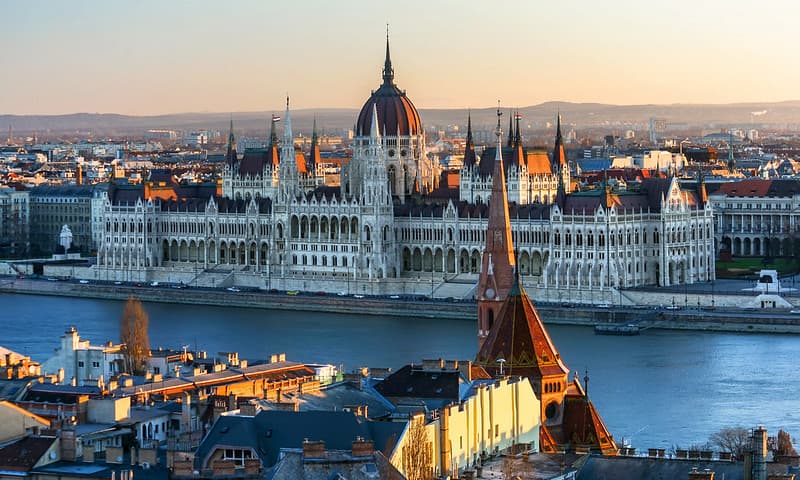
The Historic Site of Budapest, including the Banks of the Danube, the Buda Castle Quarter and Andrássy Avenue, encompasses one of the most magnificent and visually stunning urban riverfront landscapes in Central Europe. Spanning across both sides of the majestic Danube River in HUNGARY’s capital, the site brings together two historically distinct cities that were unified in 1873 alongside Óbuda: hilly, dramatic Buda on the western bank and flat, bustling Pest on the eastern plain.
On the western side, Castle Hill rises steeply above the river, crowned by the sprawling Royal Palace complex, cobblestone medieval lanes, defensive stone bastions, and royal gardens. Further south, Gellért Hill rises as a rocky outcrop topped by the Citadel and the iconic Liberty Statue. Across the water on the eastern side, the World Heritage property stretches along the sweeping riverbanks, dominated by monumental 19th-century civic architecture and grand public promenades. Extending inland from the riverfront through the heart of Pest, the site encompasses Andrássy Avenue—a quintessential late 19th-century radial boulevard flanked by elegant Neo-Renaissance palaces, diplomatic mansions, iconic cultural institutions, and shaded walkways that culminate at the majestic Heroes’ Square.
Attraction
Tourists from around the world are drawn to Budapest for its sensational architectural vistas, rich imperial history, and vibrant thermal spa tradition:
- The Panorama of the Danube & Historic Bridges: The riverfront offers an unforgettable spectacle anchored by the neo-Gothic Hungarian Parliament Building—one of the largest national legislative buildings in existence—and historic engineering marvels like the 19th-century Széchenyi Chain Bridge, which connects Buda and Pest with dramatic lion-guarded stone towers.
- Buda Castle Quarter & Fisherman’s Bastion: Set high atop Castle Hill, visitors wander through historic courtyards, admire the multi-colored Zsolnay glazed roof tiles of the 14th-century Matthias Church, and take in panoramic city views from the fairy-tale white turrets of Fisherman’s Bastion.
- Andrássy Avenue & Heroes’ Square: Strolling down this grand avenue takes travelers past the magnificent Hungarian State Opera House toward Heroes’ Square, where monumental statues commemorate the founding chieftains and historic leaders of the nation.
- Millennium Underground Railway: Running directly beneath Andrássy Avenue, the historic M1 metro line opened in 1896 to celebrate Hungary’s 1000th anniversary, remaining the oldest electrified underground transit system in continental Europe.
- Historic Thermal Bath Culture: Beyond its architectural marvels, Budapest is internationally recognized as the “City of Spas”. Visitors can relax in mineral-rich, geothermally heated waters within iconic historic bathhouses like the Neo-Baroque Széchenyi Thermal Bath or the Art Nouveau Gellért Baths.

World Heritage
Originally inscribed in 1987 and expanded in 2002 to include Andrássy Avenue and the historic underground railway, the site was recognized for its Outstanding Universal Value:
- Outstanding Architectural & Urban Synthesis: The site represents a rare and harmonious urban landscape that illustrates pivotal periods in the history of Central Europe. It preserves architectural layers spanning from the ancient Roman settlement of Aquincum and medieval royal strongholds to Ottoman-era structures and grand 19th-century Austro-Hungarian imperial developments.
- Cultural & Architectural Influence: Buda Castle played a foundational role in spreading Gothic architectural forms across the region from the 14th century onward. Later, in the second half of the 19th century, the ambitious urban planning that created Andrássy Avenue, the unified riverfront, and advanced public infrastructure established Budapest as an international model for modern European urban development.
Gateway
Budapest serves as its own direct gateway city.
- Airport: Travelers fly directly into Budapest Ferenc Liszt International Airport (BUD), located approximately 16 kilometers (10 miles) southeast of the city center, offering frequent express shuttle buses (Route 100E), private taxis, and public transfers straight into the historic urban core.
- Lodging: As a major European capital, Budapest provides an exceptional range of lodging options, ranging from five-star luxury hotels overlooking the Danube and charming boutique properties on Castle Hill to budget-friendly guesthouses and holiday apartments throughout Pest.
When
- Spring (April to May) and Autumn (September to October): These shoulder seasons deliver mild, agreeable weather ideal for walking along the riverfront promenades, exploring open-air sights on Castle Hill, and enjoying outdoor sidewalk cafes without the intense heat and heavy tourist crowds of peak summer.
Consideration
- Currency & Financial Logistics: Although Hungary is a member of the European Union, the official currency is the Hungarian Forint (HUF), not the Euro. While credit cards are accepted almost everywhere, carrying a small amount of cash is helpful for small street vendors, public restrooms, and tipping.
- Public Transportation: Budapest boasts an exceptional, highly efficient public transit network comprising metros, trams, trolleybuses, and river ferry services. Purchasing a multi-day transit pass or a Budapest Card provides unlimited travel across all lines and simplifies sightseeing between Buda and Pest.
- Advance Reservations: Major cultural attractions—such as guided interior tours of the Hungarian Parliament Building, entry passes for popular thermal baths, and evening Danube river cruises—frequently sell out in advance; booking tickets online prior to arrival is strongly advised.

Resources
- Official Budapest Tourism Portal (Budapestinfo): The official municipal tourism guide offering event calendars, city transit passes, museum schedules, and neighborhood guides.
- UNESCO World Heritage Centre: Authoritative documentation detailing the geographical boundaries, historical evaluation, and protection status of the site.
- Visit Hungary Official Tourism Portal: The national tourism website featuring regional travel ideas, cultural itineraries, and practical traveler tips.
- BKK – Centre for Budapest Transport: The official public transportation authority site providing route planners, ticket prices, and transit updates.
- GetYourGuide: A global travel platform where visitors can book skip-the-line thermal bath passes, guided Parliament tours, and scenic Danube boat cruises.


Comments:
5 responses to “Budapest, including the Banks of the Danube, the Buda Castle Quarter and Andrássy Avenue”
-
I would say the must-sees would be the Buda Castle district, Parliament (inside for the crown jewels and outside for the architecture, modeled after England’s Parliament building), Hero’s Square, Andrassy Boulevard, the Great Synagogue and Hungarian National Gallery. The must-do’s include a visit to a famous bath to pamper yourself, lunch at the Great Market Hall followed by dessert in a popular coffeehouse or cafe; and, of course, a day trip to the beautiful Danube Bend.
-
At the Millennium Monument you’ll meet the world’s most historic Hungarians. The granddaddy of all Magyars was Árpád. Atop the pillar, the Archangel Gabriel offers the crown to Saint Stephen, the king who Christianized the Magyars.
-
For sweeping panoramic views of Budapest, go up to the Fisherman’s Bastion on the Buda district. Right across the Chain Bridge, make your way past Buda castle. The hill isn’t particularly steep but can induce a sweat as it meanders towards the stairs of the Fisherman’s Bastion. The effort will be well worth it, as the views are fantastic. The multi-colored tiles on Matthias Church offer a welcome sight. Here you can see the famed Parliament Building, Chain Bridge, and the radiant district of Pest from up high.
-
The banks of the Danube is a joy to take a stroll along the Danube (especially at night when everything is lit up). This stretch of the Danube walkway goes from the Elizabeth Bridge to the Chain Bridge, and is perfect for those who want a short, but interesting walk. Promenading along the Danube is a great way to see many of Budapest’s best sights.
-
The Parliament is the most dramatic of all, I think, because of its sheer size. You don’t expect a utilitarian building to have such esthetic value. It is Hungary’s largest, and Budapest’s tallest, building. Yes, you will visit it and be struck by its size and beauty on the inside.But from the outside, it is equally majestic and awe-inspiring. It is the length of three football fields (imagine standing in the end zone of one and then looking two fields beyond). It is more than 300 feet high, filled with almost 700 rooms.


Leave a Reply