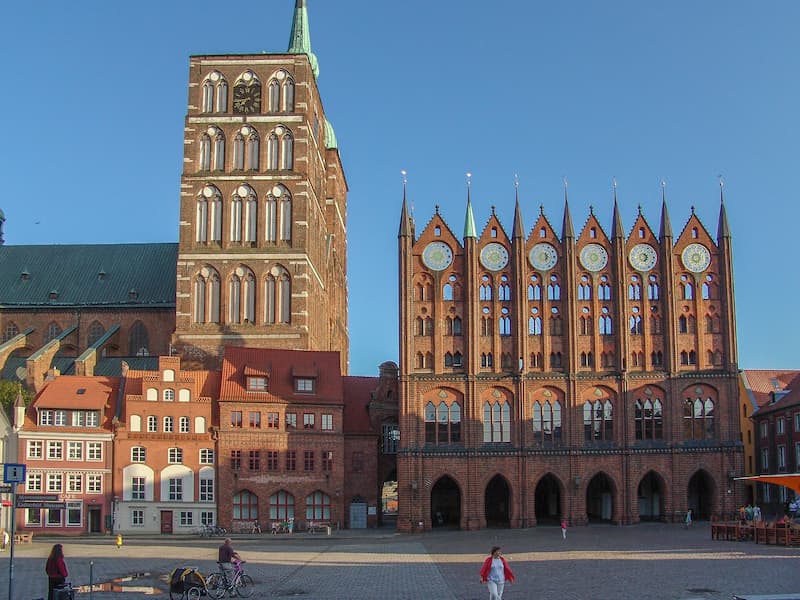
The Historic Centres of Stralsund and Wismar are two of the most significant coastal cities in northern GERMANY, serving as quintessential examples of the medieval Hanseatic League’s power and architectural ingenuity. Located on the Baltic coast in the state of Mecklenburg-Western Pomerania, these towns have preserved their 14th-century urban layouts and iconic red-brick skylines with remarkable integrity.
Stralsund and Wismar are “serial” UNESCO sites, meaning they are listed together due to their shared history and architectural style.
- Stralsund: Uniquely situated on an island between the Strela Sound and mainland ponds, its topography has remained unchanged since the 13th century. It is characterized by its high-gabled merchant houses and the dramatic silhouette of its three massive brick churches.
- Wismar: Boasts the best-preserved medieval harbor basin on the southern Baltic coast. Its town center is centered around a massive market square (the Marktplatz), which is one of the largest and best-preserved in Germany, surrounded by elegant buildings spanning centuries of architectural history.
Attraction
These towns offer a deep dive into the maritime history of the Baltic Sea:
- Brick Gothic Splendor: The cities are world-renowned for “Brick Gothic” architecture, a style born out of necessity in a region lacking natural stone. The Stralsund Town Hall, with its ornate, lace-like facade, is widely considered one of the most beautiful secular Gothic buildings in Europe.
- Maritime Life: Wismar’s “Old Harbor” (Alter Hafen) is a living postcard where visitors can buy fresh fish directly from traditional cutters. In Stralsund, the Ozeaneum (a modern maritime museum) provides a stunning contrast to the medieval surroundings.
- Swedish Heritage: For nearly 200 years, both cities were under Swedish rule. This “Swedish Era” left behind beautiful Baroque buildings, such as the Swedish Commandans House in Wismar and the Swedish Government Palace in Stralsund.
- Traditional Breweries: Wismar once had over 180 breweries; today, visitors can still enjoy Hanseatic-style beer at the historic Brauhaus am Lohberg, which has been brewing since 1452.

(Siegfried von Brilon, Wikimedia/CC BY-SA 3.0).
World Heritage
UNESCO inscribed these centres in 2002 based on two primary cultural criteria:
- Criterion (ii): The towns were pivotal in the exchange of human values and technical knowledge within the Hanseatic League. They pioneered the use of fired brick to create massive, cathedral-like structures (the “Wendish” style), which influenced architecture across Scandinavia and the Baltic states.
- Criterion (iv): They are outstanding examples of medieval maritime trading towns. Their original street patterns, harbor structures, and the scale of their commercial buildings illustrate the peak of Hanseatic economic and political power.
Gateway
Rostock or Hamburg serve as the primary regional aviation and rail gateways.
- Airport: Travelers frequently fly into Hamburg Airport (HAM) or Rostock-Laage Airport (RLG). From these transit hubs, both Stralsund (BBH) and Wismar are easily reached via direct regional train lines or highway connections.
- Lodging: Both Stralsund and Wismar offer a wide array of local boutique hotels and historic inns, while major neighboring transport hubs provide extensive metropolitan lodging options.
When
- Summer (July to August): This is the most vibrant time to visit the Baltic coast. The days are long and sunny, the harbor festivals are in full swing, and the sea breezes provide relief from the heat found further south in Germany.
- September to October (Autumn): A fantastic time for photography, as the “Golden Hour” light reflects beautifully off the red brickwork. The crowds are smaller, and the crisp air is perfect for walking tours.
- December: The Christmas markets in both Stralsund and Wismar are incredibly atmospheric, set against the backdrop of ancient market squares and illuminated brick churches.
Consideration
- Walking Surfaces: Like many medieval towns, the historic centers are paved with original cobblestones. Wear sturdy, comfortable walking shoes; avoid thin soles or heels, as the surfaces can be uneven and slippery when wet.
- Opening Hours: While the exteriors are always visible, some smaller museums and the interiors of the great churches may have limited hours during the “low season” (November to March).
- Respectful Conduct: The massive brick churches (like St. Nicholas in Wismar and St. Mary’s in Stralsund) are active places of worship or cultural sites. Maintain silence and dress modestly (covered shoulders and knees) when entering.
- Coastal Weather: The Baltic weather can be unpredictable. Even in summer, a sudden “Nordic” breeze or rain shower can appear, so carrying a light, windproof jacket is highly recommended.

Resources
- UNESCO World Heritage Centre – The official documentation, maps, and criteria for the site’s inscription.
- Official Site: World Heritage Stralsund and Wismar – A collaborative site by both cities offering visitor guides, history, and restoration updates.
- Germany Tourism: Stralsund & Wismar – The national tourism board’s guide for practical travel tips and regional highlights.
- Everything Everywhere – A comprehensive travel guide by a UNESCO expert.
- World Heritage Travel – A specialized site for UNESCO enthusiasts providing logistical advice and reviews of the “Brick Gothic” experience.


Comments:
Leave a Reply