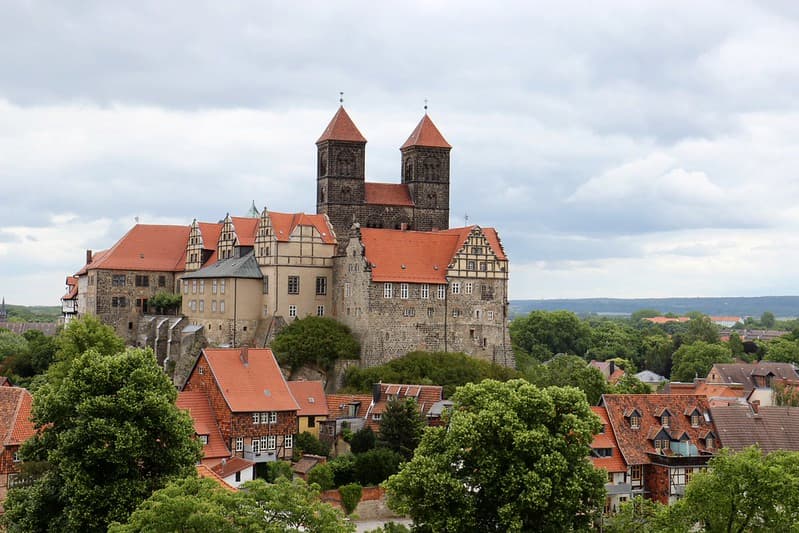
The Collegiate Church, Castle, and Old Town of Quedlinburg is one of GERMANY’s most enchanting and historically significant urban ensembles. Located on the northern edge of the Harz Mountains in the state of Saxony-Anhalt, it is often called the “cradle of German history” because it served as the residence and burial place of the first German king, Henry I.
Quedlinburg is a living museum of medieval and Renaissance architecture. The site consists of three main parts:
- The Castle Hill (Schlossberg): A steep sandstone cliff topped by a formidable complex including the former Royal Residence and the Collegiate Church of St. Servatius. The plateau offers sweeping views of the red-tiled roofs below.
- The Collegiate Church of St. Servatius: A masterpiece of Romanesque architecture. Its austere stone exterior hides a magnificent interior, a deep crypt with ancient murals, and the famous Quedlinburg Treasure (Domschatz).
- The Old Town: Below the castle lies an expansive historic district featuring over 1,300 timber-framed houses built over six centuries. The narrow, winding cobblestone streets follow the original medieval layout, leading to the grand Market Square and the Gothic Town Hall.
Attraction
Quedlinburg attracts visitors who want to “step back in time” without the artificial feel of a theme park:
- The World’s “Half-Timbered” Capital: With one of the highest concentrations of timber-framed buildings in Europe, every alleyway is a postcard. The Ständerbau, built around 1310, is one of the oldest such houses in Germany.
- Imperial History: Visitors can stand at the burial site of King Henry I and Queen Mathilde, touching the very roots of the German nation.
- The Quedlinburg Treasure: A world-renowned collection of religious artifacts, including jewel-encrusted reliquaries and a 10th-century ivory comb. The treasure’s history is a thriller in itself—it was stolen by an American soldier in 1945 and only returned in the 1990s.
- Harz Mountains Access: The town is a departure point for the Harz Narrow Gauge Railway, where vintage steam trains chuff through the mountains to the Brocken summit.

(Matthias Süßen, Wikimedia/CC BY-SA 4.0).
World Heritage
UNESCO inscribed Quedlinburg in 1994 based on two primary cultural criteria:
- Criterion (iv): The town is an exceptional example of a medieval European town. Its preservation is unique because it escaped significant damage during World War II and remained largely unchanged during the GDR era. It illustrates the progression of timber-framed architecture from the 14th to the 19th century.
- The Romanesque Masterpiece: The Collegiate Church is cited as one of the most significant Romanesque buildings in Germany, representing the architectural transition and the power of the Ottonian dynasty.
Gateway
Erfurt or Leipzig serve as the best regional gateways.
- Airport: Travelers can fly into Leipzig/Halle Airport (LEJ) or Erfurt-Weimar Airport (ERF). From either hub, Quedlinburg is easily accessible via regional rail connections or car rental in roughly 1 to 1.5 hours.
- Lodging: Quedlinburg itself offers charming historic guesthouses and boutique hotels inside converted timber-framed buildings, while nearby regional hubs provide extensive alternative accommodations.
When
- Spring & Summer (May to September): The best weather for walking the cobblestone streets and exploring the nearby mountain trails. The gardens on Castle Hill are in full bloom, and outdoor café culture is at its peak.
- December: Quedlinburg hosts one of Germany’s most atmospheric Christmas markets, “Advent in the Courtyards” (Advent in den Höfen). Over 20 private historic courtyards open their gates to the public for a magical, candle-lit experience.
- Autumn (October): The ivy covering the Town Hall turns a brilliant red, and the misty mornings in the Harz Mountains provide a moody, medieval ambiance.
Consideration
- Walking Gear: The town is almost entirely cobblestoned. Wear sturdy, supportive shoes; thin soles or heels will make a day of sightseeing very painful.
- The “Schlossberg” Climb: Reaching the church and castle requires a walk up a steep, paved hill. There is a small shuttle train (Bimmelbahn) for those with mobility issues, but the town itself is best explored on foot.
- Limited Opening Hours: During the winter (outside of the Christmas market season), some museums and the church may have shorter visiting hours. Always check the official website before traveling mid-week in January or February.
- Cash is King: While larger hotels and restaurants accept cards, many small artisanal shops and traditional bakeries in the Old Town still prefer cash (Euros).

Resources
- UNESCO World Heritage Centre – The official entry providing the historical dossier and conservation maps.
- Quedlinburg Official Tourism – The primary source for event calendars, guided tour bookings, and city maps.
- Everything Everywhere – A detailed travelogue by a UNESCO enthusiast.
- German Sights: Quedlinburg – A practical guide focused on logistics, train schedules, and local history.
- Romanesque Road (Straße der Romanik) – A specialized site explaining Quedlinburg’s place within the wider Romanesque heritage route of Germany.


Comments:
Leave a Reply