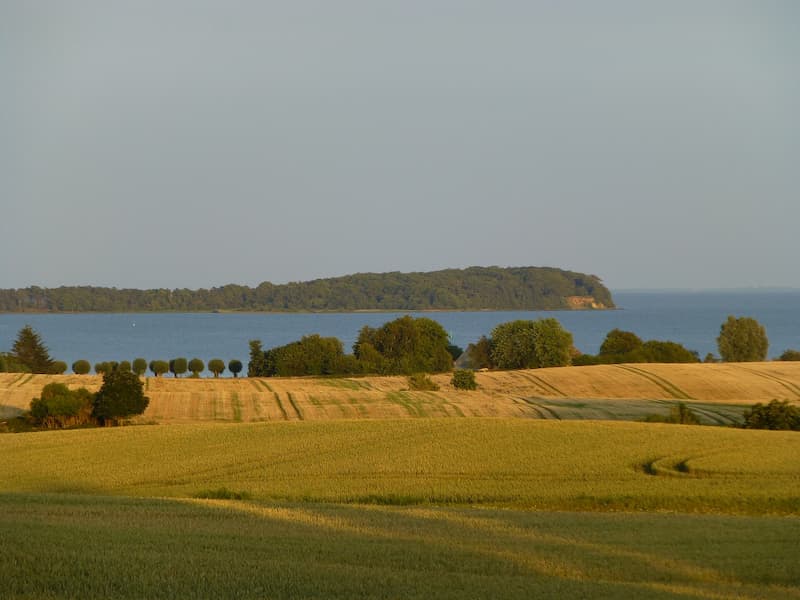
South-East Rügen balances coastal tourism with protected Baltic habitats
“South-East Rügen” (Biosphärenreservat Südost-Rügen) is a coastal and marine conservation and cultural landscape spanning 22,800 hectares—comprising 11,700 hectares of Baltic Sea and lagoon waters and 11,100 hectares of terrestrial land—on the southeastern portion of Rügen, GERMANY’s largest island, in Mecklenburg-Western Pomerania. Encompassing the Granitz coastal forest, the Mönchgut peninsula, the Zicker hills, the Putbus cultural landscape, and the island of Vilm, the reserve represents the full diversity of southern Baltic coastal formations.
Shaped by glaciers of the last Ice Age around 10,000 years ago, its terrain unites steep coastal cliffs, sandy beaches, shallow Bodden lagoons, salt marshes, beech forests, and dry calcareous grasslands. Supporting over 800 plant species, grey seals, and roughly 17,494 residents, the region blends coastal ecology with historic resort architecture and traditional small-scale fishing.
Attraction
South-East Rügen attracts hikers, cyclists, beachgoers, and heritage travelers globally who want scenic Baltic coastlines, historic seaside resorts, and tranquil lagoon landscapes.
Visitors hike the rolling Zicker hills (Zicker Berge) for sweeping views over the Greifswalder Bodden, walk through ancient beech forests to the Jagdschloss Granitz hunting lodge, and stroll along the iconic wooden piers (Seebrücken) and white spa architecture (Bäderarchitektur) of Sellin, Binz, Baabe, and Göhren. Travelers also ride the historic narrow-gauge steam railway Rasender Roland, take boat excursions to observe grey seals or visit the island of Vilm, and sample smoked Baltic herring and regional coastal cuisine.
Biosphere Reserve
Designated in 1991 under UNESCO’s Man and the Biosphere (MAB) Programme and recognized as a European Charter Park for Sustainable Tourism, South-East Rügen models harmonious coexistence between coastal communities, nature conservation, and tourism:
- Glacial Coastline and Bodden Biodiversity: Through strictly protected core zones (including Vilm), buffer zones, and transition areas, the reserve protects rare dry grasslands, salt marshes, coastal beech woods, waterbirds, and grey seals.
- Sustainable Fisheries and Eco-Tourism: The reserve preserves traditional small-scale Baltic gillnet fisheries, low-impact agriculture, ranger-led environmental education, and certified biosphere partner networks.
Gateway
Travelers planning a visit to South-East Rügen can enter via three proximate northeastern German aviation hubs—each verified in IATA’s official directory and offering overnight lodging, road or rail links, and local tour guides:
- Bergen auf Rügen / Güttin (Nearest Airport Hub / Primary Island Local Gateway):
- Airport: Rügen Airport / Güttin Airfield (IATA Code: GTI; ICAO Code: EDCG).
- Infrastructure and Distance: Located at Güttin in Dreschvitz near the B96 federal road, roughly 8 kilometers south of Bergen auf Rügen and about 20 to 35 kilometers (20 to 35 minutes by road) northwest of Putbus, Sellin, and the Mönchgut peninsula. GTI is an active commercial airfield indexed in IATA’s directory, while Bergen auf Rügen and nearby Baltic resorts provide extensive hotels, regional rail connections, buses, and accredited biosphere rangers and guides.
- Stralsund / Barth (Primary Mainland Vorpommern Gateway):
- Airport: Stralsund–Barth Airport (IATA Code: BBH; ICAO Code: EDBH).
- Infrastructure and Distance: Located near Barth on the mainland coast west of Stralsund, roughly 65 to 85 kilometers (about 1 to 1.25 hours by road across the Rügen Bridge via the B96) west of South-East Rügen. BBH is an active public airfield indexed in IATA’s directory, backed by coastal hotels in Barth and Stralsund, car rentals, and Deutsche Bahn rail links onto Rügen.
- Rostock / Laage (Primary Mecklenburg Regional Commercial Gateway):
- Airport: Rostock–Laage Airport (IATA Code: RLG; ICAO Code: ETNL).
- Infrastructure and Distance: Located south of Rostock at Laage, roughly 135 to 160 kilometers (about 1.5 to 2 hours by road via the A20 and B96 highways, or roughly 2.5 hours by regional rail via Rostock and Stralsund) southwest of the reserve. RLG is an active public airport listed in IATA’s directory, supported by extensive city hotels, car rentals, rail connections, and regional tour operators.
When
The ideal window to visit South-East Rügen is from Late Spring to Early Autumn (May to October):
- Late Spring to Early Autumn (May to October): Recommended for coastal hiking, cycling, beach days, and boat excursions, featuring blooming dry grasslands in May and June, warm summer temperatures of 18°C to 24°C (64°F to 75°F), and golden beech forests alongside the Rügen Sustainability Week in September.
- Late Autumn and Winter (November to April): Brings brisk Baltic winds, chilly temperatures, and quiet beaches suited to storm watching, thalassotherapy wellness spas, and peaceful coastal walks.
Consideration
- Use Public Transit and Guest Cards to Reduce Car Traffic: Rügen experiences heavy summer road congestion; regional trains, buses, and the Rasender Roland steam railway connect major resorts smoothly, and overnight visitors receive local spa/guest cards (Kurkarte) offering transit perks.
- Respect Core Zone and Salt Marsh Closures: The island of Vilm may only be visited on pre-booked guided excursions from Lauterbach, and marked paths protect fragile cliffs, salt marshes, and bird-breeding zones.
- Pack Windproof Layers and Sun Protection: Baltic Sea breezes make coastal cliffs feel cool even on sunny days; bring a windproof/waterproof jacket, comfortable walking shoes, and sunscreen.
- Book Peak Summer Lodging and Ferry Tours Early: Seaside resort hotels and guided boat trips fill quickly between June and September; reserve accommodations and Vilm excursions well in advance.


Resources
- UNESCO Man and the Biosphere Programme (South-East Rügen Profile): Official UNESCO portal detailing boundaries, marine and terrestrial area, ecology, and fisheries.
- Biosphärenreservat Südost-Rügen Official Portal: Dedicated Mecklenburg-Western Pomerania management portal covering ranger walks, audio guides, partner businesses, and visitor rules.
- German Commission for UNESCO (Südost-Rügen Profile): National UNESCO portal summarizing landscape features, Vilm conservation academy, and sustainability projects.
- Rügen Tourism Official Portal: Regional destination website offering accommodation listings, Rasender Roland schedules, cycling routes, and resort guides.
- GetYourGuide: Online travel booking marketplace offering affiliate-supported bookings for Rügen island excursions, boat cruises, and coastal walking tours.
Featured Image
Vilm Island, viewed from Wreechen (Silas Siedler, Wikimedia/CC BY-SA 4.0).

News Feed
Advertisement


Comments:
Leave a Reply