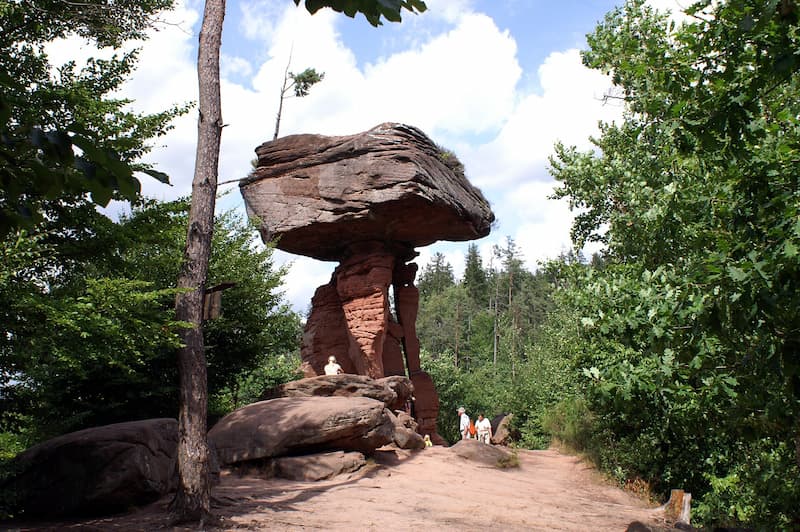
Pfälzerwald pairs weathered red sandstone cliffs with Rhineland-Palatinate forests
“Pfälzerwald / Vosges du Nord” is Western Europe’s largest contiguous forest region, spanning roughly 306,158 hectares across the Franco-German border—with 178,497 hectares forming the GERMAN Pfälzerwald (Palatinate Forest) component in Rhineland-Palatinate and 127,661 hectares forming the French Vosges du Nord component. On the German side, the reserve encompasses rolling Buntsandstein (red sandstone) hills, weathered rock towers, narrow stream valleys, springs, lakes, and dense beech, oak, and pine forests.
Home to roughly 253,390 residents in the German sector, the landscape combines low urban density with traditional forestry, viticulture along the eastern German Wine Route edge, and centuries-old hilltop castles.
Attraction
Pfälzerwald attracts hikers, rock climbers, cyclists, and heritage travelers globally who want peaceful woodland trails, dramatic sandstone formations, and historic castles.
Visitors explore weathered red-sandstone outcrops around Dahn (Dahner Felsenland), hike long-distance trails such as the Pfälzer Weinsteig and Pfälzer Waldpfad, and walk above the canopy on the Baumwipfelpfad treetop walkway in Fischbach. Travelers also tour medieval hilltop fortresses including Trifels Castle—where King Richard the Lionheart was once imprisoned—visit the Biosphere House (Biosphärenhaus) in Fischbach, and dine in traditional hiker huts (Pfälzerwald-Hütten) serving regional dishes and Palatinate wines.
Biosphere Reserve
Designated in 1998 as Western Europe’s first transboundary UNESCO Biosphere Reserve—uniting Germany’s Pfälzerwald Nature Park (1992) and France’s Vosges du Nord Regional Nature Park (1988)—the site is recognized for cross-border ecosystem protection and sustainable regional development:
- Sandstone, Water, and Forest Ecosystems: Through strictly protected core zones, buffer zones, and community transition areas, the reserve safeguards interconnected beech-oak forests, moorlands, and streams supporting Eurasian lynx, peregrine falcons, wildcats, and rare bog arum (Calla palustris).
- Franco-German Cooperation and Sustainable Livelihoods: Jointly coordinated across borders, the reserve promotes sustainable forestry, eco-certified tourism, environmental education, and regional partner networks linking local farmers, vintners, and artisans.
Gateway
Because the Pfälzerwald spans southwestern Rhineland-Palatinate along the French border, travelers entering within Germany can use three proximate German gateway hubs—each verified in IATA’s official directory and offering overnight lodging, rail or highway links, and local tour guides:
- Zweibrücken (Nearest Airport Hub / Primary Western Local Gateway):
- Airport: Zweibrücken Airport (IATA Code: ZQW; ICAO Code: EDRZ).
- Infrastructure and Distance: Located immediately beside the western edge of the Pfälzerwald, roughly 4 kilometers southeast of Zweibrücken town and within 15 to 35 minutes by road of Dahn, Pirmasens, and Fischbach. ZQW is a general aviation airport indexed in IATA’s directory, while Zweibrücken offers town hotels, regional rail connections, local buses, and direct road access into the forest.
- Saarbrücken (Primary Saarland & Western Commercial Gateway):
- Airport: Saarbrücken Airport (IATA Code: SCN; ICAO Code: EDDR).
- Infrastructure and Distance: Located at Ensheim east of Saarbrücken, roughly 40 to 65 kilometers (about 35 to 55 minutes by road via the A8 and B10 highways or regional rail via Zweibrücken and Pirmasens) west of the reserve. SCN is an active public international airport indexed in IATA’s directory, backed by city hotels, car rentals, Deutsche Bahn rail links, and regional excursion providers.
- Mannheim / Karlsruhe–Baden-Baden (Primary Eastern Rhine Valley Gateways):
- Airport: Mannheim City Airport (IATA Code: MHG; ICAO Code: EDFM) and Karlsruhe/Baden-Baden Airport (IATA Code: FKB; ICAO Code: EDSB).
- Infrastructure and Distance: Located roughly 45 to 75 kilometers (about 40 to 60 minutes by road or regional train via Neustadt an der Weinstraße and Landau) east and southeast of the Pfälzerwald. Both MHG and FKB are active public airports listed in IATA’s directory, supported by extensive Rhine Valley hotels, car rentals, high-speed rail connections, and accredited nature and wine-region guides.
When
The ideal window to visit Pfälzerwald is from Late Spring to Autumn (May to October):
- Late Spring to Autumn (May to October): Recommended for forest hiking, rock climbing, castle visits, and cycling, offering lush green beech canopies, warm summer temperatures of 18°C to 26°C (64°F to 79°F), and vibrant autumn foliage alongside Palatinate wine harvest festivals in September and October.
- Winter and Early Spring (November to April): Brings crisp woodland air, quieter trails, and occasional light snow on higher ridges, ideal for peaceful walks and cozy meals in heated hiker huts.
Consideration
- Check Hiker Hut (Pfälzerwald-Hütten) Opening Days: Many traditional forest huts are run by volunteers and open primarily on weekends, Wednesdays, and public holidays; verify schedules before planning a hike around lunch stops.
- Respect Peregrine Falcon Nesting Closures: Certain sandstone crags and cliffs close seasonally between spring and early summer to protect nesting peregrine falcons; follow posted climbing and trail signage.
- Use Regional Public Transit Links: Regional trains connect Kaiserslautern, Neustadt an der Weinstraße, Landau, Pirmasens, and Zweibrücken, complemented by weekend excursion buses (Freizeitbusse) into trailheads.
- Pack Sturdy Footwear and Weather Layers: Sandstone paths and castle steps can be sandy or slick after rain; bring grippy hiking shoes, a rain jacket, and cash euros for rural forest huts.

Resources
- UNESCO Man and the Biosphere Programme (Pfälzerwald / Vosges du Nord Profile): Official UNESCO portal detailing boundaries, surface area, wildlife, and transboundary history.
- Biosphärenreservat Pfälzerwald-Nordvogesen Official Portal: Dedicated German management portal covering sustainability projects, partner businesses, trail info, and visitor centers.
- Biosphärenhaus Pfälzerwald / Nordvogesen: Official visitor center portal featuring exhibitions, treetop walkway hours, and family nature programs.
- Pfalz Tourism Official Portal: Regional destination website offering Palatinate Forest hiking routes, castle guides, accommodation listings, and wine-country itineraries.
- GetYourGuide: Online travel booking marketplace offering affiliate-supported bookings for southwestern Germany day tours, castle excursions, and regional experiences.
Featured Image
The Devil’s Table, or Teufelstisch (Ruediger Kratz, Wikimedia/CC BY-SA 3.0).

News Feed
Advertisement


Comments:
Leave a Reply