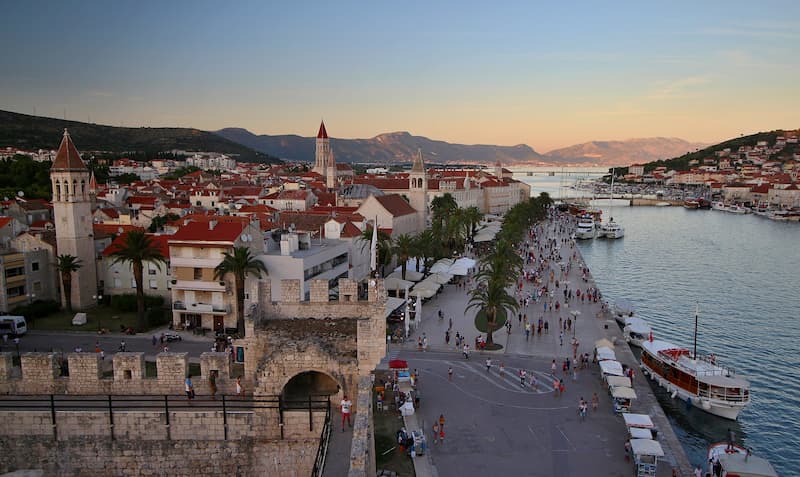
The Historic City of Trogir, in Central Dalmatia, CROATIA, is a fortified island town situated in a narrow channel between the Croatian mainland and Čiovo island. Situated 27 kilometers west of Split, it represents one of Europe’s best-preserved medieval urban centers. Founded in the 3rd century BC by Greek colonists from Vis as Tragurion (“island of goats”), Trogir evolved continuously across two millennia under Roman, Byzantine, Hungarian, Venetian, and Habsburg rule.
The historic core occupies an island connected to the mainland and Čiovo by bridges. The city retains its original Hellenistic orthogonal street grid, over which successive generations built a dense tapestry of architectural styles. The urban landscape is dominated by the monumental Cathedral of St. Lawrence (Katedrala Sv. Lovre), whose construction spanned three centuries and features Master Radovan’s famous 13th-century stone portal. Surrounding the main town square are the Renaissance City Loggia, the Church of St. Sebastian with its clock tower, and the grand Ćipiko Palace. On the southwestern waterfront stands the 15th-century Kamerlengo Fortress and St. Mark’s Tower, built during Venetian rule to defend the port.
Attraction
Trogir draws travelers through its rich concentration of historic architecture, intimate coastal atmosphere, and vibrant Mediterranean culture. Often described as an “open-air museum,” the entire pedestrian-only old town allows visitors to walk through centuries of artistic evolution within a compact, easily walkable area. Photographers and history enthusiasts are mesmerized by the intricate Romanesque stone carvings, ornate Gothic windows, and elegant Renaissance courtyards framed by narrow stone alleyways (kale).
Beyond its static monuments, Trogir offers a lively maritime lifestyle. The palm-lined seaside promenade (Riva) stretches along the southern waterfront, providing an idyllic setting for admiring yachts, enjoying fresh Dalmatian seafood, and savoring gelato while taking in Adriatic views. Trogir also appeals to pop-culture enthusiasts as a filming location for HBO’s Game of Thrones, where its medieval stone alleys and waterfront fortress served as the trading port of Qarth. Additionally, Trogir serves as an ideal hub for island-hopping excursions, sailing charters, and coastal beach vacations.

World Heritage
In 1997, UNESCO inscribed the Historic City of Trogir on the World Heritage List under cultural criteria (ii) and (iv).
- Intercultural Influence and Continuity (Criterion ii): Trogir demonstrates exceptional cultural synthesis resulting from centuries of interaction among Greek, Roman, Byzantine, Hungarian, and Venetian civilizations. This prolonged interchange influenced town planning, defense architecture, and artistic expression throughout the Adriatic basin. The city embodies a continuous urban evolution where distinct cultural waves left indelible architectural marks without disrupting the town’s social fabric.
- Outstanding Medieval Island Urbanism (Criterion iv): Trogir stands as an outstanding example of a medieval island town built upon and conforming strictly to the layout of an ancient Hellenistic and Roman grid plan. It has conserved its urban fabric to an exceptional degree with minimal modern intervention. The town constitutes the best-preserved Romanesque-Gothic urban complex along the Adriatic coast and across Central Europe.
Gateway
The primary gateway city to the site within Croatia is Split (and its immediate suburban municipality of Kaštela). The site is served directly by Split Saint Jerome Airport (IATA Code: SPU; ICAO Code: LDSP).
Split Airport sits just 5 kilometers east of Trogir’s historic center along Kaštela Bay, making access exceptionally fast and direct. SPU operates as an active international commercial airport, handling regular domestic flights from Zagreb as well as extensive international direct flights from across Europe, particularly during the summer season. From Split Airport, arriving travelers can reach Trogir in under 10 minutes via local public bus (Line 37), airport shuttles, taxis, or rental cars. Both Trogir itself and the broader Split metropolitan area offer abundant lodging options suitable for overnight stays, including upscale heritage boutique hotels inside medieval stone palaces, waterfront resort complexes, private coastal apartments, and budget guesthouses.
When
The best time to visit Trogir is during Spring (May to June) and Early Autumn (September to October).
- Spring and Early Autumn: These shoulder months provide warm, sunny weather with average daily temperatures ranging from 20°C to 26°C (68°F to 79°F). Sea temperatures during June, September, and October are comfortable for swimming in the Adriatic. Furthermore, visiting during these months avoids intense summer heat and high tourist crowds, allowing for relaxed exploration of narrow alleys and open-air monuments.
- Summer (July to August): Features hot, dry weather with daytime temperatures frequently exceeding 32°C (90°F). While summer brings vibrant nightlife and cultural festivals, it also brings heavy traffic congestion across the Čiovo bridges and high numbers of cruise ship day-trippers.
- Winter (November to April): Quiet and mild, though many tourism-focused businesses, coastal restaurants, and excursion operators close for the off-season.
Considerations
- Pedestrian-Only Zone and Parking: The entire historic center of Trogir is closed to motorized vehicular traffic. Visitors arriving by car must utilize paid public parking lots situated on the mainland side or on Čiovo island before crossing the pedestrian bridges into the old town.
- Footwear and Paving: Streets and public squares are paved with polished, centuries-old limestone slabs that can become smooth and slippery. Wearing comfortable, slip-resistant walking shoes is essential.
- Traffic Bottlenecks: Traffic crossing between the mainland and Čiovo island experiences heavy delays during peak summer months. Plan extra transfer time when heading to Split Airport during mid-summer afternoons.
- Dress Code for Religious Sites: Active places of worship, particularly the Cathedral of St. Lawrence, require modest attire covering shoulders and knees.
- Currency: Croatia utilizes the Euro (€) as its official currency. While credit cards are widely accepted, carrying small cash notes is helpful for street markets, ice cream shops, and public restrooms.

Resources
- UNESCO World Heritage Centre: Official UNESCO portal providing technical inscription history, criteria, and conservation reports for Trogir.
- Croatia Full of Life (National Tourism Board): Official Croatian national tourism authority site featuring travel planning guides, regional maps, and event calendars.
- Trogir Tourist Board: Official municipal tourism portal providing local attraction details, museum hours, and guided tour information.
- Visit Croatia: Comprehensive independent travel resource offering logistical advice, ferry schedules, and regional travel itineraries.
- Trip.com: Major global travel platform featuring community reviews, hotel reservations, guided tour bookings, and restaurant recommendations for Trogir.


Comments:
Leave a Reply