The Rock-Hewn Churches of Ivanovo are a breathtaking complex of monolithic churches, chapels, and monastic cells carved directly into the limestone cliffs of the Rusenski Lom Nature Park in northeastern BULGARIA. This spiritual sanctuary represents the pinnacle of Bulgarian medieval art and the enduring spirit of Christian hesychasm.
Founded in the 1220s by the monk Joachim (who later became the Patriarch of Bulgaria), the complex is not a single building but a network of roughly 40 rock-cut churches and more than 300 cells spread along the craggy gorge of the Rusenski Lom River.
While many of the structures have succumbed to erosion, five main chapels remain famous for their remarkably well-preserved frescoes:
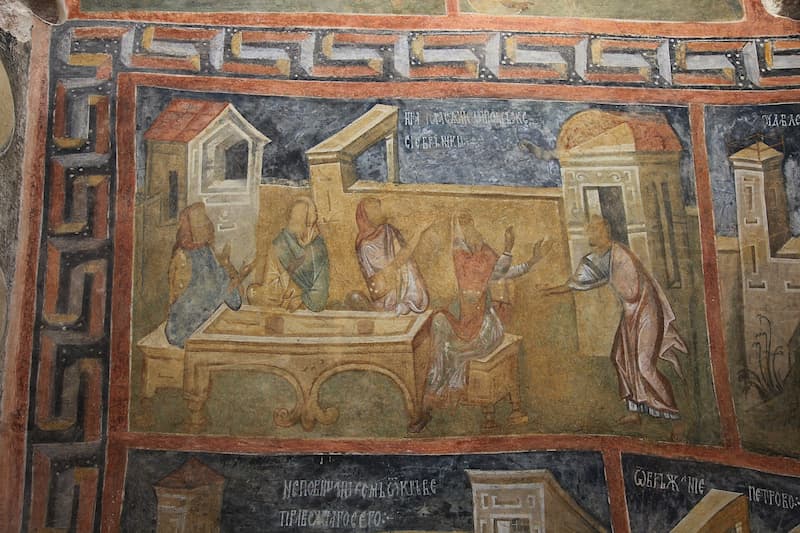
- The Church of the Holy Virgin (St. Mary): The crown jewel, featuring 14th-century murals that are masterpieces of the Palaeologue style.
- The Chapel of St. Archangel Michael: Known as “The Buried Church.”
- The Gospodev Dol Chapel: Containing portraits of the Bulgarian royal family.
- The “Demolished” Church (St. Theodore): Named for its weathered state, yet still retaining fragments of its former glory.
Unlike the vast underground cities of Cappadocia, Ivanovo is defined by its height; the monks lived in high, airy chambers overlooking the river, seeking solitude and a literal closeness to the heavens.
Attraction
The site attracts history buffs, art historians, and spiritual seekers for several reasons:
- Pre-Renaissance Art: The frescoes in the Church of St. Mary are celebrated for their expressive faces and realistic anatomy—styles that pre-date many similar developments in the Italian Renaissance.
- Royal Patronage: You can see rare, 700-year-old donor portraits of Bulgarian Tsars like Ivan Asen II and Ivan Alexander, dressed in regal Byzantine-style finery.
- Dramatic Scenery: The contrast between the rugged, grey cliffs and the vibrant, colorful murals inside is visually stunning. The hike through the nature park offers a serene, “off-the-beaten-path” experience.
- The “Living History” Aspect: Walking through the narrow, hand-carved stairs and low-ceilinged chambers allows visitors to feel the isolation and devotion of the medieval hermits who once lived there.


(Hans A Rosbach, Wikimedia/CC BY-SA 3.0).
World Heritage
Inscribed in 1979, the Rock-Hewn Churches of Ivanovo were recognized by UNESCO for their “Outstanding Universal Value” under Criteria (ii) and (iii):
- Artistic Achievement: The murals are considered an exceptional achievement in the Christian art of Southeastern Europe. They mark a departure from the rigid, flat iconography of earlier periods, introducing a more human, emotional sensitivity.
- Historical Testimony: The complex is the last standing evidence of the “Tarnovo School of Painting,” which was the cultural heart of the Second Bulgarian Empire (12th–14th centuries). It serves as a vital record of a civilization that was later largely suppressed during the Ottoman occupation.
Gateway
While the town of Ruse (ROU) is the closest settlement (22 km away), it currently lacks a major commercial airport for international travelers. Therefore, the primary gateway within Bulgaria is Varna.
- Commercial Airport: Varna International Airport (VAR). It is a major hub with year-round domestic and international flights.
- Lodging: Varna is a major tourist city with thousands of lodging options, ranging from five-star seaside resorts to cozy city-center boutiques.
- Logistics: Varna is approximately 190 km (a 2.5-hour drive) from Ivanovo. Most travelers fly into Varna, enjoy the Black Sea coast, and then take a scenic drive inland to visit the churches.
- Foreign Alternative: If you are open to flying into a different country, Bucharest, Romania (OTP) is actually the closest major airport, located only about 1.5 to 2 hours away across the Friendship Bridge on the Danube.
When
- Spring (April to June): This is the goldilocks zone. The nature park is blooming with wildflowers, the weather is mild (15°C to 22°C), and the light for photography is soft and flattering.
- Autumn (September to October): The fall foliage in the gorge is spectacular, turning the valley into a sea of red and gold.
- Note on Summer: July and August can be quite hot (often exceeding 30°C), making the steep climb to the caves more taxing.
Consideration
- Physical Effort: Accessing the main churches requires climbing a series of steep, sometimes slippery, stone steps. Wear sturdy walking shoes with good grip.
- Opening Hours: The site is often closed on Mondays and Tuesdays, and the main church (St. Mary) has seasonal hours. Always check the official Ministry of Tourism site before departing.
- Fragile Environment: Because the frescoes are extremely sensitive to humidity and light, entry to the main church is often limited to small groups for short durations. Photography with flash is strictly prohibited.
- Lack of Facilities: There are no cafes or shops at the base of the cliffs. Bring water and snacks with you from the village of Ivanovo or Ruse.
- Combined Trip: Don’t miss the nearby Basarbovo Rock Monastery (the only active rock monastery in Bulgaria) and the medieval Fortress of Cherven, both located within a short drive.

(Klearchos Kapoutsis, Flickr/CC BY 2.0).
Resources
- UNESCO World Heritage Centre – Ivanovo – Detailed historical documentation and conservation data.
- Bulgaria Ministry of Tourism – Official visitor information including opening hours and local contact numbers.
- Rusenski Lom Nature Park Official Site – Information on the flora, fauna, and hiking trails surrounding the churches.
- Bulgaria Travel – Practical tips for navigating the Ruse region and surrounding landmarks.
- GetYourGuide – Bulgaria Day Trips – A platform to book guided tours from Sofia, Varna, or Bucharest.
Featured Image
Fresco in Rock-Hewn Churches of Ivanovo (Hans A Rosbach, Wikimedia/CC BY-SA 3.0).
News Feed
Advertisement


Comments:
Leave a Reply