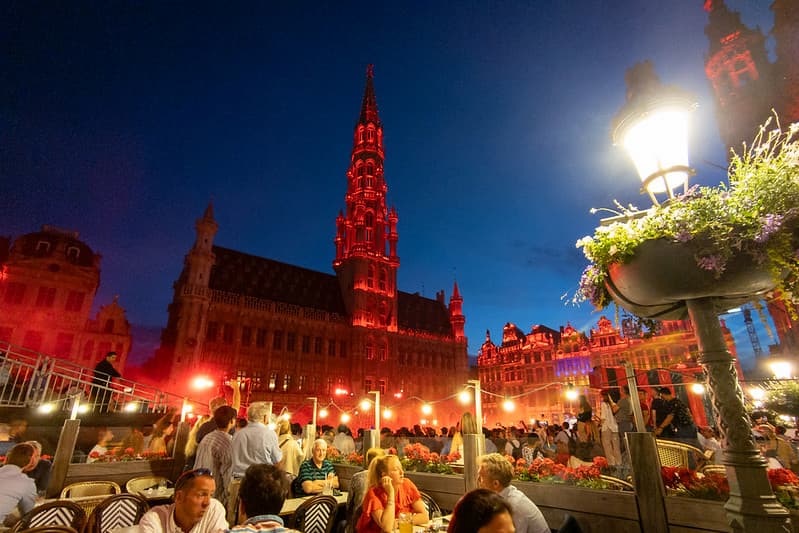
Four-year stone reconstruction defines La Grand-Place’s architectural unity
“La Grand-Place, Brussels” (Dutch: Grote Markt) is the historic central cobbled market square of Brussels, BELGIUM, encompassing a 1.48-hectare core property surrounded by a 20.93-hectare buffer zone within the medieval Îlot Sacré. Originating as a 12th-century marketplace known as the Nedermarckt (Lower Market), the rectangular square is framed by three remarkable ensembles: the Brabant Gothic Hôtel de Ville (Town Hall) built in the 15th century, the neo-Gothic Maison du Roi (King’s House or Broodhuis) opposite it, and ornate Baroque guildhalls lining the remaining sides.
Notably devoid of any church or place of worship, the square reflects Brussels’ identity as a prosperous northern European mercantile and municipal center. After French artillery bombarded and destroyed most of the square in August 1695, Brussels’ guilds and city magistrates rebuilt the facades in stone within four years, creating a cohesive gilded architectural masterpiece.
Attraction
La Grand-Place attracts architecture enthusiasts, photographers, cultural travelers, and food lovers globally as one of Europe’s most visually striking public squares.
Visitors admire the asymmetrical 96-meter spire of the Hôtel de Ville topped by Saint Michael, examine the gilded gables, statues, and emblems of individual trade guilds—such as the Brewers, Bakers, Boatmen, and Mercers—and tour the Brussels City Museum inside the Maison du Roi and the Belgian Brewers Museum. Travelers also relax at outdoor terrace cafés, shop at historic chocolatiers and speculoos bakeries, and attend major cultural spectacles including the biennial mid-August Flower Carpet, the Ommegang historical pageant, and the winter sound-and-light shows.

World Heritage
Inscribed on the UNESCO World Heritage List in 1998 under Criteria (ii) and (iv), La Grand-Place is recognized for its artistic synthesis and civic-mercantile heritage:
- Eclectic Architectural Synthesis (Criterion ii): The square exemplifies an extraordinary blending of Brabant Gothic, Flemish Baroque, and Louis XIV stylistic elements harmonized under a pioneering 1697 municipal facade ordinance.
- Triumph of a Mercantile City (Criterion iv): As a purely civic and commercial open space lacking religious buildings, its rapid post-1695 stone reconstruction demonstrates the wealth, civic pride, and urban planning sophistication of northern European bourgeois guilds.
Gateway
Because La Grand-Place sits in the heart of central Brussels, travelers enter directly through Belgium’s primary capital aviation hubs and nearby Antwerp—each verified in IATA’s official directory and supported by extensive hotels, rail links, and licensed guides:
- Brussels / Zaventem (Primary Capital & International Gateway / Nearest Major Airport Hub):
- Airport: Brussels Airport (IATA Code: BRU; ICAO Code: EBBR).
- Infrastructure and Distance: Located at Zaventem northeast of Brussels, roughly 12 to 15 kilometers (about 17 to 20 minutes by direct airport train to Brussels-Central Station, followed by a 5-minute walk to La Grand-Place, or 25 to 35 minutes by road) northeast of the square. BRU is Belgium’s busiest active public international hub indexed in IATA’s directory, backed by extensive central hotels, car rentals, SNCB/NMBS rail links, and accredited city guides.
- Antwerp / Deurne (Primary Northern Flemish Regional Gateway):
- Airport: Antwerp International Airport (IATA Code: ANR; ICAO Code: EBAW).
- Infrastructure and Distance: Located at Deurne southeast of central Antwerp, roughly 45 to 50 kilometers (about 45 to 55 minutes by road via the E19 motorway or roughly 45 minutes by InterCity train from Antwerp-Central to Brussels-Central) north of La Grand-Place. ANR is an active public airport listed in IATA’s directory, supported by city hotels, car rentals, and frequent rail connections.
- Charleroi (Primary Southern Walloon Low-Cost International Gateway):
- Airport: Brussels South Charleroi Airport (IATA Code: CRL; ICAO Code: EBCI).
- Infrastructure and Distance: Located at Gosselies north of Charleroi, roughly 55 to 60 kilometers (about 50 to 65 minutes by road or direct Flibco airport shuttle coach to Brussels-Midi Station, plus a short metro/tram or walk) south of La Grand-Place. CRL is an active public international airport indexed in IATA’s directory, offering nearby hotels, car rentals, and frequent coach transfers.
When
The ideal window to visit La Grand-Place is from Late Spring to Early Autumn (May to September), with a festive secondary peak in December:
- Late Spring to Early Autumn (May to September): Recommended for outdoor café culture, architectural photography, and major festivals such as the Ommegang (July), Brussels Jazz Weekend (May), and the biennial Flower Carpet (mid-August in even-numbered years), offering mild temperatures of 16°C to 24°C (61°F to 75°F).
- December and Winter (November to April): December transforms the square during Winter Wonders with a giant Christmas tree, nativity scene, and evening sound-and-light projections, while early spring brings quieter sightseeing.
Consideration
- Visit at Dawn and After Dark: La Grand-Place is pedestrian-only and open 24 hours; visiting early in the morning offers crowd-free photography, while returning after sunset reveals dramatic architectural illumination.
- Wear Comfortable Walking Shoes for Cobblestones: The entire square and surrounding Îlot Sacré lanes are paved with historic uneven cobblestones that can be slippery when wet.
- Watch for Pickpockets in Crowded Alleys: Because the square and nearby Manneken Pis and Rue des Bouchers attract dense crowds, keep bags zipped and valuables secure.
- Currency and Languages: Belgium uses the Euro (EUR), and Brussels is officially bilingual in French and Dutch, with English widely spoken across hotels, museums, and restaurants.

Resources
- UNESCO World Heritage Centre (La Grand-Place, Brussels): Official UNESCO portal detailing Outstanding Universal Value, inscription criteria, maps, and conservation history.
- City of Brussels Official Heritage Portal (Grand-Place): Municipal authority website covering guildhall histories, restoration timelines, live webcam, and event schedules.
- Visit.brussels (UNESCO Heritage in Brussels): Official Brussels tourism agency guide featuring walking itineraries, museum hours, and cultural events.
- Brussels City Museum (Maison du Roi): Official museum website detailing exhibitions inside the King’s House, original Town Hall sculptures, and ticket info.
- GetYourGuide: Online travel booking marketplace offering bookings for Brussels historical walking tours, chocolate-tasting experiences, and guided excursions.
Featured Image
Hotel de Ville, or Town Hall (Tom Page, Flickr/CC BY-SA 2.0).
News Feed
Advertisement


Comments:
Leave a Reply