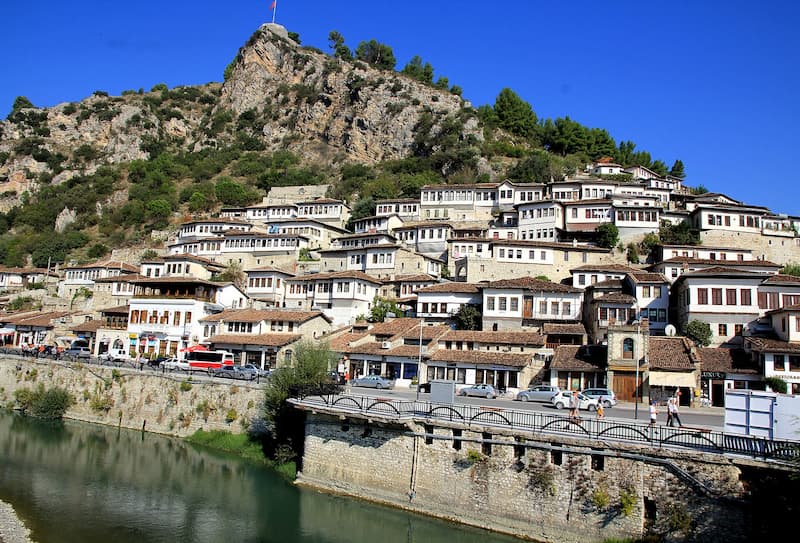
The Historic Centres of Berat and Gjirokastra, located in central and southern ALBANIA, represent two of the best-preserved examples of Ottoman-era urban architecture in the Balkan Peninsula. Inscribed together as a serial World Heritage Site, these two mountain-framed towns illustrate centuries of peaceful architectural, cultural, and religious synthesis along the ancient trade corridors of Southeastern Europe.
Berat, known as the “City of a Thousand Windows,” spans both banks of the Osum River. Its historical layout features distinct traditional neighborhoods: Mangalem (historically Muslim) on the northern bank, Gorica (historically Christian) on the southern bank, and Kalaja, a massive 13th-century inhabited citadel perched on a rocky hill. The townscape is characterized by white-walled Ottoman houses stacked up steep hillsides, featuring prominent horizontal rows of large timber-framed windows.
Gjirokastra, known as the “City of Stone,” sits in the Drino River valley beneath the Mali i Gjerë mountains. Dominated by a imposing medieval castle, the town features distinctive two- to three-story fortified tower houses known as kulle, built by wealthy landowners from the 17th through 19th centuries. These remarkable slate-roofed stone mansions, built on steep slopes, give Gjirokastra its unified architectural character.
Attraction
The dual site attracts travelers worldwide with its romantic architectural aesthetics, living heritage, and rich cultural traditions. Unlike static museum sites, both historic cores remain vibrant communities where local residents still inhabit centuries-old Ottoman homes and medieval castle walls.
Visitors to Berat can climb the cobbled paths of the Kalaja citadel to discover active Byzantine churches, the Onufri Iconographic Museum, and panoramic views over the Osum River valley. In Gjirokastra, tourists wander through the restored Old Bazaar, explore massive underground Cold War tunnels, and step inside grand historic mansions like Zekate House and Skenduli House to admire original carved woodwork, painted ceilings, and stone fireplaces. Additionally, the region draws global food and culture enthusiasts with traditional southern Albanian culinary specialties, artisan crafts, and regional iso-polyphonic folk music traditions.

World Heritage
UNESCO inscribed Gjirokastra in 2005 and extended the inscription to include Berat in 2008 under cultural criteria (iii) and (iv).
- Testimony to Ottoman Cultural Traditions and Tolerance (Criterion iii): The combined sites provide an exceptional physical testimony to the social structure, urban life, and architectural traditions of the Ottoman Empire in the Balkans. They demonstrate a long history of peaceful coexistence between Christian and Muslim communities, evidenced by mosques and Byzantine churches built adjacent to one another within the same historical neighborhoods.
- Outstanding Vernacular Architecture (Criterion iv): Berat and Gjirokastra represent an outstanding architectural ensemble that illustrates a critical period in Balkan urban history. Gjirokastra features an extraordinary density of kulle tower houses, reflecting defensive domestic architecture adapted to mountainous terrain. Berat complements this with its unique hillside urban layout, demonstrating indigenous Balkan building techniques integrated with classical Ottoman design.
Gateway
The primary gateway city to the site within Albania is Tirana, the national capital. Located approximately 100 kilometers north of Berat and 230 kilometers north of Gjirokastra, Tirana serves as the principal transportation hub for visitors entering the country.
Tirana is served by Tirana International Airport Nënë Tereza (IATA Code: TIA), situated in Rinas, 17 kilometers northwest of Tirana’s city center. As Albania’s primary international airport, TIA handles regular commercial flights from major European hubs, budget airlines, and seasonal charters.
From Tirana, travelers can comfortably reach Berat in under two hours by car, rental vehicle, or regional bus, while Gjirokastra is accessible in roughly three and a half hours via modern highway connections. Tirana offers extensive overnight lodging infrastructure for every budget, ranging from high-end international business hotels and boutique heritage properties to affordable guesthouses and traveler hostels.
When
The best time to visit the Historic Centres of Berat and Gjirokastra is during the shoulder seasons of Spring (April to June) and Autumn (September to October).
- Spring and Autumn: These months provide ideal weather conditions, featuring warm temperatures, clear skies, and blooming vegetation or crisp autumn light across the valley slopes. Crucially, moderate temperatures make walking up the steep, unpolished cobblestone inclines far more comfortable.
- Summer (July to August): Summer brings long daylight hours and lively outdoor evening dining. However, afternoon temperatures frequently exceed 35°C (95°F), making uphill walking strenuous.
- Winter (November to March): Winters bring cooler weather and frequent rainfall, which can make steep stone alleys slippery, though visitor crowds are minimal.
Considerations
- Challenging Walking Conditions: Both towns feature steep, sloping streets paved with polished limestone and river cobblestones. Highly supportive walking shoes with excellent rubber grip are mandatory.
- Cash-Based Local Economy: While hotel chains and larger restaurants in Tirana accept credit cards, small guesthouses, local cafes, artisan shops, and regional transport in Berat and Gjirokastra primarily operate on cash in Albanian Lek (ALL). Carrying adequate cash is strongly advised.
- Navigation and Accessibility: Many historic guesthouses in the upper quarters of Berat (Kalaja) and Gjirokastra cannot be reached directly by automobile. Travelers carrying heavy luggage should coordinate with hosts regarding vehicle access or meeting points.
- Respectful Conduct in Religious Sites: Active churches and mosques in both historic centers require modest attire (covered shoulders and knees) prior to entering.

Resources
- UNESCO World Heritage Centre: The official UNESCO portal offering formal inscription reports, map boundaries, and conservation assessments.
- Visit Albania: The official national tourism agency website providing travel itineraries, regional guides, and cultural context.
- Trip.com: A major global travel marketplace featuring user reviews, affiliate hotel bookings, tour packages, and dining recommendations.
- Into Albania: An informative digital travel portal offering detailed neighborhood walking routes, historic house tour schedules, and regional highlights.
- Gjirokastra Conservation and Development Organization: A local heritage portal providing historic house guides, restoration notes, and cultural trail maps.


Comments:
Leave a Reply