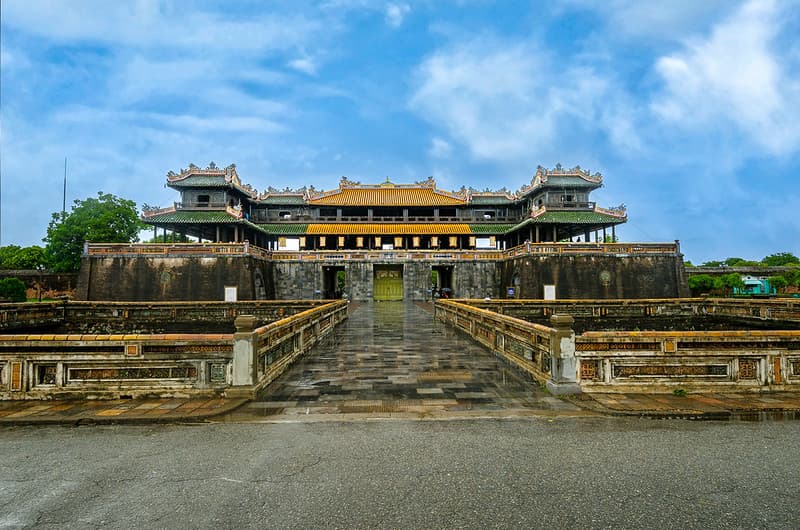
The Complex of Hué Monuments is the majestic heart of Vietnam’s imperial past. Located in central VIETNAM along the banks of the Perfume River (Sông Hương), it served as the political, cultural, and religious capital of a unified Vietnam under the Nguyen Dynasty from 1802 to 1945.
The complex is a vast ensemble of imperial architecture meticulously planned according to ancient geomancy (Feng Shui) and Confucian philosophy. It is divided into several key zones:
- The Hue Citadel (Kinh Thành): A massive square-shaped fortress with a perimeter of 10 kilometers. It features 10 fortified gates and is surrounded by a moat.
- The Imperial City (Hoàng Thành): Located within the Citadel, this enclosure housed the emperor’s offices and shrines. It is accessed through the iconic Noon Gate (Ngọ Môn).
- The Forbidden Purple City (Tử Cấm Thành): At the very center of the complex, this was the private residence of the emperor and the royal family, modeled after the Forbidden City in Beijing.
- Royal Tombs: Scattered throughout the countryside along the river are the grand mausoleums of the Nguyen emperors, such as the poetic Tu Duc Tomb, the symmetrical Minh Mang Tomb, and the ornate, European-influenced Khai Dinh Tomb.
- Sacred Sites: The complex also includes the Thien Mu Pagoda (the city’s unofficial symbol) and the Nam Giao Esplanade, where emperors performed rituals to Heaven.
Attraction
Hué offers a “time travel” experience that contrasts sharply with the modern bustle of Hanoi or Ho Chi Minh City:
- Royal Grandeur: It provides a tangible look at the life of Vietnam’s last emperors. The scale of the citadel and the artistic detail in the tombs are unparalleled in Southeast Asia.
- Imperial Cuisine: Hué is world-famous for its food. Originally created to please the royal palate, dishes like Bún Bò Huế (spicy beef noodle soup) and Bánh Bèo (steamed rice cakes) are served with a level of sophistication rarely found elsewhere.
- Royal Court Music (Nhã Nhạc): Visitors can witness performances of this UNESCO-recognized Intangible Heritage, featuring traditional instruments and courtly dances once reserved for the emperor.
- Atmospheric Beauty: The slow-moving Perfume River, the misty hills surrounding the tombs, and the “slow life” of the city create a romantic, melancholic atmosphere that attracts photographers and dreamers.

World Heritage
UNESCO inscribed the site in 1993 as it represents a unique fusion of Eastern and Western influences. It qualifies under Criterion (iv):
- Architectural Synthesis: The site is an outstanding example of an Eastern feudal capital. It successfully integrated traditional Vietnamese design with French Vauban-style military fortifications.
- Harmony with Nature: Unlike many other world capitals, Hué was designed to exist in total harmony with its natural surroundings (the Ngu Binh Mountain and the Perfume River), representing a masterwork of urban planning and landscape design.
Gateway
Hué City is the direct gateway to the monuments.
- Commercial Airport: Phu Bai International Airport (HUI) is located approximately 15 kilometers (about 30 minutes) from the city center. It handles frequent domestic flights from major Vietnamese hubs.
- Lodging: Hué has a mature tourism infrastructure. You can find everything from colonial-era luxury at the Azerai La Residence or the Saigon Morin Hotel to modern high-rises like the Melia Vinpearl Hue, along with countless boutique homestays in the “Le Loi” district.
When
- The “Dry and Cool” Window (January to April): This is the prime time to visit. Temperatures are pleasant (20^C to 26^C), and the spring flowers are in bloom.
- Avoid the “Rainy Season” (October to December): Hué is notorious for its persistent, heavy monsoon rains during these months, which can lead to flooding and make exploring the outdoor tombs difficult.
- Festival Hue: If you enjoy crowds and culture, visit during the biennial Hue Festival (usually in April, June, or July) to see large-scale royal reenactments and international art performances.
Consideration
- The “Two-Day” Rule: The monuments are spread out. You need at least one full day for the Citadel and another to visit the major tombs (Minh Mang, Tu Duc, and Khai Dinh) by boat or car.
- Dress Code: While there isn’t a strict “wrap-around” policy for the entire citadel, you must cover your shoulders and knees to enter the inner temples and the interior of the royal tombs.
- Walking vs. Transport: The Citadel is enormous. Consider renting a bicycle or taking an electric shuttle inside the grounds to save your legs. For the tombs, a dragon boat trip up the Perfume River is scenic but slower than a private car or taxi.
- Sun Protection: Many areas of the Citadel are open-air with little shade. Bring an umbrella or hat; the central Vietnamese sun can be intense even on cloudy days.

Resources
- UNESCO World Heritage Centre – The official source for maps, historical background, and the technical justification for the site’s protection.
- Vietnam Tourism (Official) – The national tourism board’s guide to Hué, featuring itineraries and local food recommendations.
- Hue Monuments Conservation Center – The local authority managing the site; best for current ticket prices and restoration updates.
- Lonely Planet: Hue – Excellent for practical logistics, such as transport tips and detailed tomb descriptions.
- GetYourGuide – A commercial platform where you can book guided “Imperial City” tours and river cruises.


Comments:
Leave a Reply