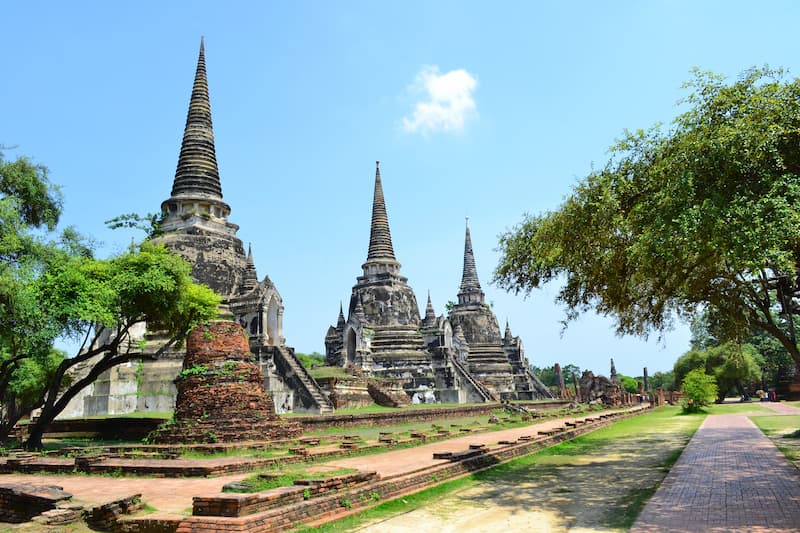
The Historic City of Ayutthaya, located in central THAILAND‘s Chao Phraya River valley, encompasses the grand archaeological ruins of the ancient capital of the Kingdom of Siam. Founded in 1350 CE by King Ramathibodi I, Ayutthaya flourished for over four centuries as a major political, economic, and religious hub in Southeast Asia before its destruction by the Burmese army in 1767. The historic city was strategically built on an island formed by the confluence of three major rivers—the Chao Phraya, Lopburi, and Pa Sak rivers—creating a natural moat for defense and establishing an intricate network of hydraulic canals for transportation, urban farming, and trade.
The archaeological site features impressive ruins characterized by towering prang (reliquary towers), colossal chedis (stupas), expansive Buddhist monasteries, and royal palace complexes. Architectural landmarks include Wat Phra Si Sanphet, which served as the royal temple model for Bangkok’s Emerald Buddha Temple; Wat Mahathat, famed for its stone Buddha head embedded within tree roots; Wat Ratchaburana; and Wat Chaiwatthanaram. The city’s design reflects a sophisticated urban grid system integrating canals, roads, and grand monuments that highlight a blend of Khmer, Sukhothai, and indigenous Siamese architectural influences.
Attraction
Ayutthaya captivates international visitors through its dramatic atmospheric ruins, deep cultural heritage, and accessible historical immersion. Standing amidst the soaring red-brick chedis and weathered stone Buddha statues allows travelers to step back into a bygone era when Ayutthaya was one of the largest and most prosperous cosmopolitan cities in the world. One of the most famous sights globally is the sandstone Buddha head entwined in the sprawling roots of a sacred Bodhi tree at Wat Mahathat, a symbol of nature seamlessly reclaiming spiritual history.
Tourists can explore the archaeological park by renting bicycles, riding tuk-tuks, or taking scenic river boat cruises that circle the island at sunset, offering striking views of illuminated riverside temples like Wat Chaiwatthanaram. Beyond ancient ruins, Ayutthaya features cultural sights such as the Bang Pa-In Royal Palace, bustling night markets, traditional riverside dining famous for giant freshwater prawns, and multi-faith heritage sites that showcase the city’s historical openness to foreign traders and diplomats from across Asia and Europe.

World Heritage
In 1991, UNESCO inscribed the Historic City of Ayutthaya on the World Heritage List under cultural criterion (iii).
- Exceptional Testimony to a Vanished Civilization (Criterion iii): The site bears an extraordinary and unique physical testimony to the artistic, architectural, and intellectual achievements of the Ayutthaya Kingdom, a major civilization that dominated Southeast Asia from the 14th to the 18th centuries. The monumental ruins of reliquary towers, vast monasteries, and intricate hydraulic systems illustrate the sophistication of Siamese urban planning, engineering, and monumental art. As the second capital of Siam after Sukhothai, Ayutthaya synthesized regional styles into a distinct national aesthetic that heavily influenced the founding and architectural layout of modern Bangkok.
Gateway
The primary gateway city to the site within Thailand is Bangkok, the national capital. Located approximately 70 kilometers south of Ayutthaya, Bangkok provides seamless transportation connections, including frequent direct trains, public buses, minivans, and private taxis that reach the historical park in roughly one to two hours.
Bangkok is served by two major international airports: Don Mueang International Airport (IATA Code: DMK) and Suvarnabhumi Airport (IATA Code: BKK). Don Mueang International Airport (DMK) is geographically closest to Ayutthaya, situated on the northern side of Bangkok along the primary highway and rail line heading toward the ancient capital. Both airports handle extensive domestic and international commercial flights. As a major global tourism hub, Bangkok offers an immense variety of overnight lodging options, ranging from luxury riverside hotels and international boutique properties to budget guesthouses and hostels. Alternatively, the city of Ayutthaya itself provides numerous riverfront hotels, heritage guesthouses, and homestays for travelers wishing to stay directly near the ruins.
When
The best time to visit the Historic City of Ayutthaya is during the Cool and Dry Season (November to February).
- Cool Season (November to February): During these months, the weather is characterized by lower humidity, clear sunny skies, and pleasant temperatures averaging between 24°C and 31°C (75°F to 88°F). This comfortable climate is ideal for outdoor exploration, walking through temple complexes, and cycling along river paths. Visiting in late November also offers the chance to experience Loy Krathong, when locals float illuminated banana-leaf vessels along the surrounding rivers.
- Hot Season (March to May): Temperatures frequently exceed 38°C (100°F) with high humidity, making sightseeing during the daytime physically exhausting.
- Monsoon Season (June to October): Heavy tropical rains and occasional flooding near riverbanks occur, though rain showers are often brief and leave the surrounding vegetation lush and green.
Considerations
- Temple Dress Code and Etiquette: Because many temples are active religious sites or revered historical monuments, visitors must dress modestly. Shoulders and knees must be covered, and shoes must be removed before stepping into sacred shrine rooms.
- Respectful Behavior Toward Sacred Relics: Buddha statues must be treated with utmost respect. Touching, climbing, or posing inappropriately with statues is forbidden. When photographing the famous Buddha head in tree roots at Wat Mahathat, visitors should crouch or sit so their head is lower than the relic.
- Sun Protection and Hydration: The archaeological ruins offer minimal shade. Travelers should bring sun hats, light breathable clothing, high-SPF sunscreen, and plenty of drinking water.
- Transportation Within the Island: Renting a bicycle or hiring a local tuk-tuk for several hours is the most efficient way to travel between spread-out temple clusters.

Resources
- UNESCO World Heritage Centre: The official UNESCO portal providing formal inscription details, maps, and conservation assessments.
- Tourism Authority of Thailand: The official national travel board site providing regional guides, temple hours, and festival dates.
- Trip.com: A major global travel marketplace featuring traveler reviews, hotel bookings, tour packages, and dining recommendations.
- Fine Arts Department of Thailand: The official government body managing the preservation of Ayutthaya Historical Park.
- Thailand Insider: An informative travel site providing detailed guides on Ayutthaya’s history, temples, and transport.


Comments:
2 responses to “Historic City of Ayutthaya”
-
Amazing. Our regret was seeing it as a day trip from Bangkok – we should have stayed longer.
-
The ancient city area is not that large and one of my favorite things to do there is to rent a bicycle and explore the city that way. I think many tourists might come to Ayutthaya seeing it as a former ancient ‘capital’ of Siam — not just Thailand — before the capital moved to Bangkok. But it would be interesting to understand Ayutthaya as a political power that existed contemporary to other kingdoms in medieval Southeast Asia: Angkor (Cambodia), Lan Xang (Laos), Lanna and Sukhothai (northern Thailand) and Pegu and Ava in what is now Myanmar. These kingdoms competed, rose and fell in reaction to each other and so in the ruins one sees the echoes of greatness, and at the same time reminders of loss in battle.


Leave a Reply