Straits of Malacca ports fuse multicultural trade with colonial legacy.
“Melaka and George Town, Historic Cities of the Straits of Malacca” is a dual-city cultural heritage property spanning two historic port settlements along the Straits of Malacca in Peninsular MALAYSIA: Melaka in the south and George Town on Penang Island in the north. Together, they preserve over 500 years of maritime trade history and multicultural urban development shaped by Malay, Chinese, Indian, Arab, Portuguese, Dutch, and British influences.
Melaka’s core centers around St. Paul’s Hill and the Malacca River, featuring early sultanate heritage, Portuguese and Dutch fortifications, civic squares, and historic shophouses. George Town, founded in 1786 as a British trading settlement, preserves an extensive urban fabric of traditional shophouses, clan houses, ancestral temples, mosques, churches, and vibrant ethnic quarters.
Attraction
These historic port cities draw cultural travelers, architecture enthusiasts, food lovers, and history buffs globally who seek living heritage towns where centuries-old traditions remain part of everyday life.
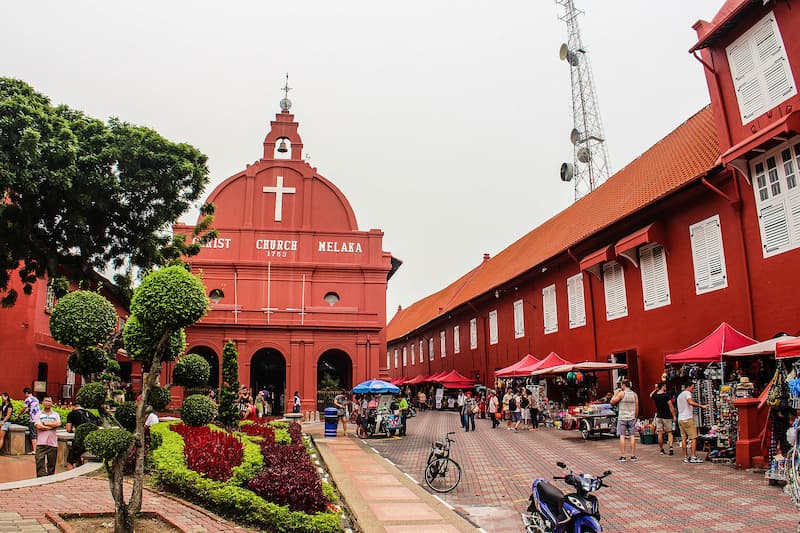
In Melaka, visitors walk along Jonker Street, explore the Dutch Square and Christ Church, view remnants of A Famosa, tour Peranakan heritage residences, and cruise the Malacca River. In George Town, travelers admire ornate clan jetties, grand mansions, street art murals, and historic religious landmarks like Khoo Kongsi and Kapitan Keling Mosque. Both cities are celebrated culinary destinations renowned for Nyonya (Peranakan) cuisine, street hawker fare, and traditional craft workshops.

World Heritage
Inscribed on July 7, 2008, as a UNESCO World Heritage Site, Melaka and George Town are recognized under strict cultural criteria for their living multicultural trading legacy:
- Criterion (ii): The cities exhibit an important interchange of human values over more than 500 years, blending Malay, Chinese, and Indian traditions with successive European colonial influences across architecture, urban layout, and culture.
- Criterion (iii): They bear exceptional testimony to living multicultural heritage and intangible traditions expressed through diverse religious institutions, ethnic quarters, festivals, crafts, and culinary practices.
- Criterion (iv): They showcase an outstanding range of historic shophouses, townhouses, and public buildings representing distinct architectural stages from early maritime trade through the colonial era.
Gateway
Because this is a two-city heritage inscription spanning southern and northern Peninsular Malaysia—with each city well within a 30-to-60-minute drive of its own local IATA-listed airport—the most direct, practical gateways are each historic city’s immediate airport hub, supported by extensive hotels, transit links, and licensed guides:
- Melaka (Southern Core Gateway / Nearest Airport to Historic Melaka):
- Airport: Malacca International Airport (IATA Code: MKZ; ICAO Code: WMKM).
- Infrastructure and Distance: Located approximately 7 to 8 kilometers (about 15 to 25 minutes by road) north of Melaka’s historic core. MKZ is an airfield indexed in IATA’s directory. Melaka offers abundant heritage boutique hotels, resort properties, city buses, ride-hailing, car rentals, and accredited heritage tour guides.
- George Town / Bayan Lepas, Penang (Northern Core Gateway / Nearest Airport to Historic George Town):
- Airport: Penang International Airport (IATA Code: PEN; ICAO Code: WMKP).
- Infrastructure and Distance: Located roughly 16 to 17 kilometers (about 25 to 55 minutes by road or public bus, depending on traffic) south of George Town’s heritage zone. PEN is an active public international airport listed in IATA’s directory, backed by extensive hotels, public buses, ride-hailing, car rentals, and licensed cultural guides.
When
The ideal window to visit both Melaka and George Town is during the Drier Months (January to March and June to August):
- Drier Months (January to March & June to August): Recommended for walking heritage trails, exploring street markets, and photography, featuring lower rainfall and warm coastal temperatures averaging 27°C to 33°C (81°F to 91°F).
- Inter-Monsoon Rainy Months (April to May & September to November): Brings periodic tropical downpours and humid conditions, though indoor museums, temples, and cafés remain easily accessible year-round.
Consideration
- Pace Your Walking and Beat the Heat: Tropical sun and high humidity can be taxing during midday walks; schedule outdoor street exploration for early morning or late afternoon and stay hydrated.
- Weekend Crowds and Heritage Etiquette: Popular lanes like Jonker Street and George Town’s core draw heavy weekend crowds; dress modestly and follow quiet conduct rules when visiting active mosques, temples, and churches.
- Advance Tickets for Key Sites: Popular historic mansions, museums, and cultural performances can sell out on peak weekends or holidays, so check opening days and book ahead where required.
- Currency and Payments: The official currency is the Malaysian Ringgit (MYR). While hotels and larger eateries take cards or e-wallets, carry cash for street food stalls, trishaws, and small heritage shops.

Resources
- UNESCO World Heritage Centre (Melaka and George Town Profile): Official UNESCO portal detailing inscription criteria, heritage boundaries, and statement of outstanding universal value.
- George Town World Heritage Incorporated (GTWHI): Official heritage management body for George Town providing conservation guidelines, cultural maps, and event updates.
- Melaka Historic City Council (MBMB): Official local authority portal covering municipal heritage administration, visitor notices, and city information.
- Tourism Malaysia Official Portal: National tourism gateway offering travel itineraries, regional transport guidance, and cultural highlights across Melaka and Penang.
- Trip.com: Online travel booking marketplace offering tickets for heritage walking tours, attraction passes, and regional transfers.
Featured Image
Red Square, Melaka (Natalie Thoo, Wikipedia/CC BY-SA 4.0).
News Feed
-
Uncovering Penang: Delicious Food and Rich History
-
Two Days of Free Entry to Penang Heritage Sites for Malaysia Day
-
Gurdwara in Penang: 125 Years of Heritage Reopened
-
RM1 Million Funding for Sikh Temple Restoration
-
Discover Local Life in George Town’s Heritage Zone
-
Top Hotels to Stay in Melaka for Every Budget
Advertisement


Comments:
11 responses to “⬛️ Melaka and George Town, Historic Cities of the Straits of Malacca”
-
I LOVE Malacca. Lived there for a month a couple of years ago and it truly became one of my favourite places in Malaysia. The locals are lovely and the food (much like the rest of the country) was delicious. Can’t wait to go back.
-
For me, Melaka’s appeal is the food and the architecture. It’s just dawned on me that every entry is going to mention the food as a highlight but that’s Malaysia in a nutshell (or should that be a coconut shell?!).
The eclectic mix of architecture is best appreciated on foot, following the town’s Heritage Trail (you can pick up a map at the Tourist Information Centre), visiting China Town and the Old Town. And when you’re ready to start eating, head to Jonker Street.
Depending on your interests, there is plenty to keep you occupied for a few days in Malacca. We’re not so into museums, but if you are, you’ll probably need to stay a week! If you only visit one museum it should be the Baba-Nonya Heritage Museum where you can learn about the history of the region.
Other ‘must see’ sights in Melaka include the Stadthuys (a Dutch-built historical building), Dutch Square, historic Christ Church, and the 17th century Cheng Hoon Teng Chinese temple.
We enjoyed walking along the river that cuts through the town, particularly at nightfall when lights from the traditional houses produce a photogenic reflection. There is also a thriving street art scene in Melaka which I have yet to fully appreciate since it has mushroomed since our last visit to the city, around four years ago. A lot of murals can be seen from the riverbanks, and the narrow alleys in the old town are another good place to go street art hunting.
-
Perhaps the most conspicuous symbol of the Chinese presence in Penang is Kek Lok Si, “The Temple of Supreme Bliss,” founded in 1891. This sprawling Buddhist temple complex built into Penang Hill is among the largest in Southeast Asia.
I slipped off my shoes and stepped into a vast prayer hall where I discreetly observed worshippers kneeling before a gleaming Buddha so massive, it made them appear as insignificant as the ephemeral smoke wafting from their heavily perfumed incense sticks.
Meandering aimlessly through a maze of towers, pagodas and gardens dotted with tortoise-filled ponds, I encountered a photo-worthy sculpture or mural at practically every turn.
I saved the best for last. The Sky Lift, a tram that climbs to the top of the mountain, takes visitors to see the impressive, 90-foot statue of Kuan Yin, the Chinese goddess of mercy, that was added in 2009. A sweeping, bird’s-eye view of the city is a bonus.
-
The Melaka streets are full of colourful, photogenic Baba Nyonya shophouses, with their mandatory shuttered windows while on Jalan Tukang Emas – also known as “Harmony Street” – an Islamic mosque and Hindu and Buddhist temples are neighbours. But it is the magnificent crimson-coloured 18th-century Dutch church – Malacca’s own “Red Square”, that draws the most tourists. It was the oldest building I’d ever seen when I first visited all those years ago. The Dutch built the church to commemorate the centenary of their colonial rule of Malacca in 1653. Eventually the British, having conquered the Dutch, transformed it into an Anglican church but, in looks alone, it will forever remain Dutch.
-
Like most tourists, I started my tour in the Dutch Square or the Stadthuys (Jalan Gereja, Malacca), which is believed to be the oldest Dutch building on this side of the world. Also known as the Red Square because of its bright, salmon-colored structures, this is where visitors have their photos taken, most of them in front of the Christ Church, the Tang Beng Swee Bell Tower, and the Queen Victoria Fountain. It took me a while to get past the crowds of tourists wanting to get every angle of the square, but I cannot blame them. The whole square is picturesque, with the undeniable European feel from its old world architecture and romantic cobblestone steps. Walking further, I immersed myself in the extensive Malacca history as I made my way to their complex of museums. For RM 5, I was able to visit three: History and Ethnography Museum, Literature Museum, and the Democratic Government Museum.
-
A trishaw is one of the best ways to take in Penang and all its romantic colonial architecture, UNESCO Heritage sites, and seaside. The canny trishaw cyclist will be able to cut through traffic quickly and recommend some good places to try out the famous Penang cuisine.
-
Chew Jetty: It’s the most interesting because it isn’t every day that you see something like this! Clan jetties are Chinese waterfront settlements comprised of wooden houses built on stilts. They were built more than a century ago by poor Chinese immigrants who moved to Penang from Fujian province and worked near the port.
-
Me and m husband were there in November last year, as part of a tour. I wasn’t expecting to like Penang, pre conceived ideas, but I was completely wrong and really loved it. We visited the Peranaken Museum, which I found incredibly fascinating, especially all the beautiful costumes and jewellery. There was so much more that we didn’t see and I would love to go and spend more time there. I’m working on trying to persuade my friend in Canada to go with me next year, combined with Langkawi and Singapore.
-
Head to the nearby Khoo Kongsi (18 Cannon Square) for what is one of the most intricately designed clan houses in Southeast Asia. Similar in purpose to those found in places like Singapore, Hoi An, Melaka, etc – these clan houses served as the headquarters of family associations. There is an entrance fee of MYR 10 – pretty steep for a temple in Malaysia but worth it for the architecture. On certain evenings, Khoo Kongsi is also floodlit which makes the building’s details stand out even more.
-
A big part of Penang’s identity is its Peranakan history. The term refers to the earliest Chinese immigrant traders who mixed with locals, creating a unique culture in terms of food, art and architecture. Some of their traditional homes have been turned into hotel-museums. The two most well-kept mansions are the Pinang Peranakan Museum and the Cheong Fatt Tze Mansion or the Blue Mansion. If I had to choose one, I would go for the Pinang Peranakan, simply because it is more ornate.
-
George Town’s center is UNESCO World Heritage listed thanks to its unique architecture, culture, and townscape. You need to set aside at least a couple of hours to wander around this Penang famous place to visit. There are neighborhoods to visit within it as well with Little India, its famous Chinese shop fronts and colonial architecture left by the British. It’s also easy to visit with it being centrally located within the most popular parts of Penang. Some area to explore include Love Lane, Armenian Street and around Queen Street, Chulia Street and Market Streets for Little India. There are also some Penang points of interest to visit to learn more the history of this area at Peranakan Mansion and Cheong Fatt Tze Mansion.


Leave a Reply