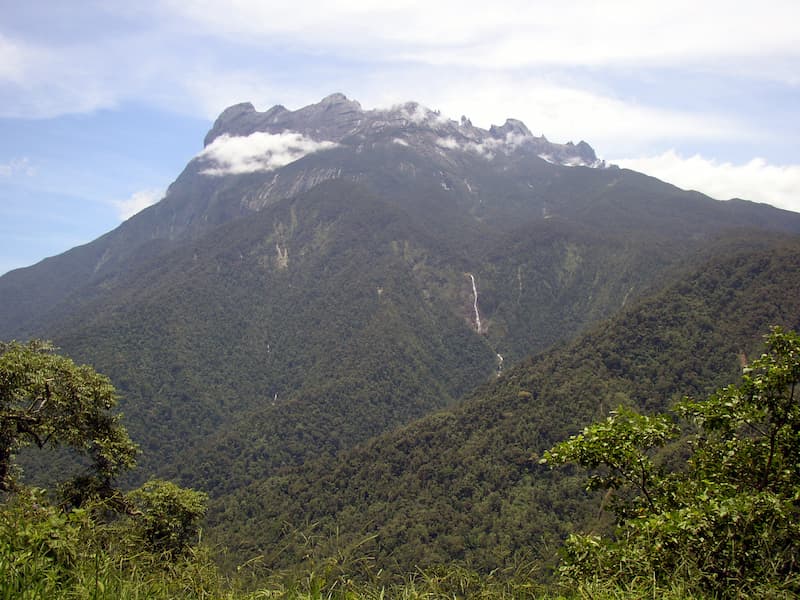
Sabah highlands unite towering granitic peaks with rare flora
The UNESCO World Heritage site titled “Kinabalu Park” is a biodiverse mountain sanctuary located on the northern end of the island of Borneo in the state of Sabah, MALAYSIA. Established in 1964 as Malaysia’s first national park, the protected estate covers 75,370 hectares (754 square kilometers) along the Crocker Range.
Dominating the landscape is Mount Kinabalu (Gunung Kinabalu), which rises to 4,095 meters above sea level—making it the highest peak between the Himalayas and New Guinea. Formed by a massive granite intrusion pushed upward by tectonic forces, the mountain is surrounded by steep ridges, deep gorges like Low’s Gully, and cascading rivers. Across its dramatic altitudinal gradient from 152 meters to 4,095 meters, the park encompasses six distinct vegetation zones: lowland dipterocarp rainforest, hill rainforest, lower and upper montane cloud forests, sub-alpine forest, and rocky alpine scrub near the summit.
Attraction
Kinabalu Park attracts mountaineers, botanists, birdwatchers, and nature travelers worldwide who come to experience Southeast Asia’s iconic summit and extraordinary biodiversity.
Adventurous travelers undertake the classic two-day, one-night climb from Timpohon Gate to Low’s Peak, staying overnight at mountain lodges before ascending granite slabs in the pre-dawn dark to watch sunrise above the clouds. At the cool Park Headquarters (1,563 meters), visitors explore the Kinabalu Botanical Garden and forest trails to spot carnivorous pitcher plants—including the giant Nepenthes rajah—rare slipper orchids, and endemic montane birds. Roughly 40 kilometers east within the park’s lowland sector, visitors relax in mineral baths at Poring Hot Springs, walk the 41-meter-high treetop canopy walkway, and search nearby forests for blooming Rafflesia flowers.

World Heritage
Inscribed on the UNESCO World Heritage List in December 2000 as Malaysia’s first World Heritage property, Kinabalu Park is recognized under Natural Criteria (ix) and (x):
- Criterion (ix) – Ongoing Ecological and Evolutionary Processes: The park exhibits an exceptional array of naturally functioning ecosystems. Its steep altitudinal and climatic gradient—spanning tropical rainforest to alpine zones—combines with dissected topography, diverse ultramafic soils, and climatic oscillations to drive rapid speciation and high endemism.
- Criterion (x) – Biological Diversity and Endemism: Designated a Centre of Plant Diversity for Southeast Asia, Kinabalu Park harbors an estimated 5,000 to 6,000 vascular plant species (including roughly 1,000 orchids, 78 fig species, and over 600 ferns), representing more than half of all Borneo’s flora alongside elements from the Himalayas, China, and Australia. It also shelters 326 bird species and over 100 mammal species.
Gateway
Travelers planning a visit to Kinabalu Park can access the property via three proximate Sabahan gateway hubs within a ~3-hour driving radius, each featuring public IATA-listed airports searchable on IATA’s official directory, overnight lodging, and overland road access:
- Ranau / Kundasang (Primary Local Gateway / Nearest Airport Hub):
- Airport: Ranau Airport (IATA Code: RNU; ICAO Code: WBKR).
- Infrastructure and Distance: Located approximately 15 to 20 kilometers (about 20 to 30 minutes via Federal Route 22) southeast of Kinabalu Park Headquarters. RNU is a public airfield indexed in IATA’s official directory. Neighboring Kundasang and Ranau offer abundant highland resorts, mountain lodges, homestays, local taxis, and licensed park guides.
- Kota Kinabalu (Primary Commercial Aviation Gateway):
- Airport: Kota Kinabalu International Airport (IATA Code: BKI; ICAO Code: WBKK).
- Infrastructure and Distance: Located roughly 88 to 95 kilometers (about 1.5 to 2 hours via the Tamparuli–Ranau Highway) west of the park entrance. BKI is Sabah’s primary public international airport listed in IATA’s directory. As the state capital, Kota Kinabalu provides extensive luxury and budget hotels, car rentals, tour operators, and intercity minivans running directly past Park Headquarters.
- Keningau (Secondary Southern Interior Gateway):
- Airport: Keningau Airport (IATA Code: KGU; ICAO Code: WBKG).
- Infrastructure and Distance: Located approximately 125 to 135 kilometers (about 2.5 to 3 hours via the Tambunan–Ranau interior road) southwest of Kinabalu Park. KGU is a public airfield searchable in IATA’s directory, with Keningau town providing comfortable hotels, rental vehicles, and scenic highland road access.
When
The ideal window to visit Kinabalu Park is during the Drier Season (March to September):
- Drier Months (March to September): Recommended for summit climbs and nature trekking, featuring clearer morning skies, lower rainfall, and pleasant highland temperatures between 15°C and 24°C (59°F to 75°F) at Park Headquarters.
- Wetter Monsoon Season (October to February): Brings frequent afternoon rain and mountain mist, though mornings often remain clear and tourist crowds are lighter.
Consideration
- Advance Climbing Permits: Summit climbs require mandatory Sabah Parks permits, licensed mountain guides, and mountain hut reservations booked months ahead. Day visitors exploring lower nature trails and the Botanical Garden do not need climbing permits.
- Cold Summit Temperatures: While Park Headquarters is cool, temperatures near Low’s Peak regularly drop to 0°C–5°C (32°F–41°F) with strong winds. Thermal layers, waterproof outerwear, gloves, a headlamp, and sturdy hiking boots are essential.
- Strict Conservation Laws: Removing orchids, pitcher plants, or wildlife from the park is strictly illegal and carries heavy fines and imprisonment.
- Currency and Cash: The official currency is the Malaysian Ringgit (MYR). Carry physical cash for park conservation fees, camera permits at Poring Canopy Walkway, and Kundasang markets.

Resources
- UNESCO World Heritage Centre: Official inscription portal detailing site boundaries, criteria evaluations, and conservation reports.
- Sabah Parks Official Portal: Official state conservation authority providing park entry fees, trail notices, and summit climb regulations.
- Sabah Tourism Board Official Portal: Official destination website featuring highland travel guides, transport logistics, and accredited tour operator directories.
- Sutera Sanctuary Lodges: Official concessionaire portal for booking Kinabalu Park Headquarters accommodations and Poring Hot Springs lodging.
- Trip.com: Leading Asian online travel marketplace offering bookings for guided Kinabalu Park day trips, Poring Hot Springs excursions, and Kota Kinabalu transfers.


Comments:
Leave a Reply