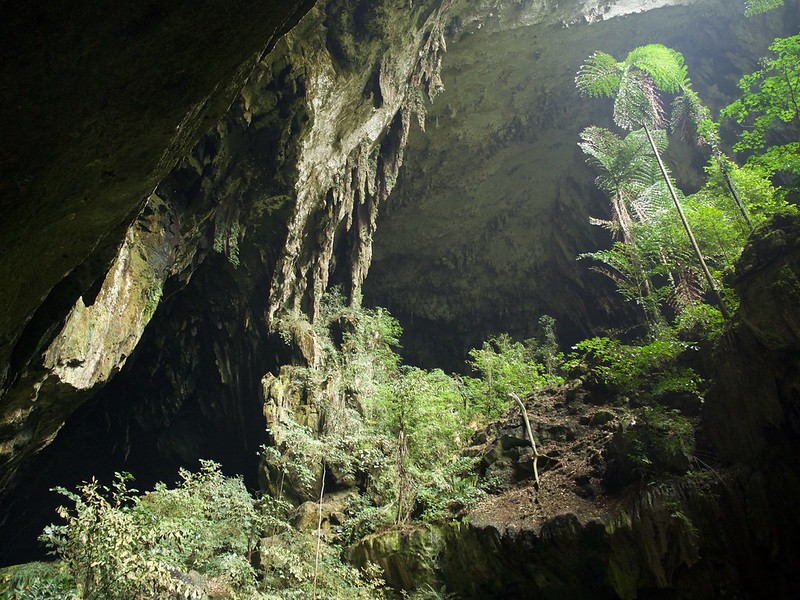
Sarawak Chamber conceals the world’s largest underground cavern
“Gunung Mulu National Park” is a spectacular tropical karst and rainforest wilderness located in the Miri Division of northern Sarawak, MALAYSIAN Borneo, near the border with Brunei. Spanning 52,864 hectares, the park is dominated by Gunung Mulu, a 2,377-meter sandstone peak flanked by dramatic limestone massifs, deep gorges, wild rivers, and dense primary equatorial rainforest.
Beneath its forested slopes lies one of the world’s largest, most intensively studied tropical limestone cave systems, encompassing hundreds of kilometers of explored subterranean passages. The park’s surface and underground terrain showcase dramatic karst evolution, including razor-sharp limestone spires known as “The Pinnacles” on Gunung Api, colossal subterranean chambers, and 17 distinct vegetation zones housing roughly 3,500 vascular plant species.
Attraction
Gunung Mulu National Park attracts cavers, adventure trekkers, wildlife photographers, and nature travelers globally who seek colossal subterranean chambers, dramatic limestone formations, and untouched Bornean jungle.
Visitors explore four world-famous, illuminated show caves—Deer Cave, Lang Cave, Clearwater Cave, and Wind Cave—marveling at the Sarawak Chamber (the world’s largest cave chamber by area) and Clearwater’s vast subterranean river system. At dusk, travelers gather at the Deer Cave observatory to watch millions of wrinkle-lipped free-tailed bats spiral into the evening sky in dramatic ribbons. Adventurous hikers tackle multi-day treks to the 45-meter-tall razor-sharp Pinnacles on Gunung Api, ascend the 30-meter canopy treetop tower, navigate rivers by traditional wooden longboat, and visit indigenous Penan and Berawan river settlements.

World Heritage
Inscribed in November 2000 as one of Malaysia’s first two UNESCO World Heritage Sites, Gunung Mulu National Park is recognized under all four natural heritage criteria for its global geological and biological significance:
- Criterion (vii): The park displays superlative natural phenomena, including colossal cave passages, massive bat exodus spectacles, and dramatic karst pinnacles rising out of pristine rainforest.
- Criterion (viii): Its extraordinary network of caves, subterranean rivers, and karst geomorphology provides an outstanding record of earth history, tectonic uplift, and tropical karst dissolution over millions of years.
- Criterion (ix): Spanning elevations from 28 meters to 2,377 meters, the park preserves uninterrupted ecological processes across 17 rainforest vegetation zones and subterranean cave ecosystems.
- Criterion (x): It protects exceptional tropical biodiversity, including extraordinarily rich palm flora, diverse bat and swiftlet populations, and endangered Bornean wildlife.
Gateway
Because Gunung Mulu National Park sits deep in an interior rainforest basin isolated from Sarawak’s external public highway network, access within a reasonable overland or river transit window relies directly on its adjacent local aviation gateway:
- Mulu / Kampung Sungai Melinau (Sole Direct Gateway / Nearest Airport Hub):
- Airport: Mulu Airport (IATA Code: MZV; ICAO Code: WBMU).
- Infrastructure and Distance: Located approximately 1.5 kilometers (a 5-minute local shuttle drive or 20-minute walk along the sole paved local road) west of the Gunung Mulu National Park Headquarters. MZV is an active public regional airport indexed in IATA’s directory, receiving regular scheduled turboprop flights from regional Sarawak and Sabah cities. The immediate Mulu settlement provides luxury rainforest resorts, park-operated lodges and hostels, community homestays, longboat jetties, and mandatory licensed park guides.
When
The ideal window to visit Gunung Mulu National Park is during the Drier Season (February to September):
- Drier Months (February to April & June to September): Recommended for hiking the Pinnacles trail, exploring caves, and watching the evening bat exodus (which rarely occurs during heavy rain), featuring lower rainfall and daytime temperatures averaging 26°C to 32°C (79°F to 90°F).
- Wet Season (October to January): Brings heavy tropical downpours that swell the Melinau River, occasionally causing temporary flash-flood closures in low-lying cave passages and flight delays.
Consideration
- Book Flights, Lodging, and Specialist Treks Early: Because MZV relies on regional turboprop aircraft subject to weather delays, book flights, park bungalows, and guided Pinnacles, Summit, or Adventure Caving slots months in advance, leaving buffer days before onward international connections.
- Mandatory Certified Park Guides: Independent exploration is restricted to self-guided plankwalks around Park Headquarters; entering show caves, adventure caves, or mountain trails legally requires hiring an accredited park guide and paying applicable conservation fees.
- Rainforest Gear and Leech Protection: High humidity, wet limestone rocks, and leeches require high-grip trail shoes, leech socks, lightweight quick-dry clothing, a waterproof dry bag, and a reliable headlamp.
- Cash and Remote Logistics: There are no banks or ATMs in Mulu; bring sufficient Malaysian Ringgit (MYR) cash for park conservation fees, boat charters, meals, and guide tips.

Resources
- UNESCO World Heritage Centre (Gunung Mulu Profile): Official UNESCO portal detailing all four natural heritage criteria, karst geology, and biodiversity records.
- Gunung Mulu National Park Official Portal: Official park management website providing cave tour schedules, Pinnacles trek requirements, lodging bookings, and tariff lists.
- Sarawak Forestry Corporation: Official state conservation agency portal overseeing protected area regulations and wildlife management in Sarawak. (Website:
sarawakforestry.com) - Sarawak Tourism Board Official Portal: Official destination website featuring Mulu travel itineraries, flight connectivity updates, and cultural insights.
- Trip.com: Leading online travel marketplace offering bookings for multi-day Mulu cave and Pinnacles tour packages, airport transfers, and Sarawak excursions.


Comments:
One response to “⬛️ Gunung Mulu National Park”
-
After exploring the caves, the bat observatory deck located outside of Deer Cave is a fantastic place to stop and enjoy the thousands of bats flying out of the caves in the early evening. For a more precarious activity, take the rough trails that lead to Mulu’s Pinnacles, a cluster of large, protruding, razor-sharp rock formations situated on Mount Api’s limestone hills. The rock formations were created by heavy rain that eroded the rocks over millions of years.


Leave a Reply