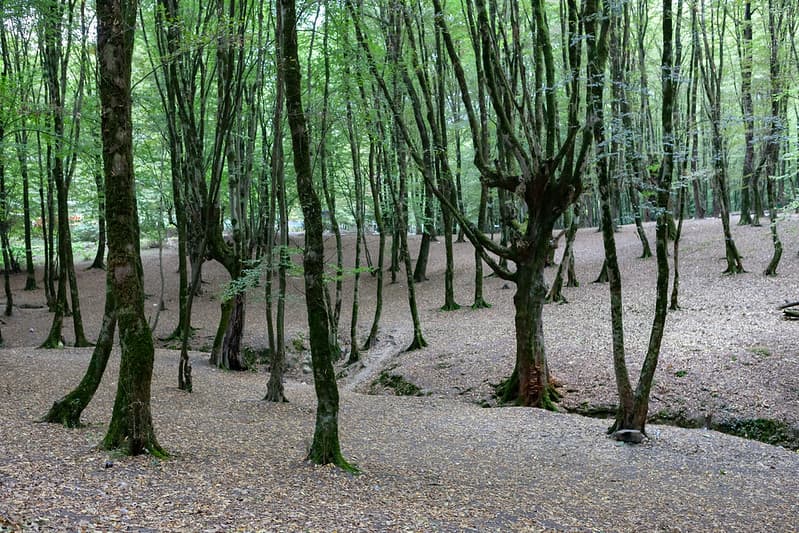
Hyrcanian Forests: A Prehistoric Paradise in Iran
The UNESCO World Heritage property titled “Hyrcanian Forests” is an ancient, lush green belt of temperate broadleaved deciduous rainforest stretching over 850 kilometers along the southern coast of the Caspian Sea in northern IRAN. Spanning across five northern Iranian provinces—Gilan, Mazandaran, Golestan, Semnan, and North Khorasan—this unique ecosystem covers approximately 1.9 million hectares on the northern slopes of the Alborz Mountain range.
Dating back between 25 and 50 million years to the Paleogene period, the Hyrcanian region is a relict flora sanctuary. When ice ages wiped out temperate broadleaf forests across most of the Northern Hemisphere, the protective microclimate created by the Alborz Mountains and the moist air currents of the Caspian Sea sheltered this prehistoric ecosystem. Today, the serial UNESCO property consists of 15 distinct protected forest components in Iran (along with extensions in neighboring Azerbaijan). The terrain spans from sea level up to elevations exceeding 3,000 meters, featuring dense canopy covers of Persian Ironwood (Parrotia persica), Oriental Beech, Chestnut-leaved Oak, and ancient Yew trees, forming a vibrant green paradise within an otherwise arid region.
Attraction
The Hyrcanian Forests draw international nature enthusiasts, hikers, photographers, and botanists eager to experience one of Earth’s oldest living ecosystems.Often referred to as “living fossils,” these woods offer a rare glimpse into a prehistoric landscape that has remained largely continuous since the Cenozoic era.
A major draw for travelers is the stunning diversity of forest landscapes across varying altitudes. Visitors can trek through mist-shrouded cloud forests such as the famous Abr Forest (Cloud Forest) near Shahroud, where clouds descend into the tree canopy, creating a surreal walking experience above a sea of fog. Coastal and low-altitude zones like Philband, Gisoom, and the forests of Talesh offer sweeping vistas where emerald hills meet the Caspian shore. In autumn, the forests undergo a dramatic visual transformation as species like the endemic Persian Ironwood shift into fiery shades of amber, crimson, and gold, making autumn foliage tours world-famous. Beyond plant life, eco-tourists come for birdwatching and wildlife tracking, as the forest shelters rare fauna including the Persian leopard, brown bear, Caspian red deer (Maral), roe deer, and over 180 bird species.

World Heritage
Inscribed on the UNESCO World Heritage List in 2019 under Criterion (ix), the Hyrcanian Forests were recognized for their outstanding ecological importance and ongoing evolutionary processes:
- Criterion (ix) – Outstanding Biological and Evolutionary Processes: The property represents a rare Arcto-Tertiary relict forest that survived the Quaternary glaciations. It serves as an irreplaceable evolutionary refugium where broadleaved temperate forests expanded and adapted over millions of years. The forest exhibits exceptional floristic biodiversity, harboring over 3,200 vascular plant species—representing roughly 44 percent of all vascular plants documented in Iran within just 7 percent of its landmass. Due to prolonged geographic isolation bounded by the Caspian Sea and Alborz range, the ecosystem maintains an extraordinary concentration of endemic, threatened, and relict flora and fauna found nowhere else on Earth.
Gateway
Travelers venturing into the Hyrcanian Forests can utilize several well-equipped gateway cities located along northern Iran’s Caspian coast, each featuring active IATA-coded airports, lodging, transport links, and local tour operators:
- Rasht (Western Caspian Gateway):
- Airport: Rasht International Airport / Sardar-e Jangal Airport (IATA Code: RAS; ICAO Code: OIGG).
- Infrastructure: Located in Gilan Province, Rasht provides immediate access to the western Hyrcanian forest reserves, including Gisoom, Fuman, and Masuleh. As a major provincial capital, Rasht offers diverse accommodation options ranging from multi-star commercial hotels to traditional boutique eco-lodges. Transport links include long-distance bus terminals, car rentals, and private taxis, while local agencies offer licensed nature guides.
- Sari (Central Caspian Gateway):
- Airport: Sari Dasht-e Naz International Airport (IATA Code: SRY; ICAO Code: OINZ).
- Infrastructure: Serving as the capital of Mazandaran Province, Sari sits near prime central forest zones like Kiasar and Badab-e Surt. The city boasts modern infrastructure, suburban resorts, and traditional guesthouses. Sari connects to Tehran via scenic highways and railway lines, with local tour operators organizing trekking expeditions into high-altitude forests.
- Gorgan (Eastern Caspian Gateway):
- Airport: Gorgan Airport (IATA Code: GBT; ICAO Code: OIGT).
- Infrastructure: Located in Golestan Province near the easternmost Hyrcanian sector (including Golestan National Park and Naharkhoran), Gorgan offers comfortable urban hotels and rustic forest lodges, backed by local guides specializing in wildlife tracking.
When
The ideal time to visit the Hyrcanian Forests depends on the desired activity, but Spring (May to June) and Autumn (October to November) offer the best experience.
- Autumn (October to November): Widely considered the most magnificent season. Daytime temperatures range from 15°C to 22°C (59°F to 72°F), and the forest canopy turns into a breathtaking mosaic of red, orange, and yellow foliage.
- Spring (May to June): Delivers lush green scenery, roaring mountain streams, blooming wildflowers, and comfortable temperatures (18°C to 25°C / 64°F to 77°F) suitable for trekking.
- Summer (July to August): Brings high humidity along the coastal lowlands, though high-altitude cloud forests like Abr remain pleasantly cool.
- Winter (December to March): Cold and snowy in mountain zones, making remote trails difficult to navigate.
Consideration
- Local Guide Requirements: Due to dense foliage, changing mountain weather, and wild animal habitats (including bears and leopards), hiring a certified local guide or joining an organized eco-tour is strongly advised when trekking deep into protected reserves.
- Visa and Legal Regulations: International visitors require an Iranian visa prior to entry. Certain nationalities must be accompanied by a licensed guide throughout their itinerary.
- Financial Matters: International credit and debit cards (Visa, Mastercard) do not function in Iran due to banking sanctions. Travelers must carry sufficient physical foreign currency (Euros or US Dollars) to exchange for Iranian Rials upon arrival or purchase a local prepaid travel card.
- Dress Code and Customs: Islamic dress codes apply nationwide. Women must wear headscarves (hijab) and loose-fitting coats or tunics in public, while men should wear long trousers.
- Footwear and Gear: Waterproof hiking boots, rain gear, insect repellent, and layered clothing are essential for damp, variable forest climates.

Resources
- UNESCO World Heritage Centre: Official site detailing the global significance, boundary mapping, and criteria of the Hyrcanian Forests.
- IUCN World Heritage Outlook: Environmental assessment platform monitoring conservation trends and biodiversity stats of the site.
- Ministry of Cultural Heritage, Tourism and Handicrafts of Iran: Official state tourism portal providing regional travel guides and site information.
- ECO Cultural Institute (ECI): Regional diplomatic organization publishing in-depth ecological and cultural articles on Hyrcanian history.
- Tripadvisor: World-leading travel review marketplace offering booking services, hotel reviews, and guided tour listings across northern Iran.


Comments:
Leave a Reply