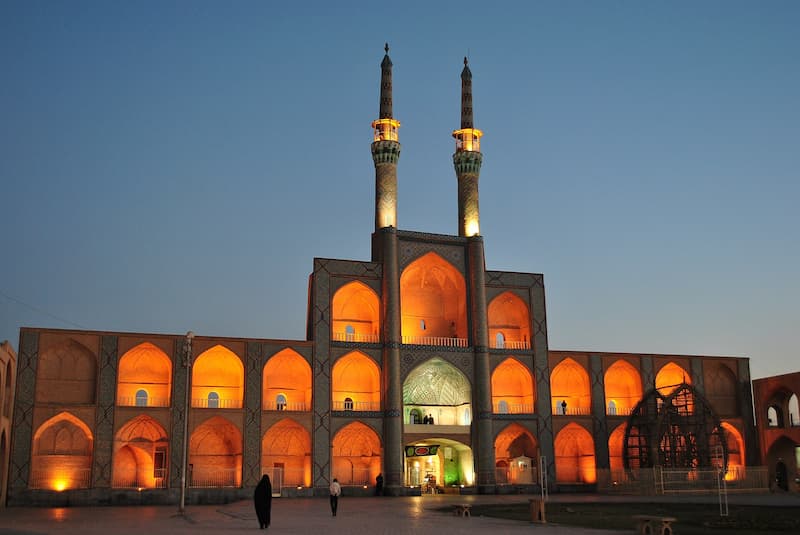
The Historic City of Yazd, situated in central IRAN on the high arid plateau between the Dasht-e Kavir and Dasht-e Lut deserts, is one of the world’s oldest continuously inhabited earthen urban settlements. Operating historically as a vital commercial oasis along the ancient Silk Road and Spice Routes, Yazd is famous for its remarkably preserved traditional adobe architecture, constructed almost entirely of sun-dried mud bricks (khisht), straw, and clay plaster (kahgel).
The old town, centered on the historic neighborhood of Fahadan, features a dense, labyrinthine network of narrow covered alleyways (sabat), vaulted earthen passageways, and sun-lit courtyard residences designed to withstand extreme desert thermal variations. Distinctive skyline features include the soaring twin minarets of the 14th-century Jameh Mosque of Yazd, numerous domed water reservoirs (ab-anbars), and hundreds of iconic windcatchers (badgirs)—traditional natural air-conditioning towers protruding above flat rooftops. Beneath the city surface lies an intricate, centuries-old network of subterranean aqueducts (qanats) that bring groundwater from distant mountain foothills to sustain human life, public fountains, and lush oasis gardens such as the UNESCO-listed Dowlat Abad Garden.
Attraction
Yazd captures international traveler fascination through its unique combination of ancient desert survival engineering, atmospheric streetscapes, and deep spiritual heritage. As the premier global center of living Zoroastrian culture, Yazd welcomes visitors to experience ancient religious traditions at the Yazd Atash Behram (Zoroastrian Fire Temple)—housing a sacred flame reported to have burned continuously for over 1,500 years—and the dramatic, silent Towers of Silence (Dakhmeh) set atop barren desert hills outside the urban core.
Beyond its spiritual monuments, travelers are drawn to Yazd’s immersive sensory ambiance. Visitors can wander through bustling historical bazaars like the Timurid-era Coppersmiths Bazaar, attend traditional Zurkhaneh (House of Strength) martial arts demonstrations held inside converted underground water cisterns, and admire the majestic three-story façade of the Amir Chakhmaq Complex lit up at night. The city is equally renowned for its signature Persian handicrafts, including fine hand-woven silk and brocade textiles (termey), hand-hammered copperware, and traditional Persian confections like almond qottab and saffron baklava.

World Heritage
In 2017, UNESCO inscribed the Historic City of Yazd on the World Heritage List under cultural criteria (iii) and (v).
- Exceptional Cultural Tradition (Criterion iii): Yazd bears unique and exceptional physical testimony to a living cultural tradition of human resilience in harsh desert environments. It stands as an extraordinarily intact example of an earthen city that avoided the sweeping modernization that destroyed similar historical settlements across the Middle East. Furthermore, it preserves the living cultural co-existence of Islamic, Zoroastrian, and Jewish traditions within an integrated urban fabric.
- Outstanding Human Settlement (Criterion v): The site represents an outstanding example of traditional human settlement and land use adapted to an arid environment with extremely limited natural resources. The combination of subterranean qanat water systems, passive cooling badgirs, thermal adobe mass construction, and compact urban shading demonstrates a sophisticated, sustainable interaction between human civilization and desert ecology.
Gateway
The primary gateway city serving the UNESCO World Heritage property is Yazd itself, the provincial capital of Yazd Province, Iran. Because the historic old town is integrated directly into the broader modern municipality, the city provides immediate access to all historical monuments alongside complete tourism logistics and accommodations.
Yazd is served directly by Yazd Shahid Sadooghi Airport (IATA Code: AZD; ICAO Code: OIYY). Situated approximately 10 kilometers northwest of the city center, AZD operates public commercial domestic flights connecting Yazd to major Iranian aviation hubs, including Tehran’s Mehrabad International Airport, Isfahan, Mashhad, and Bandar Abbas, alongside regional charter services. From the airport, travelers reach the historic center in roughly 15 to 20 minutes via taxi or private hotel transfer. Yazd features extensive lodging options tailored for overnight travelers, ranging from restored 18th-century Qajar-era traditional boutique hotels (traditional houses) featuring central courtyard pools and rooftop dining to modern multi-star hotels and budget guesthouses.
When
The ideal time to visit the Historic City of Yazd is during Spring (March to May) and Autumn (September to November).
- Spring and Autumn: These shoulder seasons provide mild, pleasant weather with average daytime temperatures ranging between 18°C and 28°C (64°F to 82°F). Low rainfall, moderate sunshine, and comfortable evening temperatures make walking through unshaded earthen alleyways and climbing desert rooftops highly enjoyable.
- Summer (June to August): Extremely harsh and dry desert conditions prevail, with daytime temperatures regularly exceeding 40°C (104°F) under intense solar exposure, making daytime outdoor sightseeing physically exhausting.
- Winter (December to February): Brings cold desert nights where temperatures drop near or below freezing (0°C / 32°F), though winter days remain clear, crisp, and sunny with low tourist density.
Considerations
- Footwear and Navigation: The historic Fahadan neighborhood consists of narrow, uneven mud-brick alleys, steps, and cobblestones. Comfortable, closed-toe walking shoes are essential. Navigation can be tricky without digital offline maps.
- Dress Code Compliance: Iran enforces national modesty laws in public spaces. Women must wear headscarves (hijab) covering hair, loose-fitting long tops reaching mid-thigh, and long trousers or skirts. Men must wear long trousers and avoid sleeveless tops.
- Financial and Payment Systems: International credit and debit cards linked to Western banking networks (Visa, Mastercard) do not function in Iran due to financial sanctions. Travelers must bring sufficient physical foreign currency cash (Euros or US Dollars) to exchange for Iranian Rial (IRR) or purchase a local pre-paid tourist debit card upon arrival.
- Respect for Cultural and Religious Sites: Active places of worship—including the Jameh Mosque and Zoroastrian shrines—require quiet decorum and respectful dress. Photography inside certain sacred areas may be restricted.

Resources
- UNESCO World Heritage Centre: The official UNESCO portal offering official documentation, inscription history, site boundaries, and conservation reports.
- Visit Iran (Ministry of Cultural Heritage, Tourism and Handicrafts): Official Iranian national tourism portal providing regional travel guides, heritage monument lists, and visa regulations.
- Iran Tourism Board (Iran Tourism & Touring Organization): Official travel authority platform offering logistical advice, cultural itineraries, and historical context for Iranian destinations.
- Iran Chamber Society: Comprehensive cultural and historical online repository detailing Persian history, traditional architecture, and Yazd monument guides.
- Trip.com: Major global travel platform featuring user reviews, community travel advice, hotel reservations, and local excursion listings.


Comments:
Leave a Reply