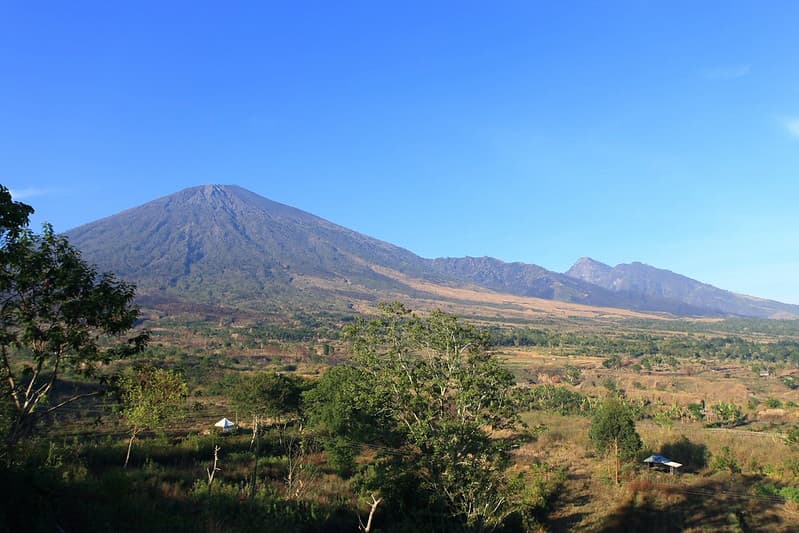
Community geotourism safeguards Lombok’s volcanic and cultural reserve
“Rinjani Lombok” (Rinjani Lombok Biosphere Reserve) is a volcanic island conservation and cultural landscape spanning 459,097 hectares across Lombok Island in West Nusa Tenggara Province, INDONESIA, within the Lesser Sunda Islands. Rising from sea-level coastlines across fertile plains and rolling hills to 3,726 meters at the summit of Mount Rinjani—Indonesia’s second-highest active volcano—the reserve protects Mount Rinjani National Park alongside surrounding coastal and highland communities.
Shaped by the cataclysmic 1257 AD eruption of Mount Samalas, its centerpiece is an expansive 50-square-kilometer caldera cradling the crescent-shaped Segara Anak crater lake at roughly 2,000 meters elevation and the active intra-caldera volcanic cone Mount Barujari. Home to roughly 3,394,280 residents, the reserve spans coastal dry woodlands, tropical montane rainforests, casuarina woodlands, and alpine grasslands.
Attraction
Rinjani Lombok attracts trekkers, volcanologists, beachgoers, and cultural travelers globally who seek challenging volcanic summit climbs, crater-lake camping, and indigenous Sasak island heritage.
Visitors undertake multi-day treks via Sembalun, Senaru, or Torean to watch sunrise from the 3,726-meter summit, camp above Segara Anak Lake, and soak in natural volcanic hot springs along the caldera floor. Travelers also hike to Sendang Gile and Tiu Kelep waterfalls, explore traditional Sasak weaving villages producing tenun ikat and songket textiles, sample local Lombok coffee and spicy ayam taliwang cuisine, and relax along nearby beaches and coral reefs.
Biosphere Reserve
Designated in 2018 under UNESCO’s Man and the Biosphere (MAB) Programme—and overlapping with the Rinjani-Lombok UNESCO Global Geopark—the reserve is celebrated for uniting Wallacean biodiversity protection with sustainable island livelihoods:
- Wallacean Biogeography and Altitudinal Ecosystems: Positioned near the transitional Wallace Line between Asian and Australasian faunas, the reserve safeguards lowland forests, montane cloud forests, and sub-alpine zones sheltering endemic species such as the Rinjani scops owl, ebony leaf monkey, and Rusa deer.
- Sustainable Agroforestry and Community Geotourism: Local communities sustain livelihoods through terraced rice farming, shade-grown coffee and cacao, horticulture, traditional handicrafts, and community-led homestays and trekking cooperatives.
Gateway
Because Rinjani Lombok spans Lombok Island in the Lesser Sunda archipelago, travelers enter via Lombok’s primary aviation hub or two proximate neighboring island gateways connected by short sea ferries—each verified in IATA’s official directory and offering overnight lodging, road or ferry links, and licensed guides:
- Praya / Mataram (Nearest Airport Hub in IATA Directory / Primary Island Gateway):
- Airport: Zainuddin Abdul Madjid International Airport / Lombok International Airport (IATA Code: LOP; ICAO Code: WADL).
- Infrastructure and Distance: Located at Tanak Awu in Central Lombok, roughly 30 kilometers southeast of Mataram and about 75 to 95 kilometers (2 to 3 hours by road) south of the main Rinjani trailheads in Senaru, Sembalun, and Torean. LOP is an active public international airport indexed in IATA’s directory, backed by extensive hotels in Mataram, Senggigi, and Kuta Lombok, car rentals, taxis, and accredited mountain guides.
- Denpasar / Badung, Bali (Primary Western Intercontinental & Sea-Ferry Gateway):
- Airport: I Gusti Ngurah Rai International Airport (IATA Code: DPS; ICAO Code: WDPS).
- Infrastructure and Distance: Located at Tuban south of Denpasar on neighboring Bali, roughly 35 kilometers south of Padangbai Port—from which fast boats cross the Lombok Strait to Bangsal or Senggigi in roughly 1.5 to 2 hours, followed by a 1 to 1.5-hour road transfer to Senaru (roughly 3 to 3.5 hours total travel time). DPS is a major active public international hub listed in IATA’s directory with abundant lodging and transfer operators.
- Sumbawa Besar, Sumbawa (Primary Eastern Neighboring Island Gateway):
- Airport: Sultan Muhammad Kaharuddin III Airport (IATA Code: SWQ; ICAO Code: WADS).
- Infrastructure and Distance: Located at Sumbawa Besar on neighboring Sumbawa Island east of Lombok, roughly 105 kilometers east of Poto Tano Port—connected by regular vehicle-and-passenger ferries across the Alas Strait to Kayangan Port in East Lombok (about 1.5 to 2 hours by ferry plus 1 to 1.5 hours by road to Sembalun). SWQ is an active public airport indexed in IATA’s directory, supported by town hotels, car rentals, and inter-island ferry links.
When
The ideal window to visit Rinjani Lombok is during the Dry Season (April to November):
- Dry Season (April to November): Recommended for summit trekking, crater-lake camping, and coastal excursions, offering clear morning skies, stable trail footing, and warm lowland temperatures of 26°C to 32°C (79°F to 90°F)—with May to June and September to October providing slightly quieter trails.
- Rainy Season (December to March): Brings heavy monsoon downpours, slippery volcanic scree, and mandatory annual national park trail closures from January through March for ecological recovery and safety.

Consideration
- Book e-Rinjani Permits and Licensed Guides Early: Mount Rinjani National Park enforces strict daily trekker quotas and requires foreign visitors to register online and trek with a licensed mountain guide and porters.
- Pack Cold-Weather Gear for High Elevations: While coastal Lombok is tropical, overnight temperatures at the 2,600-meter crater rim and 3,726-meter summit drop near freezing (0°C to 5°C / 32°F to 41°F); bring insulated layers, windproof outerwear, broken-in hiking boots, trekking poles, and a headlamp.
- Monitor Volcanic Activity Advisories: Because Mount Barujari inside the caldera remains active, always verify current volcanic alert levels and trail openings with park authorities before ascending.
- Currency and Cash Preparation: The official currency is the Indonesian Rupiah (IDR). Bring sufficient cash rupiah for rural villages, trailhead shops, and porter tips, as ATMs are scarce in mountain communities.
Resources
- UNESCO Man and the Biosphere Programme (Rinjani Lombok Profile): Official UNESCO portal detailing boundaries, surface area, population, and ecological characteristics.
- UNESCO International Geoscience and Geoparks Programme (Rinjani-Lombok): Official Global Geopark profile covering volcanic heritage, geotrails, and Sasak community initiatives.
- Mount Rinjani National Park Official Portal (Balai Taman Nasional Gunung Rinjani): Official Indonesian park authority website for e-Rinjani trekking permits, daily quotas, and safety rules.
- Wonderful Indonesia (Lombok & Mount Rinjani Official Guide): National tourism ministry resource highlighting attractions, cultural heritage, and travel planning.
- Trip.com: Online travel booking marketplace offering bookings for Mount Rinjani multi-day trekking packages, waterfall tours, and Lombok transfers.


Comments:
Leave a Reply