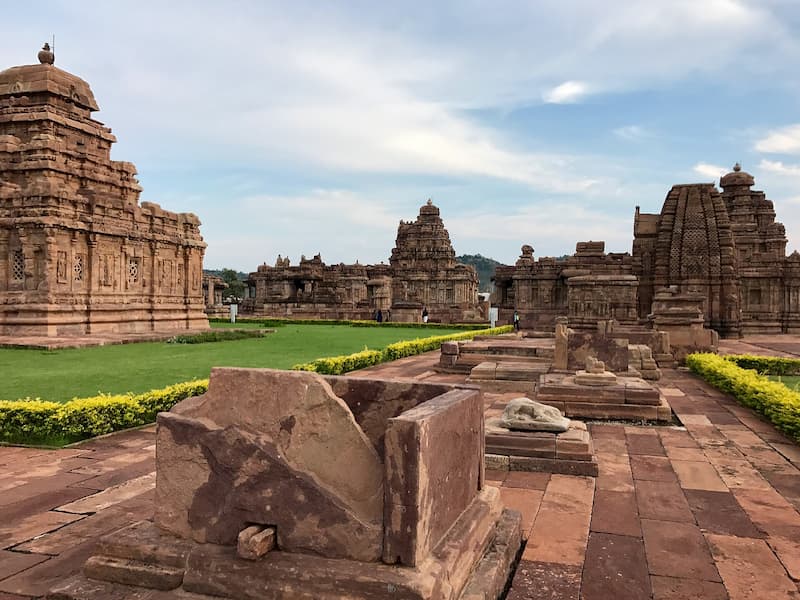
The Group of Monuments at Pattadakal is a collection of ten major Hindu and Jain temples located on the banks of the Malaprabha River in Karnataka, INDIA. Built during the 7th and 8th centuries by the Chalukya dynasty, the site is often referred to as the “university” of temple architecture, as it showcases the culmination of experimental building styles that originated in nearby Aihole and Badami.
The monuments are celebrated for their harmonious blend of two primary Indian architectural traditions: the Nagara style (Northern India) and the Dravidian style (Southern India).
- Architectural Fusion: Some temples, like the Virupaksha Temple, exhibit mature Dravidian features, while others, like the Kashi Vishwanatha Temple, showcase the curvilinear spires characteristic of the Northern style.
- The Temples: Notable structures include the Virupaksha Temple (the largest), Sangameshwara Temple, Mallikarjuna Temple, and a 9th-century Jain temple. These sites are adorned with intricate friezes depicting scenes from the Ramayana, Mahabharata, and various Hindu puranas.
Attraction
- Architectural Laboratory: For history and art enthusiasts, Pattadakal provides a unique opportunity to see the transition and fusion of ancient Indian building techniques side-by-side.
- Living History: Beyond its structural beauty, the site is deeply tied to the history of the Chalukya Empire, serving as the sacred location where their kings were coronated.
- Sculptural Detail: The site is famous for its high-quality carvings in sandstone and polished granite, showcasing a level of detail that remains exceptionally well-preserved.

World Heritage
Inscribed in 1987, the site holds “Outstanding Universal Value” for the following reasons:
- Eclectic Artistry: UNESCO describes it as an “illustration of eclectic art at its height,” representing the peak of architectural experimentation during the Early Chalukyan era.
- Cultural Testimony: The monuments serve as a significant testimony to a cultural tradition that fused distinct regional aesthetics into a cohesive, sophisticated style.
Gateway
Badami serves as the primary base for visiting Pattadakal.
- Airport: The nearest commercial airport is Belagavi/Belgaum Airport (IXG), located approximately 180 km away.
- Rail/Road: The town of Badami is the closest rail hub (about 22 km from Pattadakal) and offers various lodging options ranging from heritage hotels to comfortable lodges, such as the Hotel Badami Court.
When
- October to March: This is the most pleasant time, as the weather is cool and ideal for exploring open-air temple complexes. The monsoon season (July to September) is also an option for those who enjoy lush, green landscapes and cooler temperatures.
Consideration
- Transportation: Pattadakal is best explored by hiring a private taxi from Badami. It is often combined with visits to the cave temples of Badami and the temple complex at Aihole.
- Etiquette: As these are protected heritage sites, do not deface the stone or pillars. Check with local guides regarding photography restrictions within specific sanctums.
- Plan Ahead: Carry sufficient water and sun protection, as the temple grounds are largely open-air with limited shade.

Resources
- UNESCO World Heritage Centre – Pattadakal – Official documentation of the site’s heritage criteria.
- Archaeological Survey of India (ASI) – The official custodian for conservation status and visitor guidelines.
- Karnataka Tourism – The state’s official portal for regional travel planning and site information.
- South India Tours and Travels – Offers detailed historical context and guided tour options.
- Trip.com – Belagavi/Belgaum Hotels – A reliable platform to secure your accommodation in the gateway town of Belagavi/Belgaum.


Comments:
Leave a Reply